


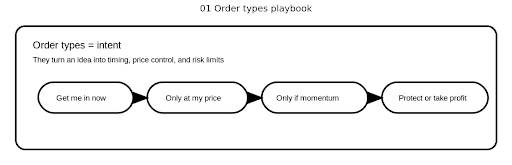

Most new traders obsess over entries and ignore the quiet lever that really shapes their results: how their orders hit the market. Order types are not just technical settings in a ticket window – they’re how you translate an idea into precise risk, timing and execution. The sooner you treat them as part of your edge, not an afterthought, the faster your trading matures.
Think of order types as a playbook, not a menu. Each one expresses a different intent: “get me in now”, “only at my price”, “only if momentum is real”, “protect me if I’m wrong”, “pay me if I’m right”. Master these seven, and you move from reacting to price to actively designing your trades.
1. Market Orders – When Execution Matters More Than Price
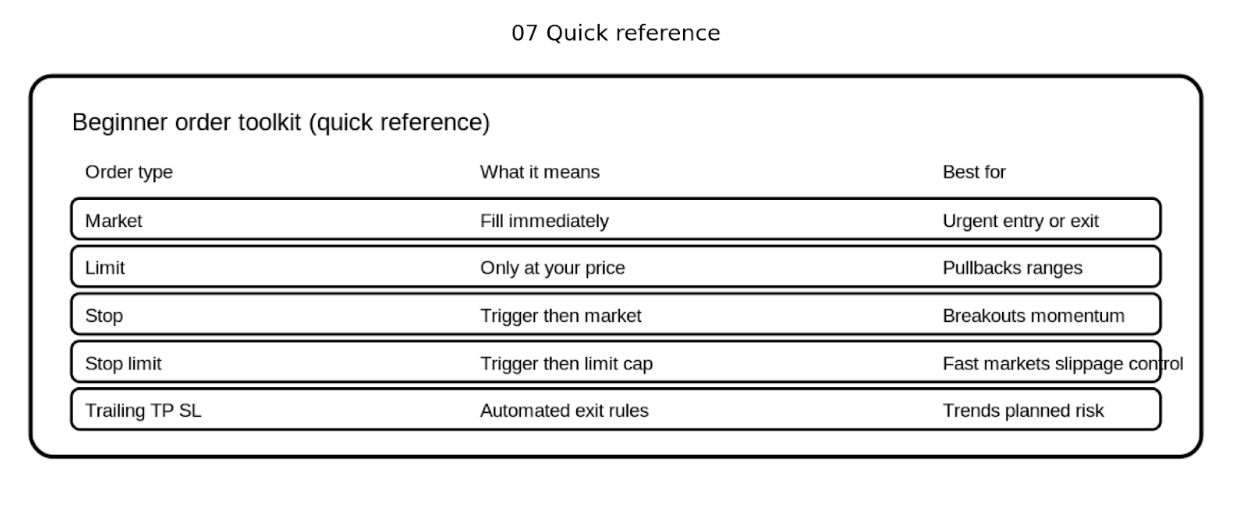
A market order says: “fill me now at the best available price”. You’re trading execution certainty for price certainty.
Use it when:
- You must enter or exit immediately (news, sudden volatility, key level breaking).
- Slippage is acceptable relative to the risk of missing the move entirely.
Example: Bitcoin spikes on a surprise bullish announcement. You’ve been waiting for confirmation and now simply need to be in the trade. A market order gets you filled instantly so you don’t watch the candle run away without you.
Key idea: Market orders are the blunt instrument of execution, ideal for speed, but expensive if you fire them into thin or erratic markets.
2. Limit Orders – Price Over Urgency
A limit order says: “fill me, but only at this price or better”. You’re willing to wait; if the market doesn’t come to you, you’re fine staying flat.
Use it when:
- You want to buy a pullback into support or sell a rally into resistance.
- You care more about price quality than catching every move.
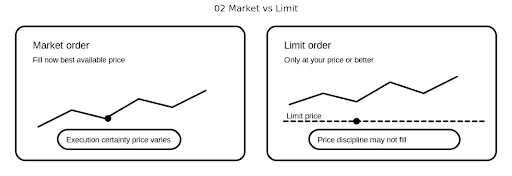
Example: ETH trades at 1800, but your plan is to buy a dip into 1750 support. You place a buy limit at 1750. If price tags that level, you’re in at your chosen price; if not, you keep your powder dry.
Key idea: Limit orders enforce discipline, they stop you from chasing and force the market to “come to your terms”.
3. Stop Orders – Trading Only When Momentum Is Real
A stop order becomes a market order once a trigger level is hit. It says: “put me in only if the market proves my thesis”.
Use it when:
- You want to enter on breakouts or breakdowns, not inside the range.
- You’re happy to pay up a little for confirmation.
Example: A pair has been stuck around 50 for days. You’ll only buy if it breaks higher, so you place a buy stop at 52. Once price trades at 52, your order becomes a market order and you’re in, now with momentum at your back.
Key idea: Stop entries filter out noise and sideways chop by only engaging when price moves with intent.
4. Stop-Limit Orders – Confirmation Without Unlimited Slippage
A stop-limit order combines a trigger (the stop) with a maximum acceptable price (the limit). It says: “enter on breakout, but not at any price”.
Use it when:
- You want breakout entries but refuse to accept large slippage.
- You’re trading instruments that can gap or spike around key levels.
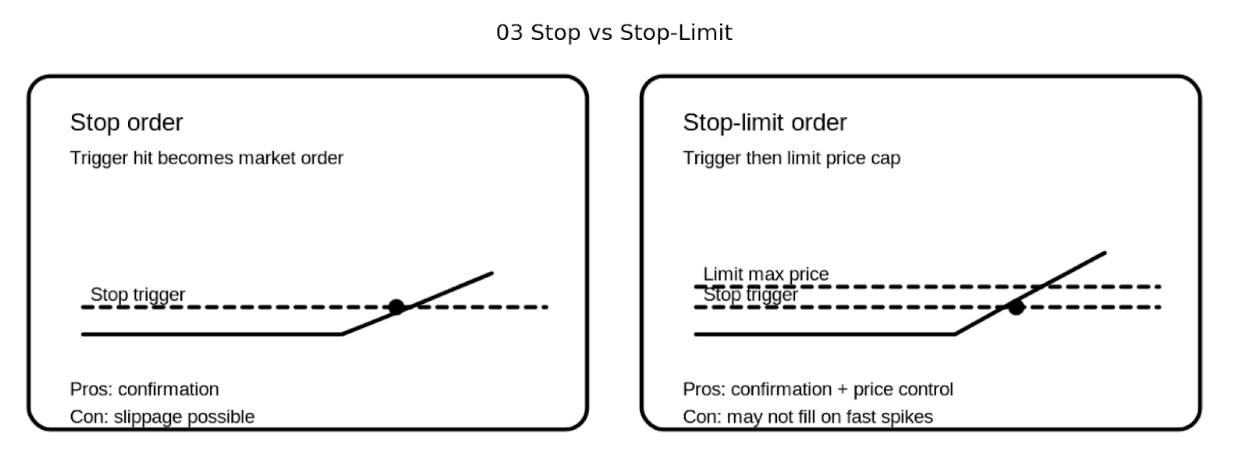
Example: You want to buy a breakout above 52, but you don’t want to get filled far above it. You set a stop at 52 and a limit at 52.10. Once 52 trades, your buy limit activates, but will only fill at 52.10 or better.
Key idea: Stop-limit orders are for traders who value both confirmation and price control, knowing that the trade might not trigger if price jumps too far, too fast.
5. Trailing Stops – Automating Discipline in Trends
A trailing stop moves with price in your favor by a fixed distance or percentage. It says: “protect my profits, but give the trend room to breathe”.
Use it when:
- You’re in a trending move and don’t want to continuously adjust your stop manually.
- You struggle with the psychology of “where do I lock in gains?”
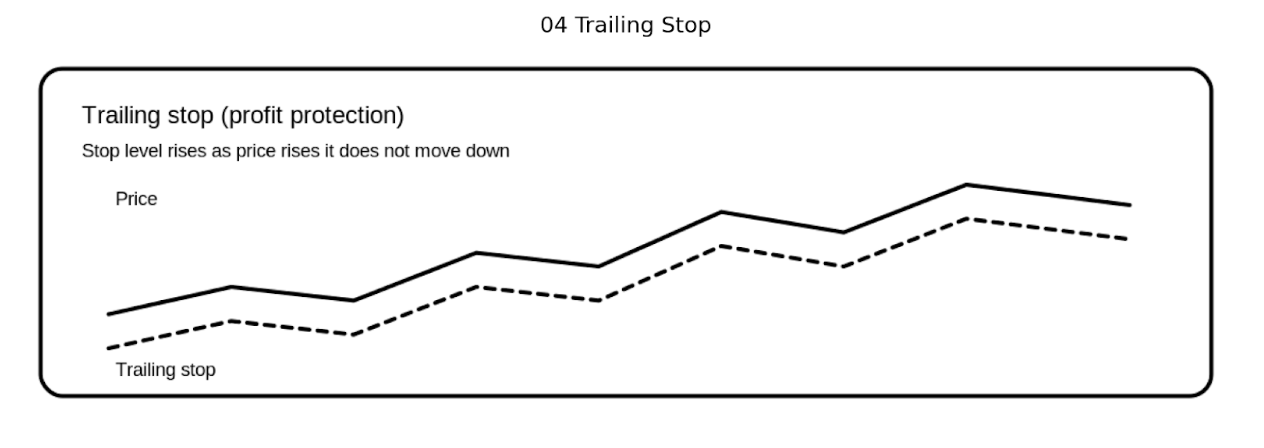
Example: You’re long, and the price moves 10% in your favor. With a trailing stop set, your protective level ratchets higher as price climbs. If the trend finally snaps back, the stop is hit and you exit with a chunk of the move captured.
Key idea: Trailing stops outsource some emotional decisions to rules, letting you ride moves longer while still defining when it’s time to quit.
6. Take Profit Orders – Exiting on Logic, Not Adrenaline
A take profit order (often called a TP or limit take-profit) closes your position once price hits your target. It says: “exit where the plan said, not where my emotions scream”.
Use it when:
- You’ve defined clear targets based on levels, risk-reward or strategy rules.
- You can’t be at the screen every second but want structured exits.
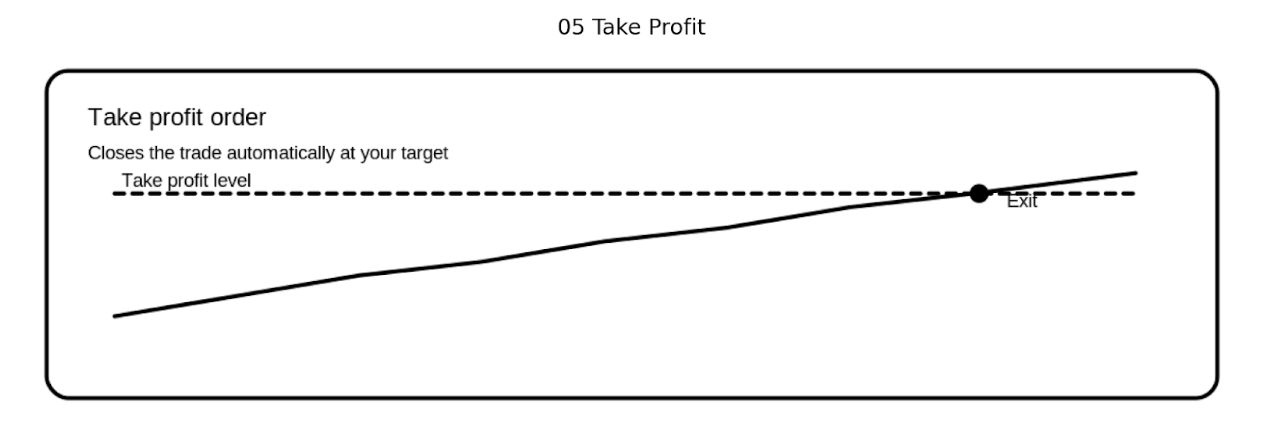
Example: You buy BTC at 30000 with a target at 32000. You set a take profit at 32000. When price tags that level, the position closes automatically, no second-guessing when the candle gets there.
Key idea: Pre-planned exits break the cycle of “I’ll just hold a bit longer” that turns good trades into missed opportunities.
7. Stop Loss Orders – The Non-Negotiable Line in the Sand
A stop loss defines how much you are willing to lose before you’re out. It says: “this is where my idea is wrong, and I’m done”.
Use it on:
- Every single trade. No exception.
- Positions sized around a fixed percentage of your capital or account.
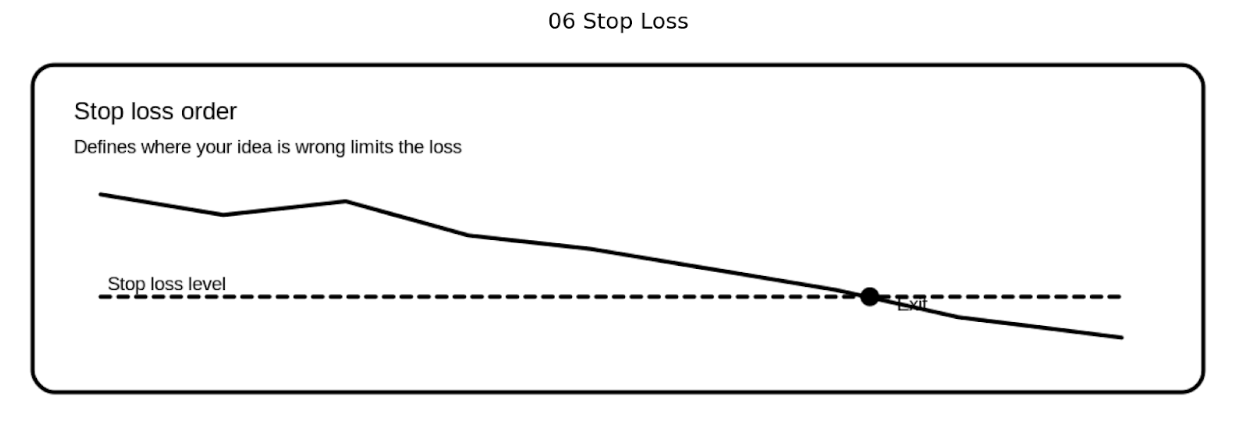
Example: You go long ETH at 1600 and place a stop loss at 1520 below a clear support zone. If price breaks down to 1520, the trade closes and your loss is limited, long before panic takes over.
Key idea: Stop losses are the foundation of survival; without them, every trade is a potential account-killer.
Putting the Toolkit to Work
Order types are how you express intent. Once you know what you’re trying to do, fade a move, buy a breakout, ride a trend, define your risk, the right order type almost chooses itself. The next step is not memorising definitions, but practicing them: placing small, deliberate trades using different order combinations until they feel intuitive.
Confidence in trading doesn’t come from guessing the next candle. It comes from knowing that, whatever the market does, your orders reflect a clear plan for entry, risk and exit. When order types become part of that plan, you stop improvising and start trading with intention.
PrimeXBT, a global multi-asset broker, supports this learning process through a broad range of educational resources covering trading fundamentals, order execution, market structure, risk management and macro-driven market behaviour. Pair that understanding with practice by using a risk-free demo account to test order placement and execution scenarios before committing real capital.
Learn more about trading with PrimeXBT.


