


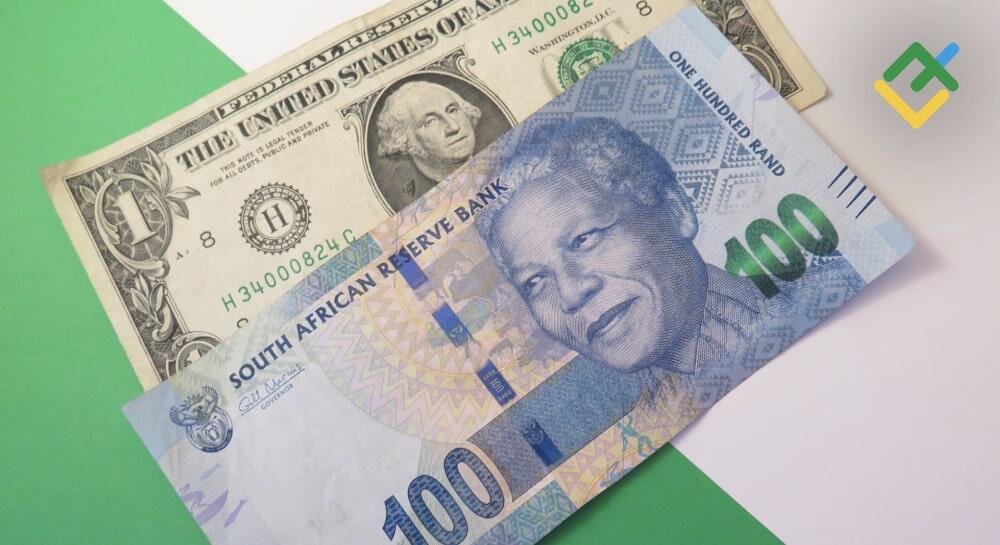


This article provides a comprehensive review of the USDZAR currency pair with technical and fundamental analysis, long-term forecasts, expert opinions, as well as market sentiment assessment.
This overview will help traders and investors better grasp the pair’s movement, identify potential entry points, and develop an effective trading strategy.
The article covers the following subjects:
Major Takeaways
- The current price of the USDZAR pair is R16.15800 as of 20.02.2026.
- The USDZAR pair reached its all-time high of R19.93023 on 09.04.2025. The pair’s all-time low of R1.5715 was recorded on 31.08.2006.
- The USDZAR currency pair represents the ratio of the US dollar to the South African rand.
- The US dollar is the main reserve currency in the world, while the rand is the currency of an emerging economy.
- The USDZAR exchange rate is sensitive to fluctuations in commodity prices, particularly gold and platinum.
- The US Fed’s policy and the South African Reserve Bank’s actions significantly influence the currency pair’s performance.
- The pair’s volatility can increase sharply during economic instability or geopolitical changes.
- The USDZAR pair is a popular asset among short-term traders who rely on news-driven strategies.
- The pair is often used to hedge risks associated with financial operations in African countries.
USDZAR Real-Time Market Status
The USDZAR currency pair is trading at R16.15800 as of 20.02.2026.
When analyzing the USDZAR pair performance, it is essential to monitor key economic and technical indicators such as interest rates, inflation, volatility, and price change over the year. This data allows traders to make more informed decisions and evaluate the risks.
|
Indicator |
Value |
|
South African interest rate |
6.75% |
|
US interest rate |
3.75% |
|
All-time low |
R1.5715 |
|
All-time high |
R19.93023 |
|
Price change over the last 12 months |
-12.74% |
USDZAR Price Forecast for 2026 Based on Technical Analysis
Let’s conduct a technical analysis of the weekly USDZAR chart to forecast the long-term movement of the exchange rate.
At the end of January 2026, the USDZAR pair halted its prolonged decline and is now consolidating within the range of 15.64–16.42, holding steady at 16.15800. Technical indicators and candlestick patterns are giving predominantly bullish signals.
- The weekly chart shows a large Falling Wedge pattern (1). The price is expected to break above the pattern at 16.42, targeting 18.71 and higher. Moreover, a Bullish Engulfing candlestick pattern has emerged (2) at one of the key support levels of 15.74, and an Inverted Hammer pattern (3) has appeared within it. The combination of these patterns indicates that the price has reached the lowest values and a bullish reversal is possible.
- The MACD is increasing (4) in the negative zone, signaling waning bearish momentum.
- The RSI value turned upward (5) in the oversold zone, signaling a potential trend reversal.
- The MFI value has also rebounded (6) from the lower boundary, indicating an inflow of liquidity and potential growth.
- The VWAP price and the SMA20 line are above the market price, suggesting that bears still have the upper hand, albeit to a lesser extent.
Below is USDZAR’s 12-month price forecast.
|
Month |
Minimum, R |
Average, R |
Maximum, R |
|
March 2026 |
15.95 |
16.34 |
16.74 |
|
April 2026 |
16.41 |
16.69 |
16.98 |
|
May 2026 |
16.36 |
16.82 |
17.28 |
|
June 2026 |
16.87 |
17.15 |
17.44 |
|
July 2026 |
17.25 |
17.55 |
17.85 |
|
August 2026 |
17.36 |
17.72 |
18.09 |
|
September 2026 |
17.76 |
18.01 |
18.26 |
|
October 2026 |
17.93 |
18.29 |
18.65 |
|
November 2026 |
18.09 |
18.54 |
18.99 |
|
December 2026 |
18.63 |
18.98 |
19.34 |
|
January 2027 |
18.98 |
19.25 |
19.53 |
|
February 2027 |
19.41 |
19.60 |
19.80 |
Long-Term Trading Plan for USDZAR for 2026
The technical analysis conducted has revealed key support and resistance levels that can be used in a trading strategy for the coming year.
Trading Plan for the Year
- The trend is expected to turn bullish soon.
- Key support levels: 15.74, 15.28, 14.83, 14.33, 13.84, 13.34, 12.82, and 12.19.
- Key resistance levels: 16.42, 16.94, 17.35, 17.77, 18.20, 18.71, 19.07, 19.43, and 19.91.
- Base long-term scenario: Open long trades above the resistance of 16.42 with potential targets in the 16.94–19.91 range. Investment horizon: 12 months.
- Alternative long-term scenario: Open short trades below the support of 15.74 with potential targets in the 15.28–12.19 range.
Analysts’ USDZAR Price Projections for 2026
Analysts expect the rand to strengthen moderately in 2026. Key influencing factors could be the Fed’s interest rates, commodity prices, and the state of South Africa’s power grid. However, if the Fed tightens its policy, the US dollar may appreciate, pushing USDZAR higher.
LongForecast
Price range (ZAR): 13.46–16.39.
According to LongForecast, the USDZAR exchange rate will reach 15.80 by early March and fall to 14.62 by mid-year. In the second half of the year, the price is expected to fluctuate, settling at 13.67 by the end of December.
|
Month |
Open, R |
Min–Max, R |
Close, R |
|
March |
15.80 |
15.25–16.39 |
15.66 |
|
April |
15.66 |
15.03–15.66 |
15.26 |
|
May |
15.26 |
14.58–15.26 |
14.80 |
|
June |
14.80 |
14.40–14.84 |
14.62 |
|
July |
14.62 |
14.45–14.89 |
14.67 |
|
August |
14.67 |
14.13–14.67 |
14.35 |
|
September |
14.35 |
13.71–14.35 |
13.92 |
|
October |
13.92 |
13.92–14.53 |
14.32 |
|
November |
14.32 |
13.88–14.32 |
14.09 |
|
December |
14.09 |
13.46–14.09 |
13.67 |
WalletInvestor
Price range (ZAR): 16.03–16.49.
WalletInvestor predicts that the asset will trade at 16.10 in early March, reach 16.18 in late June, and continue to grow in the second half of the year. The closing price will stand around 16.27 in December.
|
Month |
Open, R |
Close, R |
Minimum, R |
Maximum, R |
|
March |
16.10 |
16.11 |
16.10 |
16.14 |
|
April |
16.11 |
16.13 |
16.11 |
16.14 |
|
May |
16.14 |
16.18 |
16.14 |
16.21 |
|
June |
16.18 |
16.18 |
16.14 |
16.19 |
|
July |
16.18 |
16.06 |
16.03 |
16.18 |
|
August |
16.07 |
16.30 |
16.07 |
16.32 |
|
September |
16.29 |
16.37 |
16.26 |
16.37 |
|
October |
16.38 |
16.48 |
16.38 |
16.48 |
|
November |
16.48 |
16.47 |
16.45 |
16.49 |
|
December |
16.46 |
16.27 |
16.27 |
16.47 |
CoinCodex
Price range (ZAR): 13.15–16.15.
CoinCodex forecasts the average price to hover around 15.81 in early March and then drop to 14.81 by mid-year. During the second half of the year, the bearish trend may intensify, pushing the price down to 13.40.
|
Month |
Minimum, R |
Average, R |
Maximum, R |
|
March |
15.58 |
15.81 |
16.15 |
|
April |
14.83 |
15.38 |
15.62 |
|
May |
14.97 |
15.13 |
15.37 |
|
June |
14.54 |
14.81 |
15.08 |
|
July |
13.84 |
14.36 |
14.59 |
|
August |
13.89 |
14.07 |
14.34 |
|
September |
13.72 |
13.89 |
14.17 |
|
October |
13.63 |
13.78 |
13.95 |
|
November |
13.55 |
13.73 |
13.96 |
|
December |
13.15 |
13.40 |
13.64 |
Analysts’ USDZAR Price Projections for 2027
Forecasts indicate that the USDZAR pair may decline in 2027. Global demand for export goods, inflation, and interest rates will be critical factors affecting the currency pair.
Note: The price ranges reflect the asset's expected volatility throughout the year. Lows and highs may not be shown in the summary tables.
LongForecast
Price range (ZAR): 13.29–14.75.
LongForecast predicts that the US dollar price against the rand will reach 13.67 in early 2027. The exchange rate is projected to advance in the first half of the year and hit 14.26 by the end of June. In the second half of the year, the bearish trend is likely to resume, though at a moderate pace. At the end of December, the asset is expected to settle at 13.52.
|
Quarter |
Open, R |
Min–Max, R |
Close, R |
|
Q1 |
13.67 |
13.43–14.09 |
13.63 |
|
Q2 |
13.63 |
13.29–14.47 |
14.26 |
|
Q3 |
14.26 |
13.60–14.75 |
13.81 |
|
Q4 |
13.81 |
13.32–14.15 |
13.52 |
WalletInvestor
Price range (ZAR): 16.26–16.88.
According to WalletInvestor, the currency pair will reach 16.27 by early 2027 and go up to 16.57 by the end of June. In the second half of the year, the bullish trend is expected to strengthen, pushing the price up to 16.67 in December.
|
Quarter |
Open, R |
Close, R |
Minimum, R |
Maximum, R |
|
Q1 |
16.27 |
16.50 |
16.26 |
16.53 |
|
Q2 |
16.51 |
16.57 |
16.51 |
16.61 |
|
Q3 |
16.58 |
16.77 |
16.43 |
16.77 |
|
Q4 |
16.78 |
16.67 |
16.67 |
16.88 |
CoinCodex
Price range (ZAR): 10.69–13.20.
CoinCodex estimates that the USDZAR price will trade at 12.43 by the end of Q1 2027, then decrease in Q2 and Q3, reaching 11.38 by the end of September. In Q4, the price is expected to continue falling, closing at 11.20.
|
Quarter |
Minimum, R |
Average, R |
Maximum, R |
|
Q1 |
12.02 |
12.43 |
13.20 |
|
Q2 |
11.45 |
12.19 |
12.81 |
|
Q3 |
10.72 |
11.38 |
11.99 |
|
Q4 |
10.69 |
11.20 |
11.74 |
Analysts’ USDZAR Price Projections for 2028
The USDZAR is expected to consolidate within a wide range in 2028. Investor confidence will depend on the effectiveness of the South African government’s reforms. Accelerated global economic growth may temporarily support the rand, though volatility is projected to remain high.
LongForecast
Price range (ZAR): 13.02–14.10.
LongForecast suggests the price will fluctuate in 2028. The USDZAR pair is expected to open the year at 13.52 and increase to 13.62 by the end of June. The second half of the year is expected to be volatile, with the pair closing at 13.41.
|
Quarter |
Open, R |
Min–Max, R |
Close, R |
|
Q1 |
13.52 |
13.05–13.80 |
13.60 |
|
Q2 |
13.60 |
13.27–14.10 |
13.62 |
|
Q3 |
13.62 |
13.22–14.05 |
13.84 |
|
Q4 |
13.84 |
13.02–13.84 |
13.41 |
WalletInvestor
Price range (ZAR): 16.66–17.28.
According to WalletInvestor, the currency pair will trade at 16.67 in early 2028. The asset is anticipated to rise to 16.98 by the end of June. In the second half of the year, the upward momentum may strengthen, bringing the price to 17.07 by the end of December.
|
Quarter |
Open, R |
Close, R |
Minimum, R |
Maximum, R |
|
Q1 |
16.67 |
16.91 |
16.66 |
16.93 |
|
Q2 |
16.91 |
16.98 |
16.91 |
17.00 |
|
Q3 |
16.98 |
17.18 |
16.82 |
17.18 |
|
Q4 |
17.18 |
17.07 |
17.07 |
17.28 |
CoinCodex
Price range (ZAR): 9.90–11.72.
CoinCodex predicts a bearish trend for the USDZAR currency pair in 2028. The price is expected to reach 10.00–11.24 by mid-year and close at 10.40 in June. In the second half of the year, the average price may recover to 10.56.
|
Quarter |
Minimum, R |
Average, R |
Maximum, R |
|
Q1 |
10.00 |
10.42 |
11.16 |
|
Q2 |
10.19 |
10.40 |
11.24 |
|
Q3 |
10.32 |
10.62 |
11.00 |
|
Q4 |
9.90 |
10.56 |
11.72 |
Analysts’ USDZAR Price Projections for 2029
Forecasts for USDZAR performance in 2029 vary. Some analysts predict that the asset will reach swing highs, while others anticipate a correction. The outcome will depend on the trajectory of fiscal policy and the progress in attracting foreign investment. South Africa’s risk premium is likely to remain elevated.
LongForecast
Price range (ZAR): 13.18–15.43.
LongForecast expects the asset price to reach 13.41 at the beginning of 2029 and climb to 13.51 by Q3. In the second half of the year, the bullish rally may accelerate to 14.99.
|
Quarter |
Open, R |
Min–Max, R |
Close, R |
|
Q1 |
13.41 |
13.18–14.00 |
13.78 |
|
Q2 |
13.78 |
13.31–14.31 |
13.51 |
|
Q3 |
13.51 |
13.45–14.70 |
14.48 |
|
Q4 |
14.48 |
14.48–15.43 |
14.99 |
WalletInvestor
Price range (ZAR): 17.05–17.68.
WalletInvestor provides positive outlooks for the USDZAR pair’s performance in 2029. The asset is expected to trade at around 17.07 at the beginning of the year, climb to 17.38 by mid-year, and hit 17.47 by year-end.
|
Quarter |
Open, R |
Close, R |
Minimum, R |
Maximum, R |
|
Q1 |
17.07 |
17.31 |
17.05 |
17.33 |
|
Q2 |
17.31 |
17.38 |
17.31 |
17.40 |
|
Q3 |
17.38 |
17.57 |
17.21 |
17.57 |
|
Q4 |
17.58 |
17.47 |
17.47 |
17.68 |
CoinCodex
Price range (ZAR): 9.31–12.50.
CoinCodex expects the USDZAR exchange rate to stabilize at 9.56 by the end of Q1 2029 and edge higher to 10.73 by mid-year. Analysts predict an uneven trajectory in the second half of the year. The price is forecasted to close at 11.52 at the end of the year.
|
Quarter |
Minimum, R |
Average, R |
Maximum, R |
|
Q1 |
9.31 |
9.56 |
10.06 |
|
Q2 |
9.54 |
10.73 |
11.20 |
|
Q3 |
10.59 |
11.89 |
12.50 |
|
Q4 |
10.99 |
11.52 |
12.03 |
Analysts’ USDZAR Price Projections for 2030
Long-term forecasts suggest that USDZAR will trade within a broad range in 2030. Structural imbalances and external debt are likely to weigh on the rand. While the transition to sustainable energy and improved production efficiency could provide support, achieving these goals remains challenging.
WalletInvestor
Price range (ZAR): 17.45–18.07.
WalletInvestor predicts that the currency pair will strengthen in 2030, reaching 17.46 in early 2030. It is expected to climb to 17.77 by mid-year and to 17.86 by year-end.
|
Quarter |
Open, R |
Close, R |
Minimum, R |
Maximum, R |
|
Q1 |
17.46 |
17.70 |
17.45 |
17.72 |
|
Q2 |
17.71 |
17.77 |
17.70 |
17.79 |
|
Q3 |
17.77 |
17.97 |
17.61 |
17.97 |
|
Q4 |
17.97 |
17.86 |
17.86 |
18.07 |
Gov Capital
Price range (ZAR): 11.60–15.35.
According to Gov Capital, the USDZAR price will remain at 13.17 by the end of Q1 2030. The asset may decline to 13.05 by mid-year but then recover to 13.83 by year-end.
|
Quarter |
Minimum, R |
Average, R |
Maximum, R |
|
Q1 |
11.80 |
13.17 |
14.96 |
|
Q2 |
11.69 |
13.05 |
14.84 |
|
Q3 |
11.60 |
13.35 |
14.84 |
|
Q4 |
11.85 |
13.83 |
15.35 |
CoinCodex
Price range (ZAR): 10.72–12.48.
CoinCodex offers an ambiguous forecast regarding the movement of the USDZAR price in 2030. The asset is predicted to trade at 11.62 by the end of Q1. After that, moderate volatility is expected, with the asset reaching 11.76 by the end of June. By year-end, the price is estimated to stabilize at 11.62.
|
Quarter |
Minimum, R |
Average, R |
Maximum, R |
|
Q1 |
10.72 |
11.62 |
11.85 |
|
Q2 |
11.23 |
11.76 |
12.17 |
|
Q3 |
11.18 |
12.00 |
12.48 |
|
Q4 |
11.30 |
11.62 |
12.40 |
Analysts’ USDZAR Price Projections until 2050
Forecasting the USDZAR movement that far ahead is extremely difficult, as the economy is a complex system shaped by countless unpredictable factors.
The global financial system may change dramatically by 2040–2050, with potential shifts in the dollar’s reserve status, wider adoption of CBDCs, and the rise of new trading blocs. Climate change is also likely to unevenly affect South Africa’s economy, as demand for its mineral exports will depend on the pace of the energy transition.
South Africa’s political course, demographic shifts, and technological advances (for example, in green energy or mining) are factors that are currently impossible to predict.
Any assessment this far out is not a scientific forecast but an extrapolation of current trends that inevitably ignores “black swans,” which are major crises or breakthroughs. As a result, experts tend to focus on qualitative scenarios rather than specific numbers.
Market Sentiment of USDZAR on Social Media
Media sentiment reflects the collective market view of USDZAR expressed in comments, posts, and discussions. Positive sentiment can support the South African rand and push USDZAR lower, while negative sentiment may strengthen demand for the US dollar and drive the pair higher.
For example, user @Davinatorz predicts on X (formerly Twitter) that the USDZAR price will rise to 16.31–16.34 in the near future.
Independent analyst @ArcisFX also expects the USDZAR price to climb to 17.08.
Independent trader @elliottwavespot, on the contrary, anticipates a continued decline in USDZAR prices to around 14.99.
There is no consensus among X users. The analysis of social media posts suggests that some traders predict a weakening of the rand, while others expect the US dollar to depreciate.
USDZAR Price History
The USDZAR pair reached its all-time high of 19.93023 ZAR on 09.04.2025.
The all-time low of the USDZAR pair was recorded on 31.08.2006 when the price declined to 1.5715 ZAR.
It is crucial to evaluate historical data to make predictions as accurate as possible. The chart below shows the USDZAR pair performance over the last ten years.
The USDZAR pair, representing the exchange rate between the US dollar and the South African rand, has a long trading history characterized by significant price fluctuations.
The exchange rate remained relatively stable in the 1980s. However, starting in the early 2000s, the rand began to weaken amid political instability and economic challenges in South Africa. By 2008, the global financial crisis triggered a sharp rise in the USDZAR pair, pushing it above the R11 mark.
Since 2015, the pair has exhibited increased volatility since it is highly vulnerable to changes in commodity prices, US Fed decisions, and political events in South Africa. In 2020, the rate exceeded R19 amid the COVID-19 pandemic. Since then, the pair has been trading in a wide range.
In 2020, the USDZAR price surged to R19.34 due to the COVID-19 pandemic. After that, it retreated to R15.02. From mid-2021 to mid-2023, the US dollar strengthened to R19.92, bolstered by global monetary policy tightening, the energy crisis, and geopolitical risks. Until the end of 2025, the USDZAR pair traded in a wide range between R19.92 and R17.03 amid high inflation, unemployment, and logistics disruptions.
In 2026, the African rand continues to strengthen and is now consolidating between 15.64 and 16.42, as traders await further signals from the Fed and the South African budget.
USDZAR Price Fundamental Analysis
Fundamental analysis is crucial for understanding the economic and political factors influencing the USDZAR currency pair. It aids in assessing risks, identifying market trends, and making informed trading decisions for short-term and long-term trading.
What Factors Affect the USDZAR Pair?
The USDZAR exchange rate is determined by a range of internal and external economic factors.
- Interest rates. The difference between the US Fed and the central bank of South Africa’s rates affects capital flows and asset appeal.
- Commodity prices. South Africa depends on exports of platinum, gold, and other resources. Rising prices strengthen the rand while falling prices weaken it.
- Inflation. High inflation in South Africa undermines confidence in the currency and reduces its purchasing power.
- US economic data. Labor market, inflation, and GDP reports directly affect the value of the US dollar.
- Political stability. Internal problems in South Africa reduce investor interest in the rand.
- Investor’s risk appetite. During global instability, the US dollar strengthens as a safe asset.
- Geopolitics and sanctions affect trade, investment, and capital inflows into South Africa.
More Facts About USDZAR
The USDZAR currency pair indicates the exchange rate between the US dollar and the South African rand, a currency introduced in 1961 when South Africa became a republic. This pair is actively traded on Forex and is known for its volatility. Its popularity is rooted in the rand’s attractiveness as a commodity currency since the South African economy depends on the export of gold, platinum, and other resources.
Traders and investors utilize the USDZAR pair for speculation, hedging, and diversifying their portfolios. This currency pair is particularly responsive to global economic and political developments. Additionally, it often serves as an indicator of sentiment in emerging markets.
Advantages and Disadvantages of Investing in USDZAR
The USDZAR currency pair can become an attractive asset for both short-term traders and long-term investors. However, it is crucial to take into account its specific features.
Advantages
- High volatility allows traders to profit from short-term rate fluctuations.
- Macroeconomic data from South Africa and the US are published frequently, which simplifies making forecasts.
- Technical and fundamental analysis. The pair can be easily analyzed.
- Suitable for various strategies. It is used in speculation, hedging, and portfolio diversification.
- Dependence on commodity prices. The increase in gold and platinum prices strengthens the South African rand.
- Availability. Most Forex brokers provide access to trading this pair.
- Variety of trading sessions. The pair is actively traded during Asian, European, and US trading sessions.
- Risk indicator for emerging markets. The pair helps estimate investment sentiment in South Africa and other developing countries.
Disadvantages
- Increased risks. High volatility can lead to significant losses.
- Political instability in South Africa frequently triggers abrupt fluctuations in the exchange rate.
- Dependence on commodities. Falling metal prices are reflected in the value of the rand.
- Limited liquidity. Slippages can occur when trading volumes are low.
- Risks of currency regulation. Unexpected interventions of the South African Reserve Bank or the US Fed are possible.
- High inflation in South Africa may lead to a devaluation of the rand.
- The lack of analysis data. Expert forecasts regarding the South African economy are rarely published.
How We Make Forecasts
We use a comprehensive approach combining technical and fundamental analysis to predict the USDZAR pair’s movement.
Short-term forecasts (up to 1 month) are based on technical indicators such as the RSI, MACD, and moving averages, as well as news releases and price patterns.
Medium-term forecasts (1–6 months) take into account macroeconomic data such as interest rates, inflation, GDP data, the trade balance, and political risks.
Long-term forecasts (6 months and more) focus on geopolitical stability, commodity market trends, central banks’ forecasts, and global economic scenarios. Moreover, we analyze expert opinions, media sentiment, and historical volatility and use forecasting models from credible sources.
Conclusion: Is USDZAR a Good Investment?
USDZAR is generally more volatile than traditional assets. Long-term investments in the US dollar against the South African rand can be risky due to political uncertainty and economic instability in South Africa. Although the rand tends to depreciate over time, it can also strengthen sharply, as in 2020–2021. Such swings can lead to significant losses for those investing in the USDZAR pair.
It may be more prudent to invest in South African stocks or bonds through professionally managed funds, where risks are diversified. Therefore, the USDZAR pair is better suited to experienced traders who actively manage their positions rather than long-term passive investors.
USDZAR Price Prediction FAQs
Price chart of USDZAR in real time mode
The content of this article reflects the author’s opinion and does not necessarily reflect the official position of LiteFinance broker. The material published on this page is provided for informational purposes only and should not be considered as the provision of investment advice for the purposes of Directive 2014/65/EU.
According to copyright law, this article is considered intellectual property, which includes a prohibition on copying and distributing it without consent.


