



Australia’s consumer prices rose more than expected in January, while core inflation climbed to its highest level in over a year, solidifying market expectations for another RBA interest rate hike.
The monthly headline CPI rose 0.4% in January, beating the median forecast of a 0.3% uptick and keeping the annual reading steady at 3.8% instead of dipping to the projected 3.7% figure. The more closely watched trimmed mean measure, which is considered a proxy for underlying or “core” inflation, ticked up to 3.4% year-over-year from 3.3% previously, reaching its highest level in 16 months.
Key Takeaways
- Headline CPI: +0.4% month-on-month; +0.5% seasonally adjusted. Consensus was +0.3%.
- Annual CPI: +3.8% year-over-year, unchanged from December 2025 and well above the RBA’s 2–3% target band.
- Trimmed Mean (Core): +3.4% annually, up from 3.3%, reached the highest reading in 16 months and a key hawkish signal.
- Biggest annual contributors: Housing (+6.8%), Clothing & Footwear (+5.6%), Alcohol & Tobacco (+5.0%), Education (+5.4%).
- Electricity costs surged 32.2% year-over-year, driven largely by the expiry of Commonwealth and State Government energy rebates.
- Non-discretionary inflation ran hotter at +4.1% annually vs. discretionary at +3.5%, adding to cost-of-living pressures.
The largest contributor to the monthly rise was Housing (+2.2% MoM), propelled almost entirely by electricity costs jumping 18.5% in January alone as households exhausted their Energy Bill Relief Fund (EBRF) rebates. Stripping out the rebate distortion, electricity prices rose a more modest 4.5% over the year.
While some of the monthly spike was still attributable to this one-off electricity factor, the breadth of price pressures across services, housing, and health suggests underlying demand is proving more resilient than policymakers may have hoped.
Link to official ABS Australian Consumer Price Index (January 2026)
On the downside, Recreation & Culture fell 3.4% on the month largely due to a sharp pullback in international airfares after strong December demand, providing a partial offset.
Markets raised the probability of an RBA rate hike at the May meeting to approximately 80%, up from around 76% before the release, according to Reuters.
Promotion: Master your trading psychology with AI-powered insights! TradeZella helps you track, backtest, and eliminate bad habits automatically! Click on the link and use code “PIPS20” to save 20%!
Disclosure: To help support our free daily content, we may earn a commission from our partners if you sign up through our links, at no extra cost to you.
Market Reactions
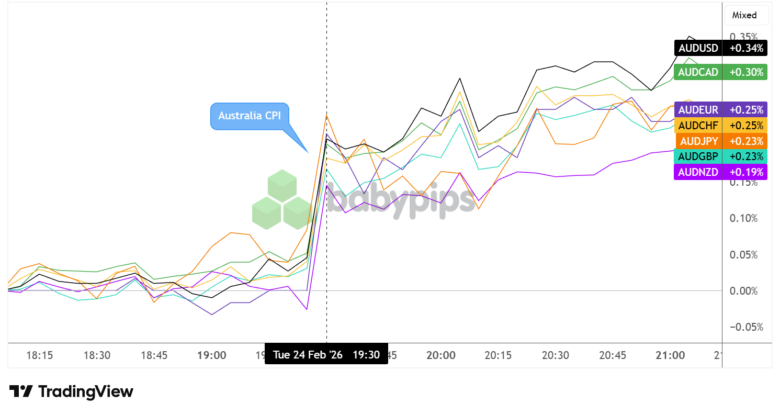
Australian Dollar vs. Major Currencies: 15-min
AUD Overlay 15-min – Chart Faster with TradingView
The Australian dollar, which had been cruising slowly higher leading up to the inflation release, jumped higher across the board upon seeing another set of stronger than expected results. After all, the RBA had already hiked interest rates in their latest decision and kept the door open for further tightening should inflation stay elevated.
The Australian currency sustained its bullish reaction as the Asian session progressed, though rallies appeared muted while markets braced for Trump’s State of the Union address.
AUD advanced 0.34% against USD a few hours after the numbers were printed, followed by a 0.30% lead against CAD. Gains against NZD were limited at 0.19% while raking in a 0.23% uptick against GBP.


