


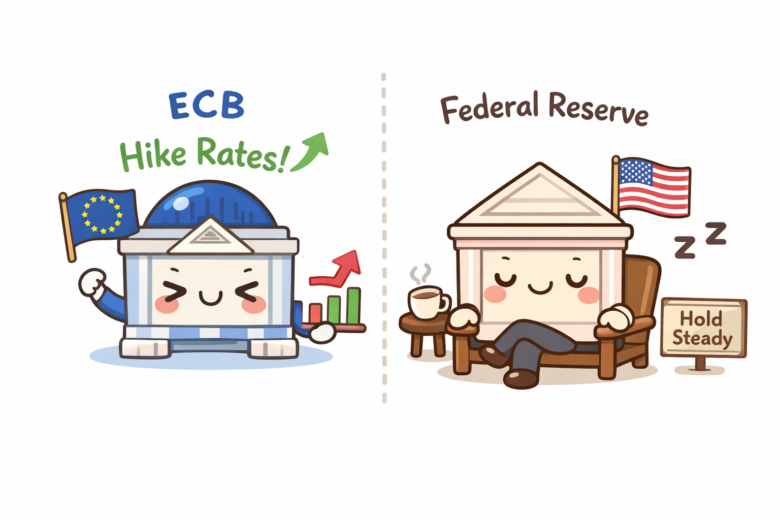

If you’ve heard about “policy divergence” in forex, you probably learned a simple rule: when one central bank raises rates while another holds steady, the currency of the hiking bank tends to appreciate. It’s one of the most reliable forces in currency markets.
But right now, that rule is being put to the test in a big way, and EUR/USD is the pair caught in the middle.
The Iran conflict that erupted a few weeks back sent oil prices surging past $100 per barrel. Europe, which relies heavily on imported energy, is now facing renewed inflation pressure. Markets are suddenly pricing in the possibility that the European Central Bank (ECB) might actually hike rates while the U.S. Federal Reserve stays on hold. That should be straightforwardly bullish for the euro, right?
Not exactly.
The Basics: The ECB’s Dilemma
The ECB entered 2026 in a comfortable spot. The deposit rate was sitting at 2.0%, inflation had fallen back near the 2% target, and central bankers described policy as being in a “good place.” Rate hikes weren’t on anyone’s radar.
Then the Iran conflict broke out late February when U.S. and Israeli forces launched coordinated strikes. Iran closed the Strait of Hormuz, the passage through which roughly 20% of global oil flows, and crude oil prices skyrocketed to record highs in a matter of days.
For Europe, this is a serious problem. The eurozone is a massive energy importer. When oil and gas prices jump, inflation goes up fast, so the ECB may feel forced to respond.
Before the conflict, futures markets saw practically zero probability of an ECB rate hike in 2026. Within two weeks, that had flipped dramatically, with swaps pricing in a roughly 70% probability of two 25-basis-point hikes by year-end, with a first hike fully priced by July.
On the flip side, the Federal Reserve seems set on staying put.
The Fed’s benchmark rate is currently at 3.5–3.75%. Before the Iran conflict, traders had been expecting rate cuts in June and September. Now, with oil prices adding to already-above-target U.S. inflation (CPI was 2.4% in February), those cut bets have been pushed back significantly. Traders now see at best one cut, possibly in December.
So we have a genuine policy divergence setting up: the ECB potentially hiking, the Fed standing still or even retreating on its cut timeline.
Why It Matters: The Policy Plot Twist
Normally, here’s how policy divergence works:
ECB hikes → euro becomes more attractive to hold → EUR/USD goes up
Fed holds → dollar becomes relatively less attractive → EUR/USD goes up
Both factors should push EUR/USD higher. Yet the euro has actually been weakening. According to Bloomberg, the euro has dropped more than any other major currency since the Iran conflict began, falling from above $1.20 to near $1.15 in a matter of days.
Why? Because the reason for the ECB’s potential rate hike matters enormously.
The ECB isn’t hiking because the eurozone economy is booming. It would be hiking to fight inflation caused by an energy crisis that is simultaneously crushing European growth. Higher energy prices act like a tax on European businesses and consumers.
Oxford Economics estimates eurozone inflation could run 0.5–0.6 percentage points higher in late 2026 than previously forecast while GDP growth could slow to as little as 0.8% if the shock intensifies.
In short, the ECB may hike into a weakening economy. That’s a very different situation from raising rates because things are going well.
Promoted: Stop Risking Your Own Capital on Unpredictable Trade Policies.
You’ve seen how energy shocks can cloud the euro’s outlook, but playing big macro shifts requires serious capital. With FundingPips, you trade a simulated account and can earn up to 100% of your rewards. Whether you’re looking for a 2 Step PRO evaluation starting at just $26 or seeking funding options up to $300K, you have the flexibility to trade your way.
Learn more about FundingPips and use code HELLO to get 20% OFF your first purchase!
Disclosure: We may earn a commission from our partners if you sign up through our links, at no extra cost to you.
Key Lessons for Traders
1. The reason for tightening matters, not just the hike itself.
A central bank raising rates to fight a growth boom is very different from hiking to fight a supply-side energy shock. In the first case, a strong economy supports the currency. In the second, rising rates fight inflation while the underlying economy deteriorates, making the currency less attractive, not more.
2. Policy divergence is a spectrum, not a switch.
The ECB might hike. The Fed might stay on hold. But both are responding to the same external shock. The degree of divergence, and who it helps more, depends entirely on how the energy situation evolves week by week.
3. Safe-haven flows can override fundamentals — at least temporarily.
When geopolitical risk spikes, traders rush to the U.S. dollar regardless of rate differentials. The dollar strengthened broadly when the Iran conflict broke out, even while the Fed had no plans to raise rates. Fear trades can last weeks or months.
4. Europe’s energy dependence is a structural FX vulnerability.
This isn’t the first time an energy shock has hurt the euro. The 2022 Russia-Ukraine war did the same thing. Whenever global energy markets are disrupted, Europe tends to suffer disproportionately, and the euro reflects that exposure.
5. Watch the duration, not just the headline.
If the Iran conflict resolves quickly and oil normalizes toward $70–80/barrel, the inflation shock could be manageable and ECB hikes may not materialize. If the conflict drags on for three to four months, the macro damage becomes severe. The length of the disruption is what determines whether EUR/USD eventually recovers.
The Bottom Line
The situation in EUR/USD right now is a masterclass in why forex is more complex than “higher rates = stronger currency.”
The ECB may raise rates in 2026, possibly before the Fed does anything. But if those hikes are driven by energy-shock inflation while the eurozone economy slows, they may do little to support the euro and could even hurt it if traders read them as a sign of how stressed Europe’s economic situation really is.
Watch for three things going forward: how long the Iran conflict lasts, whether European energy prices stabilize, and what the ECB signals at its March 19, 2026 meeting. Those data points will tell you far more about EUR/USD’s direction than the rate differential alone.
The lesson for any beginner: fundamentals work, until the context changes everything.
This article is for educational purposes only. It does not constitute financial advice. Trading involves substantial risk, and past performance is not indicative of future results. Always do your own research and consider consulting with a qualified financial advisor.
Promoted: Master Your Execution During Macro Shocks
When EUR/USD doesn’t have a straightforward reaction to policy divergence, does your execution stay clinical or get emotional? TradeZella’s trade replay tool lets you revisit your past trades tick-by-tick. See exactly where your entry slipped or why you hesitated, so you can dominate the next volatility spike with a data-driven playbook.
Start Your Journal with Tradezella and use code “PIPS20” to save 20% on your first purchase!
Disclosure: To help support our free daily content, we may earn a commission from our partners if you sign up through our links, at no extra cost to you.


