


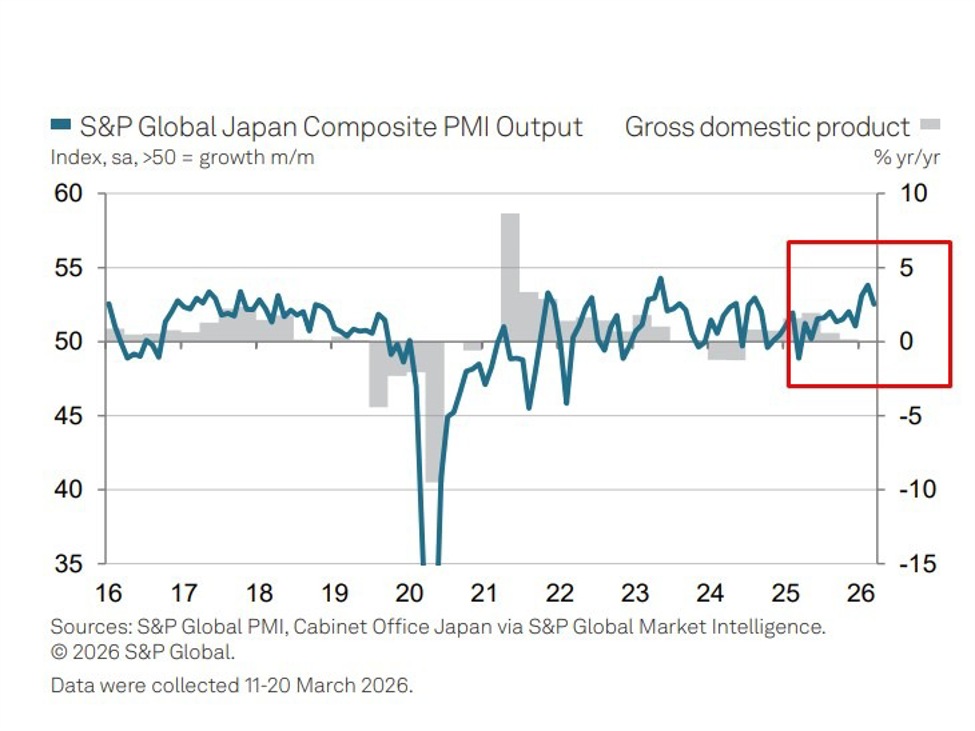

Japan’s flash PMI shows continued expansion but with clear signs of slowing growth and rising cost pressures.
Summary:
- Japan flash composite PMI slows to 52.5 (Feb: 53.9)
- Services activity eases to 52.8 (Feb: 53.8)
- Manufacturing PMI drops to 51.4 (Feb: 53.0)
- Manufacturing output slows to 51.8 (Feb: 54.2)
- New orders growth weakens to slowest in three months
- Input costs rise at fastest pace in 11 months
- Business confidence slips to near one-year low
- Growth remains intact but momentum clearly softening
Japan’s private sector continued to expand in March, but at a slower pace, as both manufacturing and services activity lost momentum amid rising cost pressures and growing geopolitical uncertainty.
According to preliminary S&P Global flash PMI data, the composite output index fell to 52.5 in March from 53.9 in February, marking the weakest pace of expansion in three months, although still firmly above the 50 threshold that separates growth from contraction.
The slowdown was broad-based across sectors. Services activity eased to 52.8 from 53.8, while manufacturing showed a more pronounced loss of momentum, with the headline PMI falling to 51.4 from 53.0. Manufacturing output also slowed sharply, coming in at 51.8 compared with 54.2 previously.
Underlying demand conditions softened, with new orders expanding at the slowest pace in three months. Both domestic and export demand showed signs of moderation, with foreign demand for goods weakening and services exports only modestly improving. Employment continued to rise, extending the current hiring streak, although job growth slowed to a four-month low.
At the same time, cost pressures intensified significantly. Input prices rose at the fastest pace in nearly a year, driven in part by higher fuel costs, supply chain disruptions linked to the Middle East conflict, and a weaker yen, which has increased import costs. Despite this, firms were less able to pass on higher costs, with output price inflation easing slightly, suggesting some pressure on margins.
Business confidence also deteriorated, slipping to its lowest level in around a year as firms expressed concern about the uncertain outlook, particularly regarding energy prices and supply chain stability. While manufacturers remained relatively optimistic due to expectations of stronger demand in sectors such as semiconductors, defence and AI, services firms showed a more marked decline in sentiment.
Overall, the data point to a moderation in Japan’s growth trajectory rather than a reversal. However, the combination of softer demand, rising costs and declining confidence highlights a more challenging environment for businesses heading into the second quarter.


