


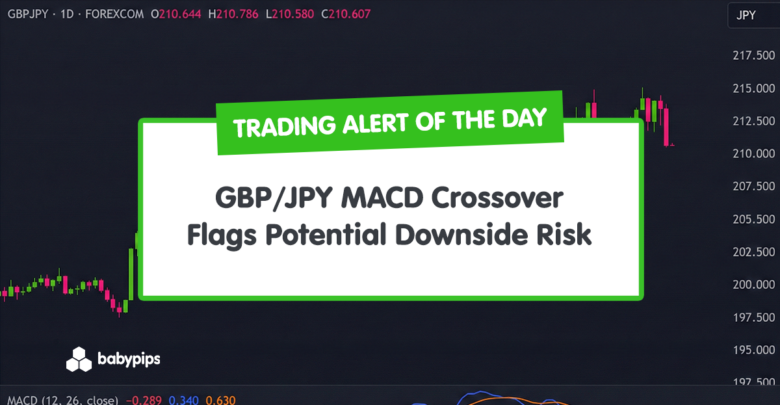

GBP/JPY just printed a sharp daily drop, and momentum has started to roll over alongside it.
With a widely followed momentum indicator now flipping, traders are weighing whether this move marks the start of a deeper pullback or just a temporary reset after an extended push higher.
Near prior reaction zones, the market’s response in the next few sessions will help clarify whether momentum is truly shifting.
Welcome to “TA Alert of the Day.” Each day after the market close, MarketMilk scans for popular technical indicator alerts. We use these alerts as the basis for a mini-lesson, breaking down what each alert means, why it matters, and how traders might interpret it. The goal is to help beginner traders not only spot these alerts but also understand the logic behind them and how they can inform trading decisions.
What MarketMilk Has Detected
MarketMilk has detected a bearish MACD(12,26,9) crossover on the daily chart, with the MACD line moving below its signal line (from 0.724200/0.695505 to 0.490558/0.654516).
This crossover arrived on a wide-range down day that pushed GBP/JPY down to 210.6035 after trading as high as 213.7325.
GBPJPY remains in a strong intermediate uptrend, but recent price action shows a clear loss of upside momentum following an extended advance.
Price has repeatedly interacted with the 210.5–211.0 area (multiple closes around 210.7–211.1 in late December and late January), making that zone an immediate area of interest.
Overhead, the 214.2–215.0 region stands out as a recent resistance area (early February highs around 214.2050 and 215.0125).
What This Signals
The traditional interpretation of a bearish MACD crossover is that upside momentum is weakening, and sellers are gaining relative control.
If the move is sustained, this shift can attract trend-followers and systematic traders who view the crossover as confirmation that the prior upswing is losing traction.
However, this same pattern can also represent a late signal after a fast drop, where prices briefly flush lower and then stabilize or mean-revert.
In that scenario, the crossover may coincide with short-term capitulation rather than the start of a prolonged downswing, especially if GBP/JPY quickly reclaims broken intraday levels and holds above nearby support.
The outcome depends heavily on follow-through price action, whether support zones hold, and broader risk sentiment and rate expectations that often influence JPY crosses.
How It Works
The MACD (Moving Average Convergence Divergence) compares two exponential moving averages (typically 12- and 26-period) to gauge momentum, then smooths the result with a 9-period signal line.
A bearish crossover occurs when the MACD line drops below the signal line, indicating that recent price momentum is decelerating relative to the longer baseline.
Important: MACD is a lagging indicator and can whipsaw during range-bound markets. Crossovers tend to be more informative when they occur alongside clear structure breaks (support/resistance), expanding range/volatility, or multi-day follow-through rather than a single large candle.
What to Look For Before Acting
Do not assume the signal implies an extended downtrend. Consider these factors:
✅ Whether GBP/JPY holds below the 212.3–212.7 area (recent consolidation zone) after this selloff
✅ A decisive break and daily close below the 210.5–211.0 support band that has been tested repeatedly in the last two months
✅ Follow-through selling over the next 1–3 daily candles (avoiding an immediate snap-back)
✅ MACD histogram behavior: continued negative expansion can support the idea of building downside momentum
✅ Whether rallies toward 213.5–214.2 are rejected (former swing area) rather than reclaimed
✅ Trend check on the Weekly chart: is this a pullback within a broader uptrend or a larger trend transition?
✅ Volatility conditions: large daily ranges can increase the chance of whipsaw after crossovers
✅ Macro catalysts for GBP/JPY (BoE/BoJ messaging, UK data surprises, and global risk-on/risk-off tone)
Risk Considerations
⚠️ Whipsaw risk: MACD crossovers can flip back quickly if GBP/JPY returns to a range
⚠️ Support bounce risk: the 210.5–211.0 zone has a history of holding; shorts can get squeezed on rebounds
⚠️ Event risk: central bank commentary or unexpected data can overwhelm indicator-based signals in FX
⚠️ Gap/volatility risk: large daily candles can lead to poorer entry quality and wider stop requirements
Potential Next Steps
Add GBP/JPY to a watchlist and monitor whether price holds below 212+ and whether the 210.5–211.0 support zone breaks or stabilizes.
Some traders prefer waiting for a second day of confirmation (either follow-through lower or a failed retest of reclaimed levels) before assigning more weight to a MACD crossover.
If you choose to trade this setup, keep position sizing aligned to the current daily range and define invalidation clearly (for example, a sustained reclaim of nearby resistance zones).
Risk management matters more than the indicator itself when volatility expands.
Trade Idea
Setup:
Sell GBPJPY following the bearish MACD crossover, where the MACD line has crossed below the signal line after an extended uptrend.
This signals a loss of upside momentum and increases the probability of a deeper corrective phase or trend pause. Price is rolling over from elevated levels, reinforcing the momentum-based short bias.
Entry:
Stand aside and wait for a bearish continuation or weak bounce into the 212.50–213.50 zone, where recent minor support has flipped to resistance.
Look for confirmation such as rejection wicks, bearish reversal candles, or failure to reclaim recent highs during the bounce.
Enter short once price shows rejection from this area and resumes lower, aligning price action with the MACD downside crossover.
Stop Loss:
Place the stop on a daily close above 215.00. A reclaim of recent highs would invalidate the momentum breakdown and suggest the bearish MACD signal has failed.
Take Profit:
Target the 209.50–210.00 area as the first take-profit zone, where near-term support is expected, and a reaction is likely.
If price breaks and holds below that level, trail stops and look for continuation toward the 206.50–207.50 zone, which aligns with prior consolidation and the last major higher low in the uptrend.
Bottom line:
The MACD line crossing below the signal line marks a momentum rollover after a prolonged advance. As long as GBPJPY remains below the 214–215 resistance zone, rallies favor selling rather than dip-buying, with risk skewed toward a deeper corrective move before the broader trend can reassert itself.
This content is strictly for informational purposes only and does not constitute as investment advice. Trading any financial market involves risk. Please read our Risk Disclosure to make sure you understand the risks involved.


