




The broader cryptocurrency market remains under pressure as capital outflows extend over several months.
The decline has been evident across leading digital assets. Bitcoin [BTC] dropped from $126,000 to $67,000, while Ethereum [ETH] fell from roughly $4,980 to $1,990 at press time.
Several other altcoins have recorded similar drawdowns, erasing close to 30% of their prior gains and reinforcing the ongoing bearish structure.
Despite this weakness, macro liquidity conditions tell a different story.
Global liquidity climbs to record levels
Global M2, commonly used as a proxy for worldwide liquidity, continues to expand.
M2 measures the pool of relatively liquid money across major economies. It includes physical cash, checking deposits, savings deposits, and money market funds—capital that can be quickly deployed into financial markets.
Recent data shows that global M2 has climbed to approximately $135 trillion, marking a fresh all-time high.
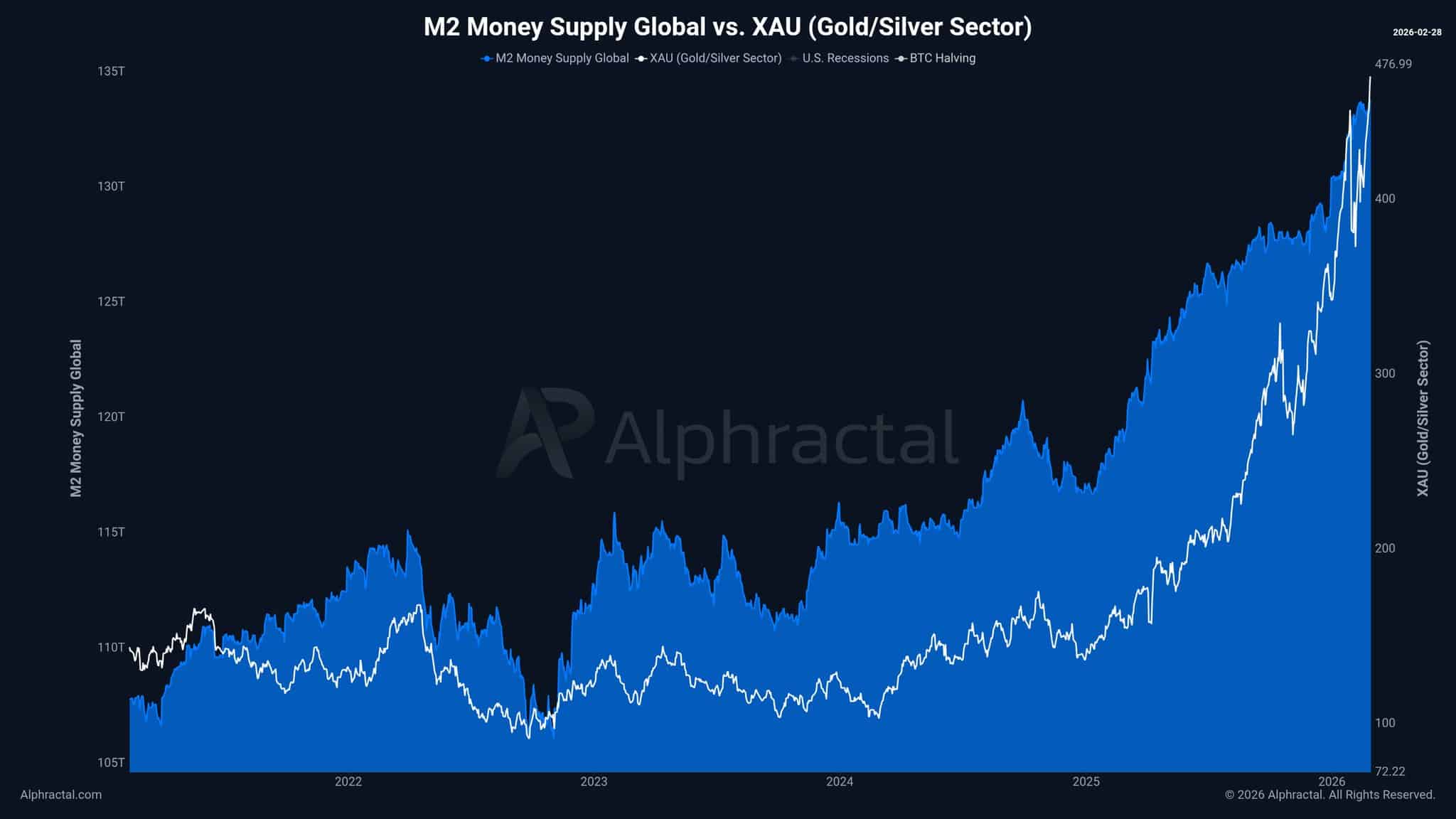
Source: Alphractal
Historically, rising liquidity increases the amount of deployable capital within the system. In risk-on environments, this excess liquidity often finds its way into higher-yielding and more volatile assets.
Bitcoin, Ethereum, and the broader altcoin market fall squarely within that category.
However, the recent 4.35% rebound in total crypto market capitalization to $2.31 trillion does not yet confirm a sustained bullish reversal. Liquidity may be expanding, but it is not decisively rotating into digital assets.
Safe havens attract the flow
To understand where capital is moving, investors often examine precious metals.
At the time of writing, gold has rallied 19.9% from its low of $4,402 per ounce on the 2nd of February, sustaining strong upside momentum. Silver has also advanced, climbing from $71 to $94 over the same period.
These gains are notable because both assets function as traditional safe havens. During periods of macroeconomic strain or geopolitical tension, investors tend to prioritize capital preservation over speculative exposure.
With tensions persisting between the United States and Iran, defensive positioning has strengthened.
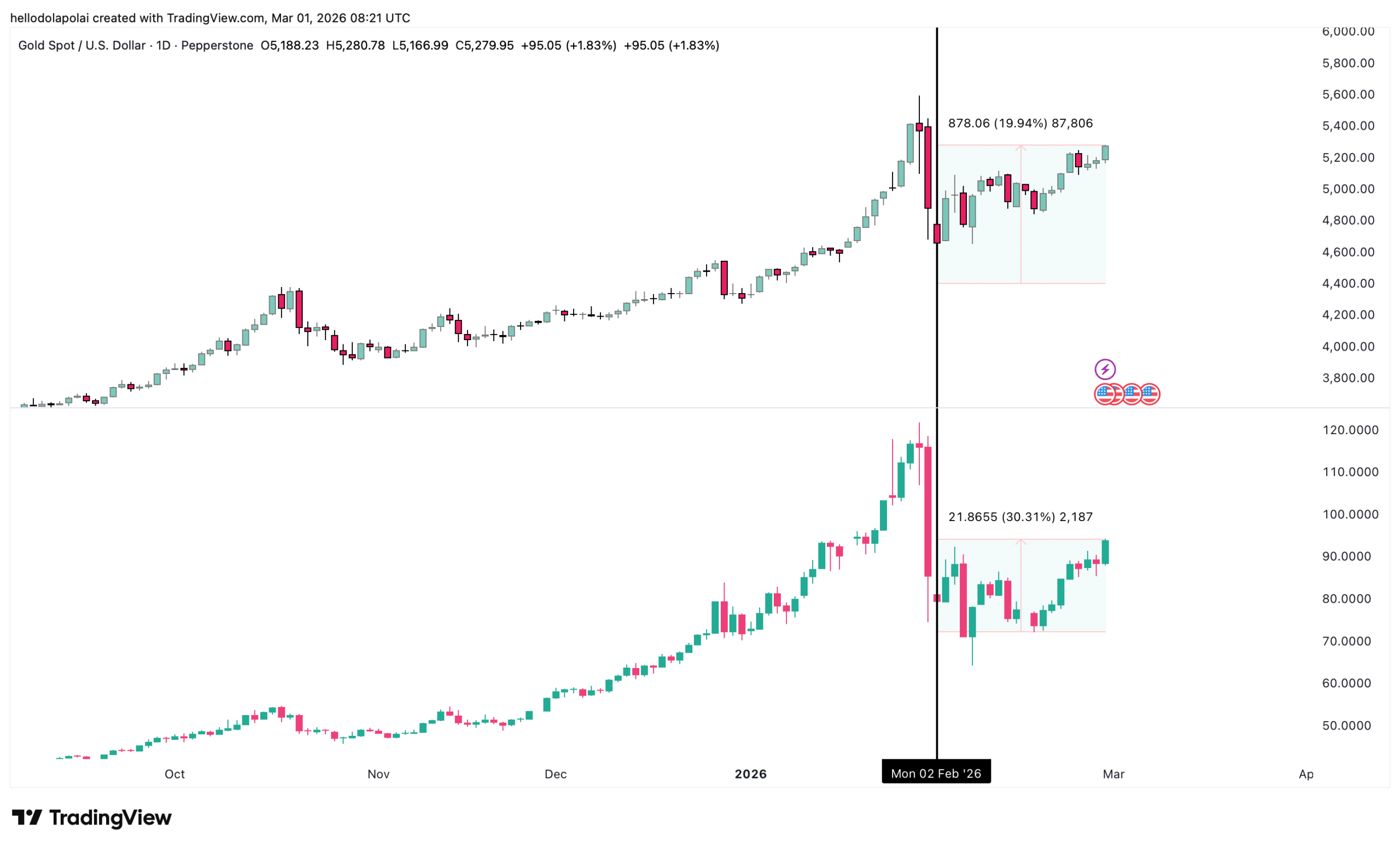
Source: TradingView
This rotation suggests that the expanding M2 supply may currently be supporting safe-haven demand rather than high-volatility crypto assets.
Data from Hyperliquid reveals that at least one trader has opened a combined $37.3 million short position across gold and silver—$28 million against gold and $9.23 million against silver—anticipating a pullback.
While this signals that some market participants view metals as overvalued, price action remains structurally bullish for now.
Exchanges broaden their reach
Meanwhile, crypto platforms are adjusting to softer trading activity.
Kraken and Coinbase have expanded their product offerings to include select stocks, commodities, and other traditional instruments.
This strategic diversification reflects an effort to capture a wider share of global capital flows as crypto volumes fluctuate.
Over the long term, such integration could strengthen capital access when risk appetite returns.
For now, however, liquidity expansion alone has not translated into sustained crypto upside. Capital appears to favor defensive assets, leaving digital markets in a holding pattern despite record global M2 levels.
Final Summary
- Global liquidity is rising, but gold and silver are outperforming crypto assets.
- The crypto market has yet to meaningfully benefit from expanding global M2.


