


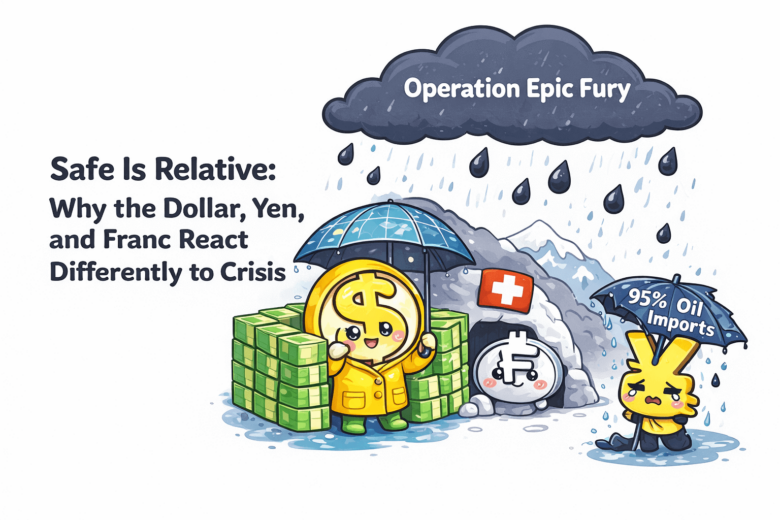

If you’re new to trading, it’s easy to assume that all “safe-haven” currencies do the same thing when markets panic: they go up. Last week was a brutal reminder that they don’t.
After the US and Israel launched Operation Epic Fury against Iran, killing Supreme Leader Ayatollah Ali Khamenei and triggering a widening regional conflict, traders rushed for safety.
But the US dollar, Japanese yen, and Swiss franc didn’t move together. The franc surged to decade highs while the dollar rallied hard, and the yen actually slipped.
That’s because safe haven flows aren’t one size fits all.
The moves reflected the type of crisis, each country’s exposure to energy prices, interest rate expectations, and how traders were positioned going in.
Why Each Currency Is a “Safe Haven” in the First Place
The US dollar is the world’s reserve currency and the center of global trade, funding, and Treasury markets. When investors want liquidity at scale, they buy dollars. It’s the deepest, most accessible pool of defensive assets on the planet.
The Swiss franc is more of a classic geopolitical shelter. Switzerland’s usual political neutrality, strong institutions, and reputation for stability make it a natural “bunker currency” when the world gets frightening.
The Japanese yen has long been seen as a safe haven because Japan runs very low interest rates, and the yen serves as the world’s main funding currency for carry trades.
In a carry trade, investors borrow yen and invest the money in higher-yielding assets elsewhere to capture the interest rate gap, often with leverage. When markets panic and volatility spikes, those trades get unwound fast. Traders rush to buy back yen to repay their loans, which can trigger sharp yen rallies. That’s the mechanism behind the yen’s safe-haven reputation. It usually shows up when there’s financial stress rather than purely geopolitical shocks.
What Happened: Three Safe Havens, Three Different Moves
When Operation Epic Fury began on February 28 and oil prices surged more than 7% on fears of a Strait of Hormuz disruption,
- The US Dollar Index surged past 98.27 — its highest in over a month
- EUR/CHF crashed to 0.9030 — the franc’s strongest level against the euro since 2015
- USD/JPY pushed above 157.75 — the yen weakened despite global panic. By week’s end, the yen was on its third consecutive weekly decline
What happened here? In most risk-off episodes, the dollar, yen, and franc tend to strengthen together.
This time, the market split them apart. The dollar and franc rallied while the yen weakened, showing that different safe-havens respond very differently depending on the type of crisis.
The Dollar: The Clear Winner of an Energy War
In a geopolitical crisis tied directly to oil, the dollar has a structural advantage. Oil is priced in USD globally, meaning demand for dollars actually increases when energy trade is disrupted.
Add to that the fact that the US is largely energy independent (read: higher oil prices are less damaging to the American economy than to Japan’s or Europe’s) and the dollar becomes a double safe haven: a defensive currency and a relative economic winner.
The dollar also got a boost from the view that an oil shock could keep inflation sticky and delay Fed rate cuts. If rates stay higher for longer, US yields look more attractive, and the dollar tends to benefit.
So, it wasn’t just fear driving USD’s gains. The fundamentals were lining up in the dollar’s favor, too.
The Yen: The Wrong Safe Haven for This Crisis
Japan imports roughly 95% of its crude oil from the Middle East, with about 74% flowing through the now-disrupted Strait of Hormuz. When oil spikes because of a Middle East war, Japan’s import bill explodes, its trade balance worsens, and its economy faces stagflationary pressure.
The Bank of Japan warned mid-week that the conflict could “significantly affect Japan’s economy,” signaling a prolonged rate hold. That made yen-denominated assets less attractive just when the economy needed support.
Some carry trade unwinding did happen as traders cutting risk positions bought back yen, but the structural economic damage from surging oil outweighed it. The yen isn’t broken as a safe haven. It’s simply the wrong tool for this type of crisis.
The Franc: The Cleanest Fear Trade — Until the SNB Said Stop
The Swiss franc had the cleanest safe-haven story of the week. Switzerland is not a direct casualty of Middle East energy shocks the way Japan or the Euro Area is, so when European natural gas prices spiked roughly 70%, the franc gave investors a way to stay close to Europe without taking on the region’s energy vulnerability.
But before traders piled on their francs, the Swiss National Bank stepped in on March 2 with an unusually direct warning that it was “increasingly prepared to intervene” to curb “rapid and excessive appreciation.” EUR/CHF quickly cooled from 0.9030 to around 0.9110, but demand soon returned as the war intensified. By March 6, EUR/CHF slipped back to 0.9019 and USD/CHF fell to 0.7764.
Still, the SNB lesson matters: when a safe-haven currency surges too fast, central bank intervention is a real and immediate risk.
Promoted: Stop Risking Your Own Capital on Unpredictable Geopolitics.
You’ve read the geopolitical headlines and watched safe-haven currencies spike, but playing big macro shifts requires serious capital. With FundingPips, you trade a simulated account and can earn up to 100% of your rewards. Whether you’re looking for a 2 Step PRO evaluation starting at just $26 or seeking funding options up to $300K, you have the flexibility to trade your way.
Learn more about FundingPips and use code HELLO to get 20% OFF your first purchase!
Disclosure: We may earn a commission from our partners if you sign up through our links, at no extra cost to you.
Key Lessons for Traders
1. Match your safe haven to the crisis type. This is the most important mental model you can build. Think of it in three buckets:
- Financial stress (market crashes, bank failures, credit scares, broad deleveraging): The yen tends to shine here because panicking investors unwind carry trades en masse, flooding the market with yen-buying.
- Geopolitical or energy shock (wars, oil supply disruptions, regional conflict): The dollar and franc tend to dominate. The dollar benefits from its reserve currency status and energy independence. The franc benefits from Switzerland’s neutrality and insulation from direct energy exposure. The yen, as Japan’s energy vulnerability shows, can actually weaken in this environment.
- US growth scare or weak data shock (recession fears, soft payrolls, Fed pivot expectations): The dollar can lose its safe-haven edge even while CHF and JPY strengthen—because a weakening US economy undermines the yield and growth advantage that normally supports the greenback. March 7’s weak payrolls print gave a small live example of this dynamic playing out mid-conflict.
Getting this wrong is expensive. Buying yen as a “safe haven” during an oil-driven Middle East war is like bringing an umbrella to a snowstorm—technically, it’s weather gear, just not the right kind.
2. Energy dependence flips safe-haven logic. Japan imports roughly 95% of its oil from the Middle East. Any Middle East conflict that spikes oil prices is fundamentally bearish for yen PERIOD. Don’t fight that with textbook assumptions.
3. Know the currency pair logic. In an oil shock risk-off move, currency pairs can react very differently. USD/JPY may rise as the dollar gains while the yen struggles, USD/CHF can fall as the franc becomes the preferred fear hedge, and EUR/CHF can drop even faster as traders see Europe as more exposed to the energy shock than Switzerland.
4. Central bank intervention caps safe-haven rallies. The SNB flipped CHF’s direction within hours of its warning. Always ask: is the central bank comfortable with where this currency is going?
5. Even safe havens have cracks. On March 7, weaker-than-expected US payrolls (a loss of 92,000 jobs) trimmed dollar gains immediately, as markets priced in earlier Fed rate cuts. The dollar’s safe-haven status is durable but not bulletproof.
The Bottom Line
Safe haven doesn’t mean “always up in a panic.” It means different things in different storms—and your job as a trader is to figure out which storm the market is actually trading.
The previous week was a masterclass in that distinction. Three currencies, three different drivers, three completely different outcomes.
Understanding why each currency earns its “safe” label—not just that it has one—is one of the most valuable frameworks you can build as a forex trader.
This article is for educational purposes only. It does not constitute financial advice. Trading involves substantial risk, and past performance is not indicative of future results. Always do your own research and consider consulting with a qualified financial advisor.
Promoted: Master Your Execution During Macro Shocks
When major geopolitical headlines split safe-haven currencies apart, does your execution stay clinical or get emotional? TradeZella’s trade replay tool lets you revisit your past trades tick-by-tick. See exactly where your entry slipped or why you hesitated, so you can dominate the next volatility spike with a data-driven playbook.
Start Your Journal with Tradezella and use code “PIPS20” to save 20%!
Disclosure: To help support our free daily content, we may earn a commission from our partners if you sign up through our links, at no extra cost to you.


