


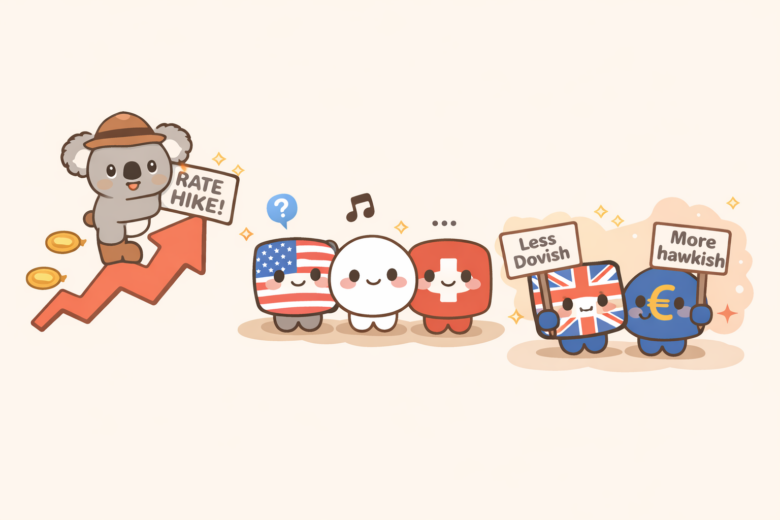

This week delivered something rare in modern markets: six of the world’s biggest central banks announced their policy decisions within days of each other.
The RBA on Tuesday, the Fed on Wednesday, then the Bank of Japan, European Central Bank, Bank of England, and Swiss National Bank all landed on Thursday.
Five held rates. One hiked.
But here’s what beginners need to understand: it’s never really about the rate decision itself—it’s about the message. And this week, the messages from these six banks were strikingly different, with one common thread tying them all together: the war in Iran.
What Happened: Central Bank Showdown
When the US and Israel began bombing Iran on February 28, oil prices surged, energy markets panicked, and the global economic outlook shifted almost overnight. That geopolitical shock landed close to a jampacked central bank week, forcing policymakers worldwide to tear up their existing scripts and start over.
Here’s the quick rundown of what each bank decided and what they actually meant.
The Reserve Bank of Australia was the week’s standout mover — the only major central bank to actually hike rates. In a tight 5–4 vote, the RBA raised its cash rate by 25 basis points to 4.10%, its second consecutive hike in 2026.
Governor Michele Bullock made clear the Iran war wasn’t the primary driver: domestic inflation was already running hot, with headline CPI at 3.8% in January, well above the RBA’s 2–3% target. The Iran shock simply piled on, but many doubt that another tightening move is in the cards since the narrow vote triggered a repricing of the May hike outlook.
The Federal Reserve held its benchmark rate steady at 3.5%–3.75%. This was the second consecutive hold, following three rate cuts at the end of 2025. The Fed’s updated “dot plot” (a.k.a. chart showing where officials expect rates to go) still pointed to just one cut in 2026, unchanged from December.
Chair Jerome Powell’s message: we’re watching the Iran oil shock closely, but we’re not panicking. Adding to the drama, this is likely Powell’s second-to-last meeting as Fed Chair, with his term ending in May.
The Bank of Japan held its rate at 0.75% in an 8–1 vote, with board member Hajime Takata dissenting in favor of an immediate hike to 1.0%. The BOJ’s message was cautious: Japan’s economy is recovering, but the Iran conflict adds uncertainty since Japan imports roughly 95% of its energy from the Middle East. Most analysts still expect the next BOJ hike to come sometime in mid-2026.
The European Central Bank kept its deposit rate at 2.0%. This was the hawkish surprise of the week. Before the Iran war, the ECB was widely expected to continue cutting. Instead, President Christine Lagarde scrapped her previous “good place” language and warned the outlook was “significantly more uncertain.” The ECB revised its 2026 inflation forecast upward to 2.6%, up from just under 2% in December.
The Bank of England held at 3.75% in a stunning unanimous 9–0 vote, marking first time all MPC members have voted the same way since September 2021. Before the Iran war, a cut was considered almost certain at this meeting.
Instead, the BOE now forecasts UK CPI reaching 3.5% in Q3 2026, up from a previous forecast of 2%. Governor Bailey warned the Bank “stands ready to act” if inflation persistence worsens—language traders read as a hint toward future hikes.
The Swiss National Bank also held rates at 0.00%, its lowest possible rate. Switzerland’s strong franc is already helping contain imported inflation. With headline CPI at just 0.1%, the SNB has little pressure to move. The SNB revised its 2026 inflation forecast up to 0.5% from 0.3%, entirely due to rising energy costs.
Why It Matters: Oil Shock Reframing
So why do five “hold” decisions matter so much for currency traders? Because the direction each bank is now leaning has flipped dramatically in just three weeks.
Consider what changed:
- AUD wobbled on a less hawkish outlook. The RBA is the only major central bank aggressively tightening, which is fundamentally supportive for AUD, except rising global uncertainty is also a headwind for the commodity-linked currency.
- GBP got hawkish. Markets went from pricing in two BoE cuts this year to now pricing in possible hikes. UK 2-year gilt yields jumped 0.3 percentage points on Thursday alone.
- EUR got less dovish. ECB rate cut bets faded sharply after Lagarde’s press conference tone-shifted.
- JPY faces a tug-of-war. The BOJ wants to keep hiking, but the Iran shock complicates timing.
- CHF faces intervention risks. Though the SNB opted to keep rates steady, traders remain wary of jawboning and actual FX intervention after officials appeared uncomfortable with franc rallies.
- USD holds firm. The Fed’s “wait and see” approach while politically chaotic with Powell’s future uncertain keeps the safe-haven dollar supported near-term.
The big takeaway? Central banks that were expected to cut are now holding or even considering hikes. That’s a major reversal of the 2025 easing cycle narrative.
Promoted: Stop Risking Your Own Capital on Unpredictable Trade Policies.
You’ve seen how major central bank decisions sparked policy divergences, but playing big macro shifts requires serious capital. With FundingPips, you trade a simulated account and can earn up to 100% of your rewards. Whether you’re looking for a 2 Step PRO evaluation starting at just $26 or seeking funding options up to $300K, you have the flexibility to trade your way.
Learn more about FundingPips and use code HELLO to get 20% OFF your first purchase!
Disclosure: We may earn a commission from our partners if you sign up through our links, at no extra cost to you.
Key Lessons for Traders
“Hold” doesn’t always mean neutral. A rate hold from the BoE this week was actually hawkish because markets had priced in a cut. A hold that surprises the market to the upside can strengthen a currency just as much as an actual hike would.
Geopolitical shocks reset the entire playbook. Three weeks ago, the trading consensus was clear: central banks were easing, inflation was fading, cuts were coming. The Iran war scrambled all of that. Economic calendars can become outdated fast when a major shock hits. Always check whether conditions have changed before leaning on old expectations.
Watch the vote count, not just the decision. The BoE’s 9–0 unanimous vote told traders more than the hold itself did. When even the most dovish members (like Swati Dhingra, who had consistently pushed for cuts) vote to hold, that signals a real shift in committee thinking.
Energy-importing economies face the toughest tradeoffs. Japan gets 95% of its energy from the Middle East. The UK depends heavily on global gas prices. These economies face a painful dilemma: rising energy costs push inflation up, but the same shock can slow growth. That’s the recipe for stagflation—and it makes central banks’ jobs much harder.
Relative policy divergence is the FX engine. Currency pairs move on the difference between two central banks’ policies. This week, the BoE went hawkish while the SNB stayed flat, creating a fundamental argument for potential GBP strength against CHF. The RBA hiking while the BOJ holds, for example, creates a fundamental argument for AUD strength against JPY. Look for these divergences when building a view on a currency pair.
The Bottom Line
This was one of the most consequential central bank weeks in recent memory, and every single decision was dominated by one thing: the Iran war and its impact on global energy prices. Five banks held rates, but the tone shifted meaningfully, particularly for the BoE and ECB.
For forex traders, the key theme going forward is policy divergence under pressure. Which central banks can pivot hawkish? Which are trapped? The answers will drive currency moves in Q2 2026. Watch UK CPI data, ECB communications, and BOJ wage data closely—those will tell you whether this week’s hawkish tilt holds or reverses.
As always, no one knows exactly how the geopolitical situation evolves. Size positions accordingly and protect your capital first.
Promoted: Master Your Execution During Macro Shocks
When major central banks shift their monetary policy outlook, does your execution stay clinical or get emotional? TradeZella’s trade replay tool lets you revisit your past trades tick-by-tick. See exactly where your entry slipped or why you hesitated, so you can dominate the next volatility spike with a data-driven playbook.
Start Your Journal with Tradezella and use code “PIPS20” to save 20% on your first purchase!
Disclosure: To help support our free daily content, we may earn a commission from our partners if you sign up through our links, at no extra cost to you.


