


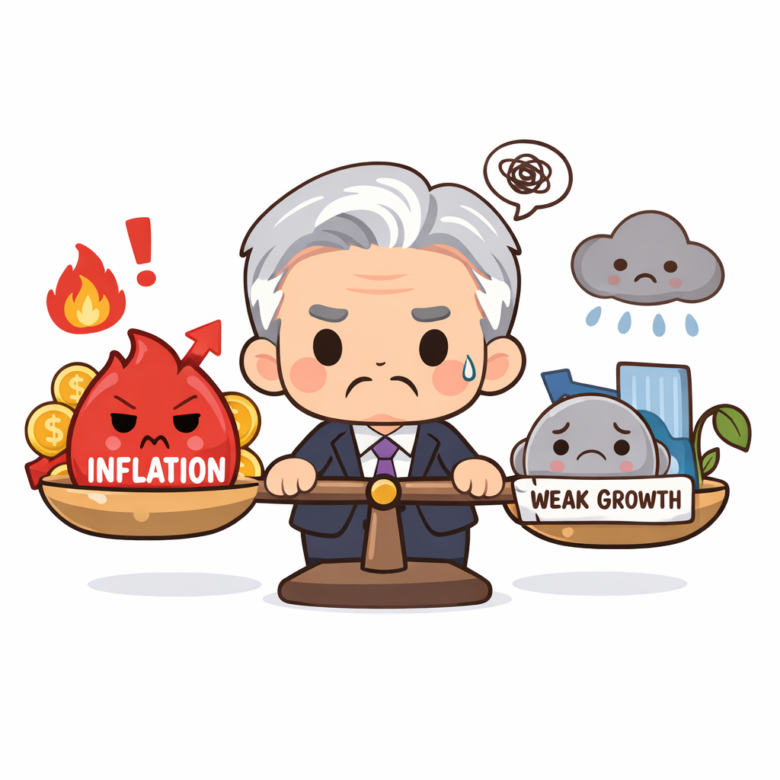

The Federal Reserve just froze in its tracks, and this time it’s not just about inflation data. With a war raging in the Middle East and oil prices surging past $110 a barrel, America’s central bank is facing one of the trickiest policy puzzles in decades.
Can the Fed cut rates to protect a slowing economy AND keep inflation under control at the same time?
Spoiler: it can’t. And that’s a big deal for every currency and asset class you’re watching.
This is the Fed’s stagflation trap. Understanding it will help you make sense of what markets are doing right now.
What Happened: Fed vs. War Inflation
Earlier this month, the Federal Open Market Committee (FOMC) voted to hold its benchmark rate steady at 3.50%–3.75%. Nearly all members supported the decision, with just one dissenter preferring a small cut.
On the surface, a rate hold sounds boring. But the decision came just weeks into a U.S.-Israel military conflict with Iran that has dramatically disrupted oil flows through the Strait of Hormuz, which is the narrow waterway that handles roughly 20% of the world’s daily oil shipments.
Since fighting began, commercial traffic through the strait has ground to a near halt, and Brent crude has surged from around $65 to over $110 a barrel. Some analysts warn prices could reach $170 or higher if the disruption continues into the summer.
The oil shock is landing on an economy that was already struggling with stubborn inflation. Core PCE (a.k.a. the Fed’s preferred inflation measure that strips out volatile food and energy costs) was running at around 2.7% in the Fed’s own updated projections, still well above their 2% target. Factor in the energy shock, and headline inflation could go higher still.
The Fed’s updated “dot plot” — a chart showing where each official expects rates to go — projected just one rate cut in all of 2026, down from two cuts anticipated only months earlier. Markets quickly priced out any near-term relief, with traders now eyeing September at the earliest for any reduction.
Fed Chair Jerome Powell summed up the uncertainty bluntly at his press conference: “The economic effects could be smaller or bigger. We just don’t know.”
Promoted: Capitalize on Currency Intervention Risks Without Risking Your Own Funds.
With geopolitical developments overriding Fed policy biases, market volatility can rise quickly. Why risk your personal capital during extreme volatility?
Most proprietary firms terminate your evaluation account if you execute a trade during a major macroeconomic release, but FundedNext permits news trading across all models.
Test your stagflation thesis with up to $300,000 in simulated capital, and take advantage of their Free Trial to experience the platform risk-free.
Explore FundedNext and Start Your Free Trial!
Disclosure: We may earn a commission from our partners if you sign up through our links.
Why It Matters: A Classic Stagflation Trap
Stagflation is the combination of rising inflation and slowing economic growth happening at the same time. It’s a central banker’s nightmare because the usual tools pull in opposite directions:
- To fight inflation, you raise interest rates (making borrowing more expensive, cooling demand)
- To support growth, you cut interest rates (making borrowing cheaper, stimulating spending)
When both problems hit simultaneously, every move you make helps one side and hurts the other.
Right now, the Fed is caught in exactly this vice. The oil shock is pushing inflation higher while simultaneously slowing growth — by eating into consumer spending power and business budgets.
Key Lessons for Traders
Oil shocks hit markets differently than tariff shocks. Unlike tariffs, which filter into prices over months, oil price increases show up almost immediately in gasoline, shipping costs, and airline tickets. That makes this inflation impulse faster and harder to dismiss.
“Safe havens” don’t always behave the way you’d expect. Gold falling during a geopolitical crisis seems strange, but the logic is: if the crisis raises inflation, and inflation delays rate cuts, then the opportunity cost of holding gold (which pays no interest) goes up. The Fed’s policy path, not just the headlines, drives gold pricing.
Watch the dot plot, not just the decision. The Fed’s rate hold was widely expected. What actually moved markets was the updated dot plot showing fewer future cuts. For forex and rates traders, forward guidance often matters more than what the Fed does today.
Leadership transitions add uncertainty. Fed Chair Powell’s term expires in May 2026. His expected replacement, Kevin Warsh, has not publicly commented on policy since oil prices surged. A new chair navigating a stagflation environment adds a wild card layer to every rate-path calculation.
Stagflation is rare but not impossible. Markets spent most of the past decade in a “low inflation, slow growth” world where central banks could cut freely. The past few weeks prove that a war-driven energy shock is one of the fastest ways to reignite stagflation.
The Bottom Line
The Fed is stuck. With inflation above target and an oil shock threatening to push it higher, rate cuts are off the table for now, even as growth slows and markets wobble. The next near-term to long-term signposts to watch:
- April 2026: Next FOMC meeting — updated guidance on the rate path
- May 2026: New Fed Chair takes over — watch for any shift in tone or policy framing
- Throughout Q2: Oil prices and Strait of Hormuz developments — the most important variable of all
- September 2026: Current market consensus for the earliest possible rate cut
If oil prices retreat by summer as futures markets suggest, the Fed may find room to ease later in the year. If the conflict deepens, the stagflation scenario becomes increasingly real and markets will reprice accordingly.
Whatever happens, the Fed’s dilemma is a textbook reminder: monetary policy can’t fix a war. All it can do is try not to make things worse.
Promoted: Master Your Execution During Macro Shocks
When the Fed’s hands are tied because of stagflation, does your execution stay clinical or get emotional? TradeZella’s trade replay tool lets you revisit your past trades tick-by-tick. See exactly where your entry slipped or why you hesitated, so you can dominate the next volatility spike with a data-driven playbook.
Start Your Journal with Tradezella and use code “PIPS20” to save 20% on your first purchase!
Disclosure: To help support our free daily content, we may earn a commission from our partners if you sign up through our links, at no extra cost to you.


