


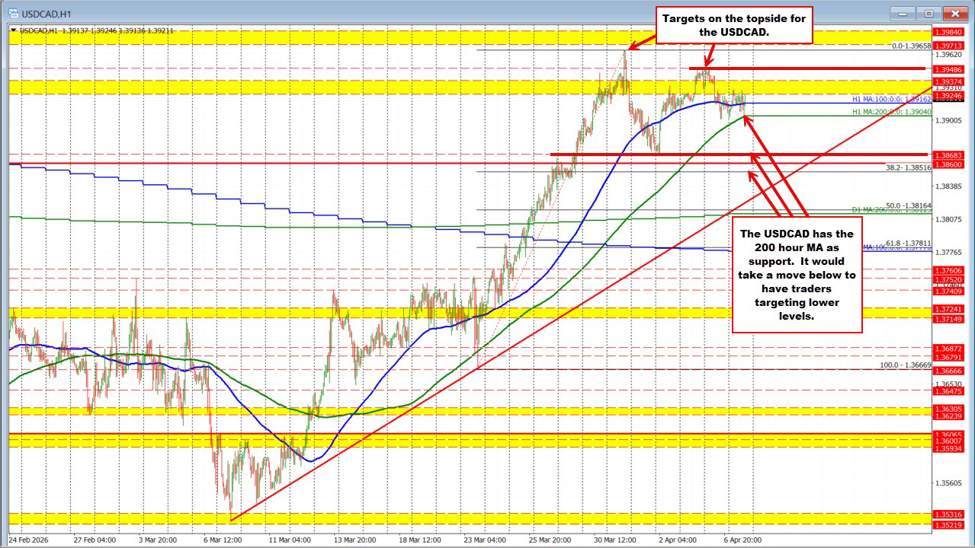

The USDCAD moved lower yesterday, but the price action was more about consolidation than conviction, with the pair trading above and below its 100-hour moving average (currently at 1.3916) and settling into a sideways range. That pause has been important technically, as it has allowed the 200-hour moving average (now at 1.3904) to catch up to price—and today, that level has stepped in as a key support floor.
In trading today, sellers pushed lower, but once again found buyers leaning against the 200-hour moving average. That reaction is telling. This level has proven to be a reliable barometer in recent weeks—it was briefly broken back on March 23, but only for a single hourly bar before snapping back higher. Since then, buyers have consistently defended it, and today is no exception. As long as the price holds above that moving average, buyers remain in control, using the level as a risk-defining pivot.
For the bias to shift more meaningfully to the downside, the price would need to break below the 200-hour moving average and stay below it. If that happens, traders would start to look toward the next downside targets, including last week’s low near 1.3868, followed closely by the 38.2% retracement of the move up from the March 23 low at 1.38516. A move below that zone would signal that sellers are gaining traction and could open the door for a deeper correction.
On the topside, the roadmap is equally clear. The first hurdle comes in a familiar swing area between 1.3924 and 1.3937, which has acted as a ceiling in recent sessions. A break above that zone would give buyers more confidence and shift focus toward the highs from yesterday and Friday near 1.39486, followed by last week’s high at 1.39658. Getting above that level would be significant—it would take the pair to its highest level since December 4 and open the door for a further extension toward the next resistance zone between 1.3971 and 1.3984.
For now, the technical story remains straightforward. Above the 200-hour moving average, buyers control the narrative. Below it, sellers start to gain ground. What also stands out is the lack of volatility—today’s range is just 29 pips, well below the 1-month average of 61 pips. That suggests the market is coiling, and with room to roam in either direction, a break from this consolidation could lead to a more directional move.
The levels are clear. The risk is defined. Now it’s about waiting for the market to tip its hand.


