




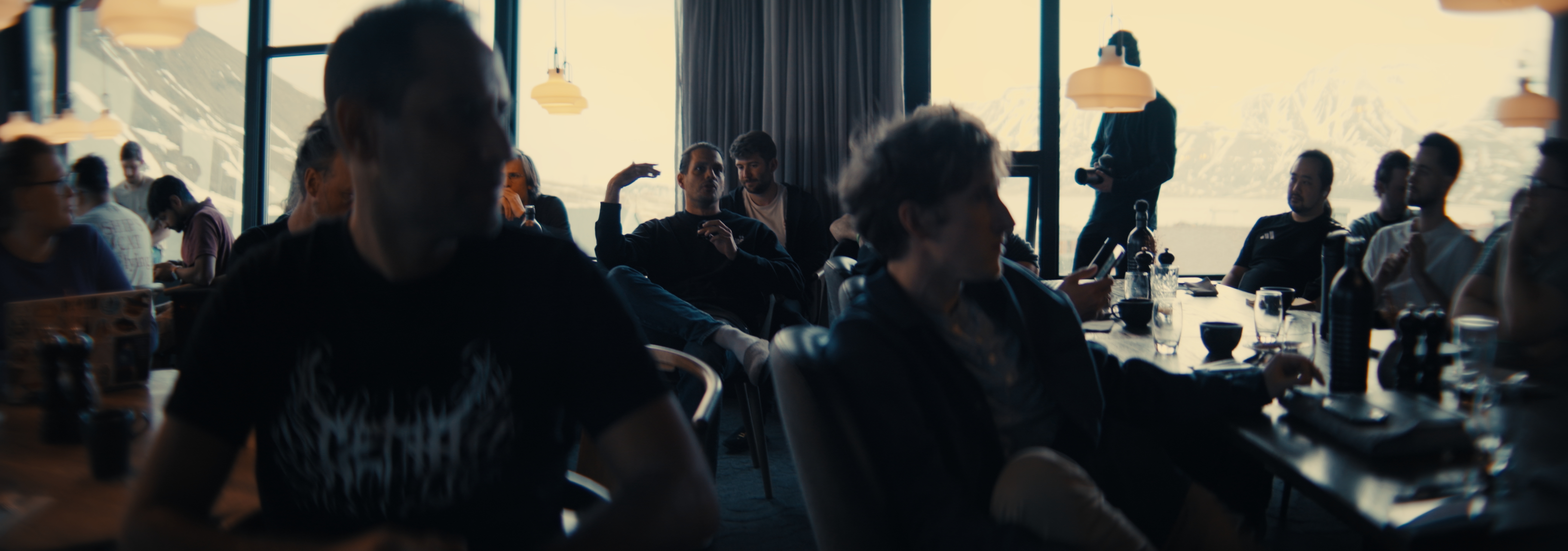
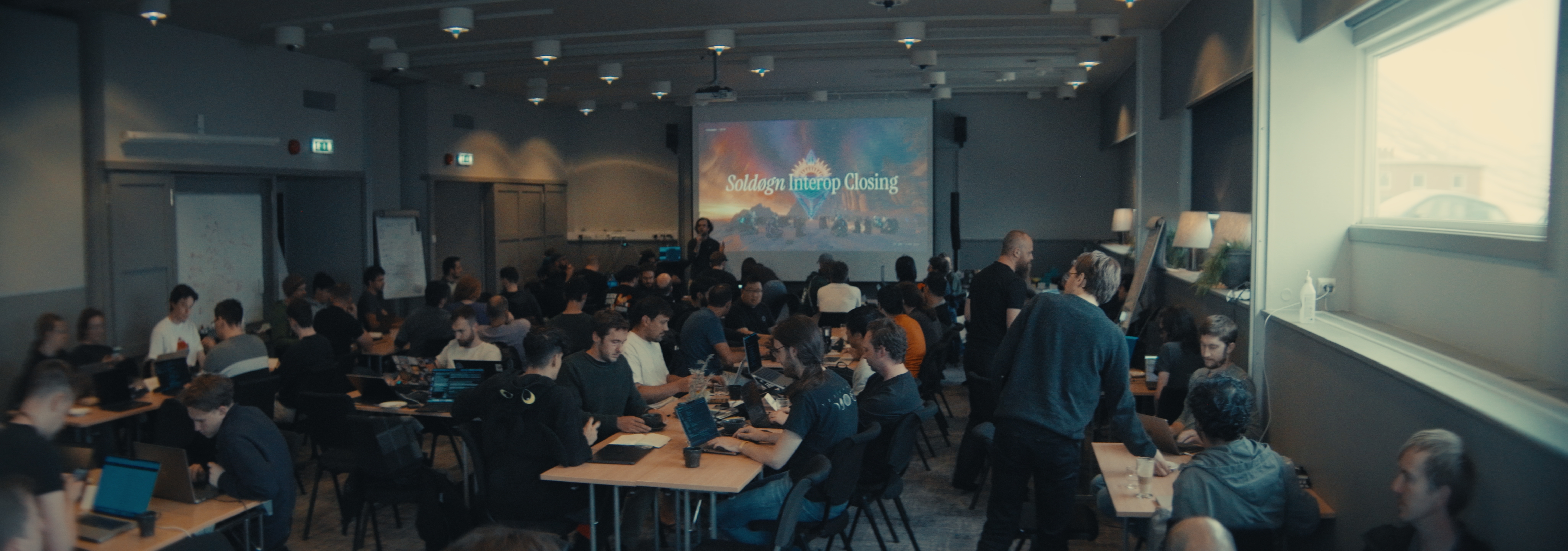
This past week, just over 100 Ethereum core contributors gathered above the Arctic Circle — in Longyearbyen, Svalbard — for the Soldøgn Interop: a week of intense work on the Glamsterdam network upgrade.
Soldøgn followed last year’s Berlinterop, but returned to the format used by Amphora 🏺, Edelweiss 🏔️, and Nyota ✨: a single-track week of focused, multi-client progress toward a specific upgrade — in this case, hardening Glamsterdam.
By Friday, the group had delivered on its three core goals: alignment on a post-Glamsterdam gas limit floor of 200M, stable ePBS implementations running with external builders, and final EIP-8037 repricing numbers locked in. Meaningful progress was also made on Hegotá features like FOCIL and native account abstraction, as well as a slew of other topics.
Why Svalbard?
Svalbard is one of the few places on Earth where anyone, regardless of nationality, can live and work without a visa. It’s also home to the Global Seed Vault and the Arctic World Archive, two cold-storage facilities tunneled into the permafrost outside Longyearbyen. Between them they hold backups of crops, books, films, manuscripts, and source code that humanity might need a thousand years from now, including a snapshot of Ethereum’s source code. Last but not least, from late April through August, the sun doesn’t set in Svalbard. It has 24/7 uptime, just like Ethereum, which core devs made the most of during the week!
Harden Glamsterdam, Scale Ethereum
The week’s goal was to harden Glamsterdam implementations and derive a target for a post-upgrade gas limit floor. Raising the gas limit safely is a multi-dimensional problem and Glamsterdam tackles several of them: how blocks are built and proposed, how much headroom client implementations have under load, and how state-creation costs scale alongside throughput.
In practice that meant ending the week with a stable multi-client Glamsterdam devnet running the latest ePBS, repricing and block access list specs, along with benchmarking data to anchor a credible gas limit proposal.
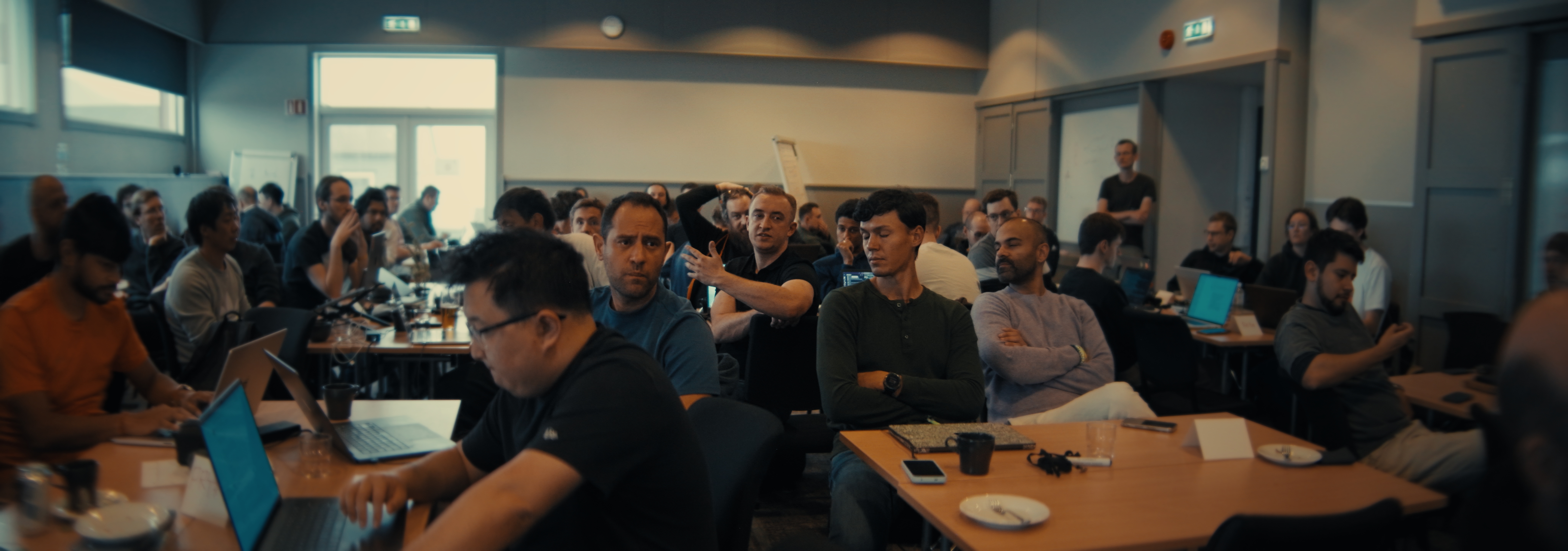
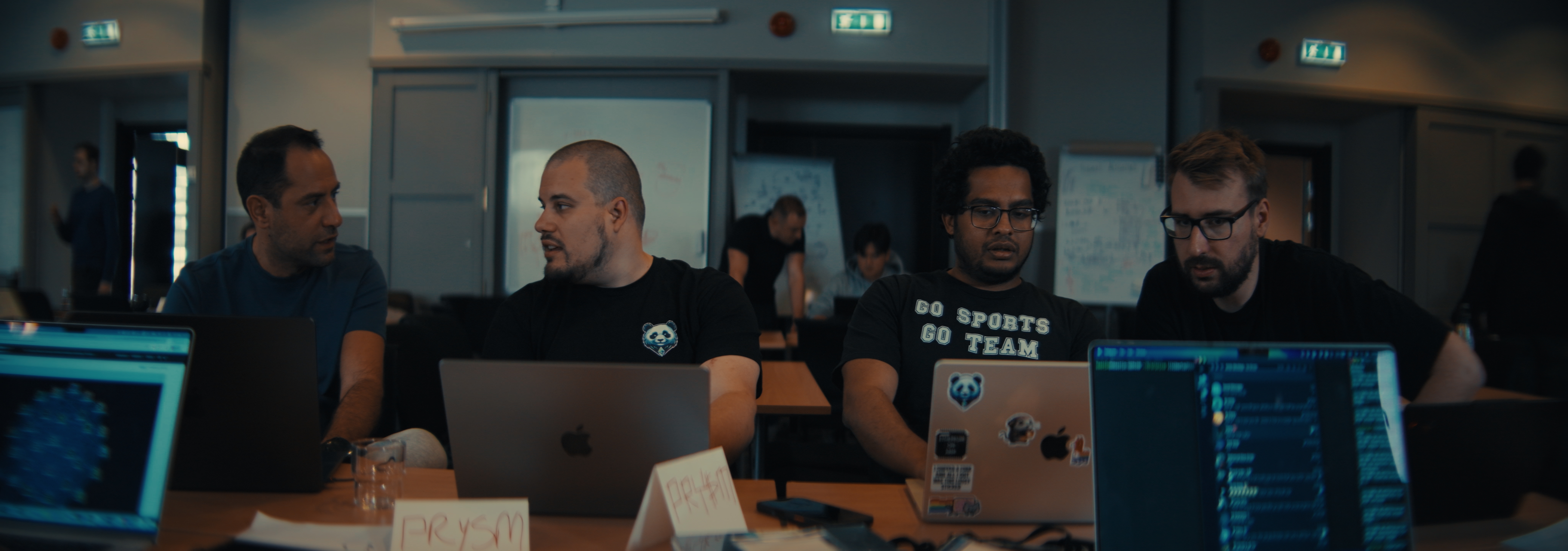
Most of the time was spent heads down writing code, often until the early hours of the morning, punctuated by breakout sessions to align on design decisions and discuss longer-term roadmap items.
Three EF teams provided infrastructure for the week: EthPandaOps shipped ethIQ and a panda MCP server to support teams’ agentic workflows; Protocol Support set up soldogn.xyz as the single source of truth for interop goals, schedule, and notes; and the EF Digital Studio team captured the week on film. Expect the very first interop documentary 🔜!
ePBS
Beyond cleaning up the proposer/builder relationship, ePBS restructures slots by adding deadlines for block construction, payload reveal, and attestations. This makes explicit how much time can be allocated for execution, increasing the head room we have to raise the gas limit.
Teams kicked off the week aiming for a 4 EL × 4 CL Glamsterdam devnet by Monday evening. The first attempts surfaced enough issues to push the target to Tuesday, when a 4×3 configuration ran stably enough for stress testing to begin.
From there, the rest of the week was an ePBS hardening cycle: stress test, expose edge cases, fix, repeat. A Tuesday-morning Builder API breakout substantially simplified the spec around validator registration, the bid/header/commitments flow, the trust model for builder payments, and circuit-breaker behavior. Mid-week debugging zeroed in on cross-client edge cases — notably around execution-request invalidation of beacon requests, where a new test suite revealed a gap across every client implementation. By Thursday morning, CL teams were reporting stable ePBS while EL-side bid pathways were still being debugged; those resolved through Thursday into Friday. Two questions remain genuinely contentious for ACD: whether a request signature should commit to the receiving builder, and how to keep a 1 ETH-staked-builder design resilient against P2P Sybil-based liveness attacks.
By Friday, nearly all clients were running together on glamsterdam-devnet-2 with the external builders pipeline tested end-to-end!
BAL Optimizations
If ePBS is the consensus-layer side of the Glamsterdam scaling story, the execution layer counterpart has two dominant pieces: gas repricings and Block-Level Access Lists. By giving clients enough information about a block’s read/write set up front, BALs enable parallel execution, batched I/O, and parallel state-root computation, all of which determine how big a block clients can comfortably handle.
The Soldøgn BAL track ran on its own devnets, separate from the Glamsterdam ePBS chains, so optimization benchmarks weren’t entangled with consensus-layer stabilization work. Each optimization sat behind its own feature flag so the week’s measurement work could compare them in isolation rather than as a single bundle. The BAL benchmark dashboard and leaderboard surfaced each client’s worst-case scenarios across the test suite — by focusing on raising the slowest paths first, teams could lift the gas limit floor across the board, not just for the fastest implementation.

Gas Repricings
Glamsterdam includes a number of EL gas repricings, calibrating costs to better match resource usage at higher throughput. EIP-8037, the state-creation gas cost increase, sits at the core: it raises the price of writing new state so that a higher gas limit doesn’t translate into unbounded state growth.
Heading into Soldøgn, the 8037 spec carried dynamic per-state-byte pricing tied to the block gas limit, which made testing combinatorially painful (one fuzz matrix per gas limit band) and benchmarking nearly intractable. Teams agreed early in the week to drop dynamic pricing in favor of a fixed cost_per_state_byte, with future repricing handled at fork boundaries rather than within a fork.
The accounting model itself took a more iterative path. The Monday breakout moved state-gas accounting from mid-execution to end-of-call-frame; a Tuesday follow-up closed out account creation costs, code deposit costs, and CREATE-transaction reverts; Wednesday surfaced reservoir refund/refill edge cases that forced a rethink. The Thursday breakout reverted accounting to opcode level, having concluded that the real complexity sat in the reservoir model, not in the accounting computation. By Friday the spec had stabilized on bal-devnet-6, with the BAL track delivering the final repricing numbers.
This whole arc highlights one of the most important aspects of interop: the ability to resolve complex spec, implementation, testing, debugging, and design issues in hours instead of weeks. At their best, interop weeks can compress a month of asynchronous progress into each day!
By Friday, the three threads converged on the headline number for the week: a credible 200M post-Glamsterdam gas limit floor. This significant increase is possible because ePBS structures the slot to give execution more time, BAL optimizations give clients the throughput headroom under that structure, and 8037 ensures the higher gas limit doesn’t translate into runaway state growth.
Other Glamsterdam Threads
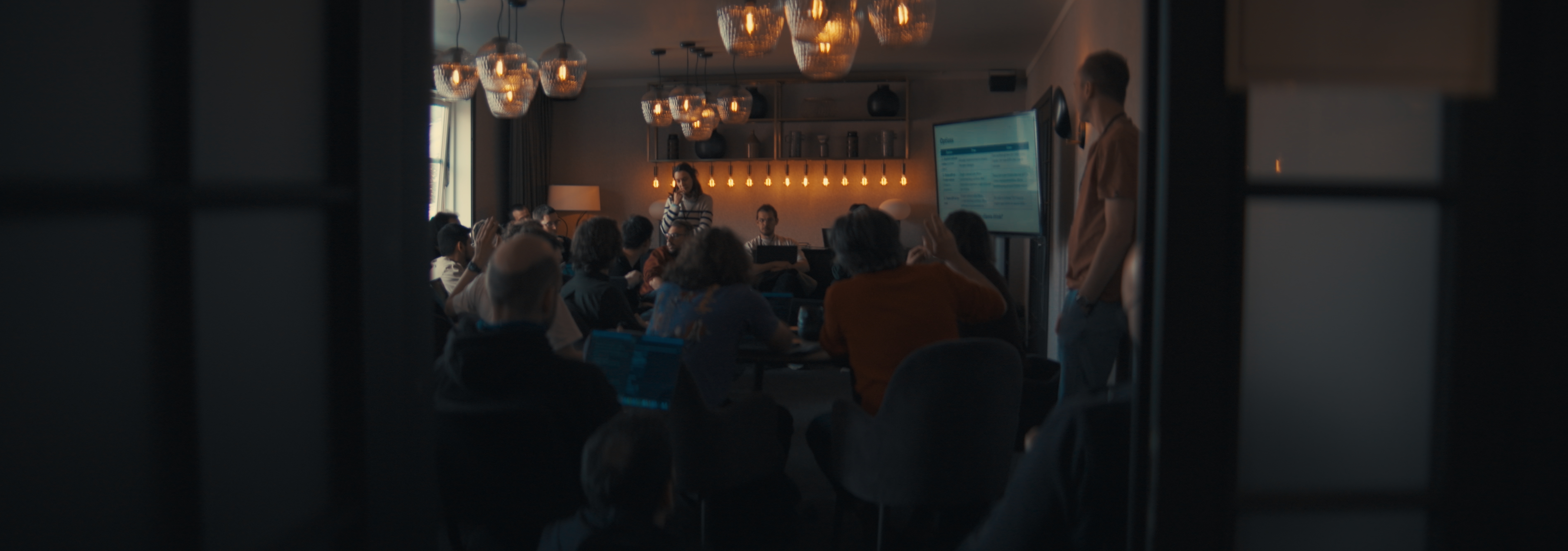
Beyond ePBS, BALs and repricings, most of the remaining Glamsterdam scope was hashed out across breakout sessions.
CL teams finalized decisions on smaller Glamsterdam EIPs: EIP-8061 (exit/consolidation churn increase) was included in glamsterdam-devnet-1; EIP-8080 (exits via the consolidation queue) was declined for inclusion; EIP-8045 (slashed-validator duty removal) was scoped down to proposer duties within the look-ahead window only; and EIP-7688 (SSZ stable containers) remains in Glamsterdam scope but is held out of glamsterdam-devnet-1 while the team works through bounded gossip-message size for attestations under progressive lists.
A Wednesday-morning EL/CL sync architecture breakout deferred EIP-8237 out of Glamsterdam in favor of preserving optionality for a longer-term “top-up sync” architecture in a future fork. In its place, the room agreed to draft an EIP that normalizes forkchoiceUpdated / newPayload / getPayload sequencing, specifies a snap-sync initiation handshake, and tightens valid/invalid consistency between the engine API surfaces.
Hardening was a constant theme of the week. A Thursday session covered fork-choice compliance testing frameworks, the Diamond repo of reproducible CL edge-case scenarios, and buildoor, PandaOps’s external-builder testing tool, demoed mid-session to a long stream of attack scenarios attendees suggested on the spot.
Beyond Glamsterdam
Several breakouts looked toward Hegotá and the forks that follow.
A deliberately proposal-agnostic session on native Account Abstraction kicked things off, working through the requirements and constraints any future design must satisfy. Feature-set goals like alternative signature schemes, aggregation, batching, recovery, gas sponsorship, flexible nonces, and keystore wallets sat alongside hard constraints around public-mempool compatibility, statelessness, and L2 DoS resistance.
A Thursday FOCIL breakout focused on implementation updates: early prototypes were already functional, with multi-client interop and a dedicated FOCIL devnet as the immediate next steps. Two notable design decisions were also made: disabling FOCIL during 2-epoch non-finality (mirroring proposer-boost circuit-breaker behavior), and adopting an index-based bookmark approach for compatibility with frame transactions / EIP-7702.
Further out, a long-running ETH P2P track sketched a QUIC-based replacement for libp2p with privacy-by-default and slot-aware integration, alongside an erasure-coded broadcast prototype that simulated ~6× faster propagation than GossipSub on 2.4 MB payloads. The CL track also surfaced strong sentiment toward eventually deprecating consolidations entirely — declaring a final fork that supports them, then forcing exit-then-redeposit afterwards — as the cleaner long-term answer to validator-set state growth.
ACD Process
On Wednesday afternoon, Nixo and Ansgar, the two ACDE co-leads, ran a session to collect input from core contributors about the ACD process. The session revisited the headliner construct, debated the pros and cons of having a strawmap, and formalized EIP SFI criteria. The room broadly wanted to keep headliners but loosen the EIP-vs-theme rigidity, accepting “theme + candidate EIP” as a viable pattern. The straw map’s per-fork year assignments past 2026 were flagged as overcanonicalized and likely to be softened. A new four-point SFI definition was put forward, with ACDT signaling readiness and ACDE/ACDC retaining the final call. A new prioritization-ordering process — produced after CFI decisions and reflected in the meta-EIP — will replace SFI’s old role of driving devnet inclusion, starting with Hegotá.
On the call-coordination side, Alex Stokes announced he will be taking a three-month sabbatical starting next week, with Pari covering ACDC moderation in the interim and Barnabas filling in for ACDT. All told: Nixo and Ansgar chair ACDE, Pari is interim on ACDC, and Mario, Barnabas, and Danceratopz rotate ACDT moderation.
Everything Else
In addition to all of the above, teams used the in-person time to make progress on everything from better test harnesses (compressing Hive feedback loops from hours to minutes), to engine-API plumbing improvements (gossip dedup, batched calls, and light-client-driven head discovery), to hard tradeoffs around client diversity, and many other topics. The full list of session notes is available at soldogn.xyz.

Next Steps
From here, teams head home to take what was prototyped during the week and make it production-ready. Expect the next several weeks to be heads-down on hardening client implementations against the new specs, finalizing test coverage, and turning Soldøgn’s draft PRs into merged code.
As always, the final decisions for values such as the 200M gas limit target and final repricing numbers will be made and shared publicly on AllCoreDevs calls. Expect these to be the major topics of the next week!
Thank you very much to everyone who came all the way up to 78°N and made this week a success! Special shout out to EthPandaOps for whipping the group into shape every day, and to everyone who worked under the midnight sun to make sure we hit our daily goals — including the Ethrex crew, joining us for their first interop. It was an incredibly productive week, and luckily we’ll have a full short film to remember it by ☀️


