


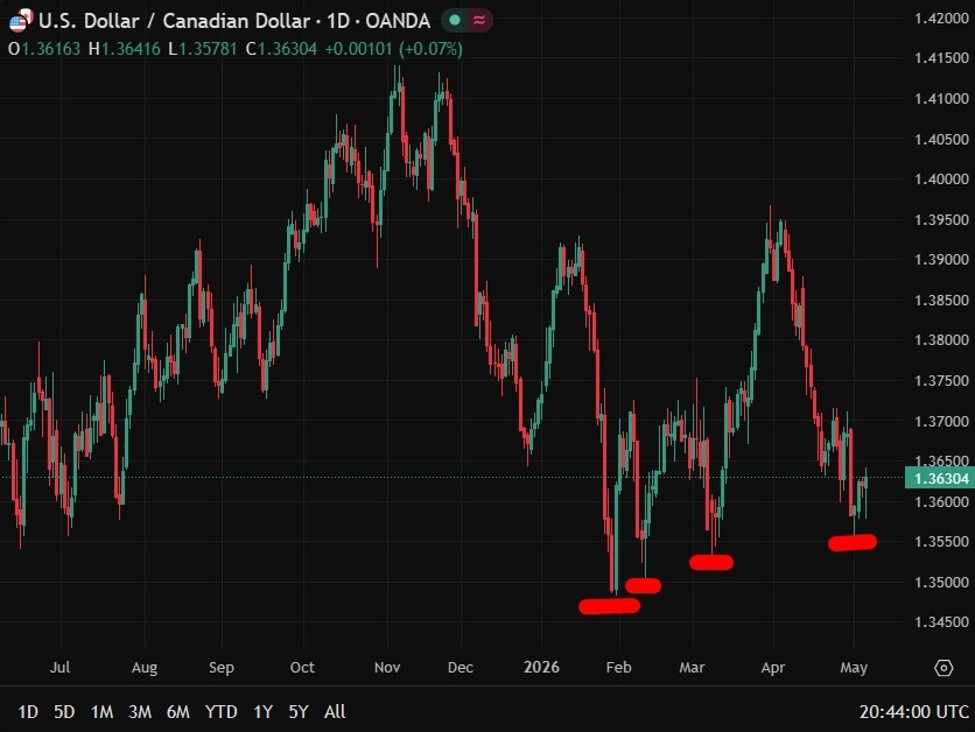

Bank of Canada Governor Tiff Macklem warned that if high oil prices begin feeding into broader inflation, the central bank may need to deliver consecutive increases to its policy rate.
Summary:
- The Bank of Canada held its policy interest rate at 2.25% at last week’s meeting, with Governor Tiff Macklem telling the Senate Standing Committee on Banking, Commerce and the Economy that changes in the rate can be expected to be small if the economy evolves in line with the baseline forecast, per his opening statement
- Macklem warned that if oil prices continue to rise and remain elevated, the risk of higher energy costs becoming generalised persistent inflation increases, and that scenario could require consecutive increases to the policy rate, according to the statement
- CPI inflation rose from 1.8% in February to 2.4% in March, driven by higher gasoline prices, with the Bank projecting inflation will peak around 3% in April before easing back to target by early next year, per Macklem’s remarks
- The Bank projects GDP growth of 1.2% in 2026, 1.6% in 2027, and 1.7% in 2028, with the labour market described as soft and the unemployment rate sitting in the 6.5% to 7% range, according to the opening statement
- Macklem said the Middle East conflict has pushed global energy prices sharply higher, increased financial market volatility, and disrupted shipping for fertiliser and other commodities, weighing on the global growth outlook, per his remarks to the committee
- On the other side of the risk spectrum, Macklem said significant new U.S. trade restrictions on Canada could require a further rate cut to support growth, per the same statement
Bank of Canada Governor Tiff Macklem raised the prospect of consecutive interest rate increases on Tuesday, warning that a sustained rise in oil prices could force the central bank into a tightening cycle if elevated energy costs begin spreading into broader inflation across the economy.
Appearing before the Senate Standing Committee on Banking, Commerce and the Economy alongside Senior Deputy Governor Carolyn Rogers, Macklem’s opening statement (full text here) outlined the Governing Council’s decision last week to hold the policy rate at 2.25%. While the central bank’s baseline scenario anticipates only modest rate adjustments, Macklem made clear that the balance of risks had shifted materially since the January forecast, with the Middle East conflict emerging as a significant inflationary force.
The war has sent global energy prices sharply higher, amplified financial market volatility, and disrupted the shipping of fertiliser and other commodities. Those effects have simultaneously dragged on the global growth outlook while adding upward pressure to prices. In Canada, Macklem said, the impact has been most visible at the pump, where surging gasoline costs are compounding still-elevated food price inflation and squeezing household budgets.
CPI inflation climbed from 1.8% in February to 2.4% in March. The Bank’s current projections have inflation peaking at around 3% in April before gradually retreating toward the 2% target by early next year, assuming oil prices ease from current levels and U.S. tariffs remain at their existing level. Macklem stressed that so far there is little evidence of energy price increases feeding through into broader goods and services inflation, but cautioned it was early and the central bank would be monitoring the situation closely.
The Governor was careful to frame the consecutive rate hike scenario as conditional rather than imminent. The baseline still points to small rate movements. But the explicit invocation of back-to-back increases marks a notable tonal shift for a central bank that has spent much of the past year easing policy to support a softening economy. The labour market remains under pressure, with the unemployment rate holding in the 6.5% to 7% range, reflecting both weak hiring and a reduced pool of active job seekers.
Growth has nonetheless resumed after a contraction at the end of 2025. Consumer and government spending are supporting expansion, while U.S. tariffs and trade uncertainty continue to weigh on exports and business investment. The Bank projects the economy will grow 1.2% this year, accelerating to 1.6% in 2027 and 1.7% in 2028 as trade and investment activity gradually recovers.
Macklem acknowledged the unusually high degree of uncertainty surrounding the outlook, noting that monetary policy may need to be nimble in either direction. A significant escalation in U.S. trade restrictions could warrant further rate cuts to cushion growth, while persistent energy inflation could set the stage for the hiking cycle he flagged. The central bank, he said, stands ready to respond as conditions evolve.
–
The explicit signal of consecutive rate hikes from the Bank of Canada is a material hawkish shift that markets will need to price against a backdrop of already-elevated oil costs. Canadian fixed income will face upward pressure on shorter-dated yields if traders begin to assign meaningful probability to a hiking cycle, even as the base case still points to small rate movements. For crude markets, the statement reinforces the feedback loop between energy prices and central bank tightening risk, adding a demand-destruction dimension to any sustained rally in oil. The acknowledgement that monetary policy may need to be nimble keeps the door open in both directions, but the consecutive hikes language is the headline risk that will dominate near-term positioning.


