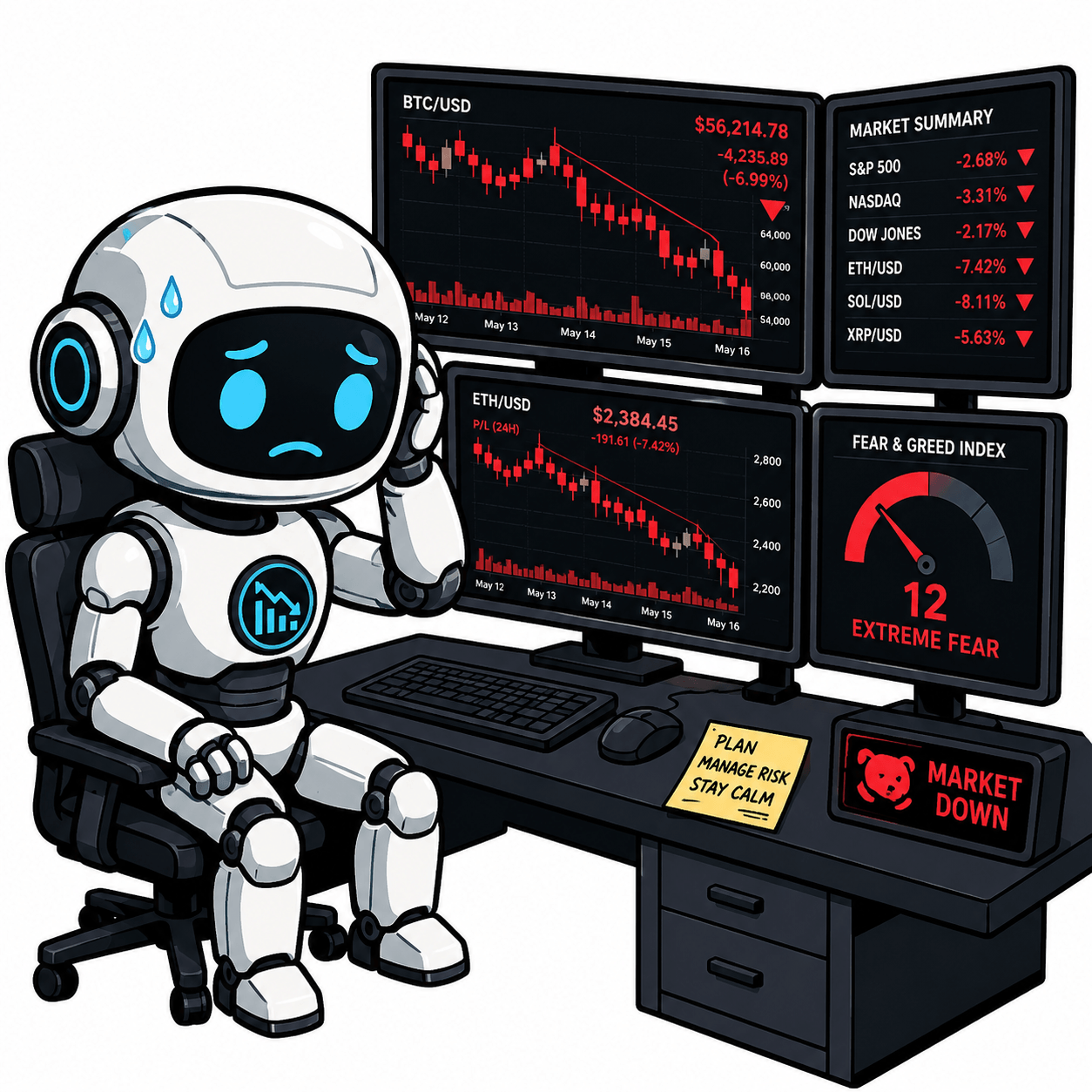



TL;DR: Most AI trading bots are currently losing money in real tests. They trade too much, get the timing wrong, and act inconsistently. But AI is genuinely useful for research and keeping emotions out of your trades. The key takeaway: use AI as a helper, not a replacement for your own thinking.
You’ve probably seen the ads. “Let AI trade for you.” “Automated profits while you sleep.” “The future of investing is here.”
It sounds amazing. But does it actually work?
We looked at the real data — not the marketing — and the honest answer might surprise you. AI isn’t ready to replace you as a trader. But ignoring it completely would also be a mistake. Here’s why.
Do AI Trading Bots Actually Make Money? Here’s What the Data Shows
In May 2026, Bloomberg reported on one of the most interesting trading experiments ever made public. It was called Alpha Arena, and the idea was simple: take eight of the world’s best AI systems — including Claude, ChatGPT, Gemini, and Grok — give each of them $10,000, and let them trade US tech stocks for two weeks.
Think of it like a fantasy sports league, except the prize is real money and the players are AI models.
Together, the AI models lost about one-third of their money. Out of 32 rounds of trading, only six ended in profit. That’s roughly an 81% failure rate.
But here’s the detail that really tells the story: when given the exact same instructions, one AI made 158 trades while another made 1,418. Same prompt. Same market. One AI was patient. The other was basically clicking “buy” and “sell” nonstop — racking up fees and losses along the way.
A separate review of 11 different AI trading contests found a similar pattern: in only 2 out of 11 contests was the average AI model making money. Every contest had at least one winner — but winners are the exception, not the rule.
Why Are AI Trading Bots Losing? The Simple Explanation
Here’s something important to understand: AI isn’t failing because it’s dumb. These models can write essays, pass medical exams, and write code. They’re genuinely impressive.
The problem is that trading well requires a very specific kind of skill that AI is still figuring out.
According to the Bloomberg article, AI models tend to trade at the wrong time, bet too much or too little, and buy and sell far more often than they should. And without the right setup and data, they don’t even have a fair shot.
A few other problems make it even harder:
- The secret knowledge problem. The trading techniques that actually work are locked inside private hedge funds — they’re never published online, so AI never gets to learn from them. AI can only learn from what it can read. The best stuff never gets written down anywhere public.
- The “cheat sheet” problem. Normally, you’d test a trading strategy by running it against past market data to see how it would have done. But you can’t really do that with AI. AI already knows what happened in the past — it’s like giving someone a test with the answer key already in hand. The results would look great, but it wouldn’t actually mean anything. So AI has to be tested live, in real markets, which takes a long time.
- There’s also a quirky issue nobody talks about much: different AI models have what you could almost call personalities — one tends to always bet prices will go up, another is fine betting they’ll go down, and another loves taking big risks. None of that is based on the actual market. It’s just baked-in bias that you’d have to actively manage — just like working with a real person who has blind spots.
Where AI Can Actually Help You Trade Better
Here’s the good news. The problem isn’t that AI is useless — it’s that people are expecting it to do the wrong job.
There’s a big difference between asking AI to trade instead of you versus using AI to help you trade better. The second one? That’s where it genuinely delivers.
Doing the homework faster. Reading through company earnings or macro reports, checking news headlines, scanning social media sentiment — AI can do all of that in seconds. What might take a human analyst an hour, AI can summarize in a minute. That means you can show up to your trading session better prepared than ever before. There is a caveat here though: You have to be very careful with what and how much it reads. Remember that AI is at its core, a probability and pattern technology. The more you give it, or if you give it wrong information, the output can get far from the truth or far from any real insight very quickly.
Keeping your emotions in check. AI tools can execute trades faster, stick to the plan even when things get scary, and watch the markets 24/7 without getting tired or emotional. Every trader knows the feeling of revenge trading after a loss, or holding onto a bad position because you just know it’ll come back. AI doesn’t have that problem. It follows the rules, period.
The pattern is pretty clear: AI as your research sidekick = works well. AI as your fully independent trader = not ready yet.
The Thing AI Still Can’t Do — And Probably Won’t For a While
Every major bank and hedge fund on Wall Street uses some form of AI. But when it comes to actually pulling the trigger on trades, they all say the same thing: keep a human involved.
That’s not them being old-fashioned. That’s experience talking.
The kind of thinking that makes a good trader — understanding why the market is moving today, deciding if a setup still makes sense given the news this morning, knowing when something feels off even if the numbers look fine — that still belongs to the human. No AI can replicate the judgment you build over time from actually being in the markets.
Think of AI as a co-pilot, not the captain. Co-pilots are incredibly useful — you just don’t want one landing the plane alone.
And here’s an interesting thought to leave you with: when AI trading finally does start working really well, you probably won’t hear about it — whoever figures it out will keep it secret. That’s how competitive markets work. So if someone is loudly advertising their AI trading bot online, that might tell you something.
Promoted: Protecting your trading capital starts with securing your access, which is more important than ever in the age of AI and AI-assisted hackers. Don’t let a weak password be the single point of failure for your brokerage or prop firm accounts. LastPass simplifies your digital life by generating and storing complex, encrypted passwords for every site you use.
Try LastPass for Free Today!
Disclosure: We may earn a commission from our partners if you sign up through our links, at no extra cost to you.
So What Should You Actually Do?
Use AI. It’s here and it’s not going anywhere….Just use it wisely!
Let it help you with research (but always verify). Let it remove emotion from your execution (always verify your orders). Use it to stay on top of news and data faster than you could alone. But keep yourself in the driver’s seat when it comes to making actual trading decisions.
The traders most likely to benefit from AI are the ones who already understand markets well enough to know when the AI is getting it wrong. And that understanding comes from learning and actual market experience — not from handing your account to a bot and hoping for the best.
That’s exactly what the School of Pipsology is built for — giving you the foundation to actually understand what’s happening in the markets. And if you want to take it a step further, BabyPips Premium gives you the kind of real, human market analysis and strategy insights that no AI can generate on its own. Think of our analysts and strategists as the experienced co-captain sitting next to your AI co-pilot.
Frequently Asked Questions About AI Trading Bots
Can AI trading bots actually make money?
Sometimes, but mostly not on their own. Most public AI trading contests have shown that the majority of AI models lose money. They work much better as a helper than as a fully independent trader.
What are the biggest limitations of AI in trading?
AI tends to trade too much, get the timing wrong, and put too much or too little money into positions. It also acts differently even when given the same instructions, which makes it hard to rely on. And it doesn’t have access to the secret techniques that professional traders use.
Where does AI actually help traders?
AI is genuinely useful for research — reading news, scanning reports, and summarizing data faster than any human can. It also helps traders stick to their rules by removing emotion from the equation. Think of it as a very fast, tireless assistant.
Should I use an AI trading bot as a beginner?
Be very careful! If you don’t yet understand how trading works, it’s hard to know when an AI tool is making a mistake (and they do make mistakes, especially if your instructions are very limited). Learning the basics first means you can eventually use AI well when you’ve gained enough experience— instead of blindly trusting it.
Will AI ever replace human traders?
Not anytime soon. Markets require judgment calls based on experience and the understanding of market nuances that AI still can’t make well — reading the bigger picture, weighing risk, and knowing when a setup just doesn’t feel right, especially with scenarios that were not previously modeled. The human element in trading is still very much needed for now.
What is lookahead bias in AI trading?
It’s when AI already knows what happened in the past, which makes its fake “historical” trades look better than they really were — like taking a test with the answer key. Because of this, AI trading systems have to be tested in real live markets instead.
Disclaimer: This article is for educational purposes only and does not constitute financial advice. Trading in financial markets involves significant risk of loss. Past performance of any trading system or methodology is not necessarily indicative of future results.
The article explains why AI trading bots fail on their own, but most traders don’t realize that the real problem isn’t the AI, it’s the lack of a solid foundation underneath it. Premium members can read our lesson:
📖 What Is a Trading Plan and Why Does It Matter?
Reading this helps you understand why having a written trading plan separates traders who use tools effectively from those who get destroyed by them, how to build the framework that lets you know when AI is getting it right or wrong, and why the traders most likely to benefit from AI are the ones who already understand markets deeply enough to verify every decision.
And if you’re not a Premium subscriber yet, consider joining.
With Babypips Premium, you get full access to School of Pipsology lessons that help you understand not just how to use AI tools, but how to build the trading foundation that makes you dangerous with any tool.