


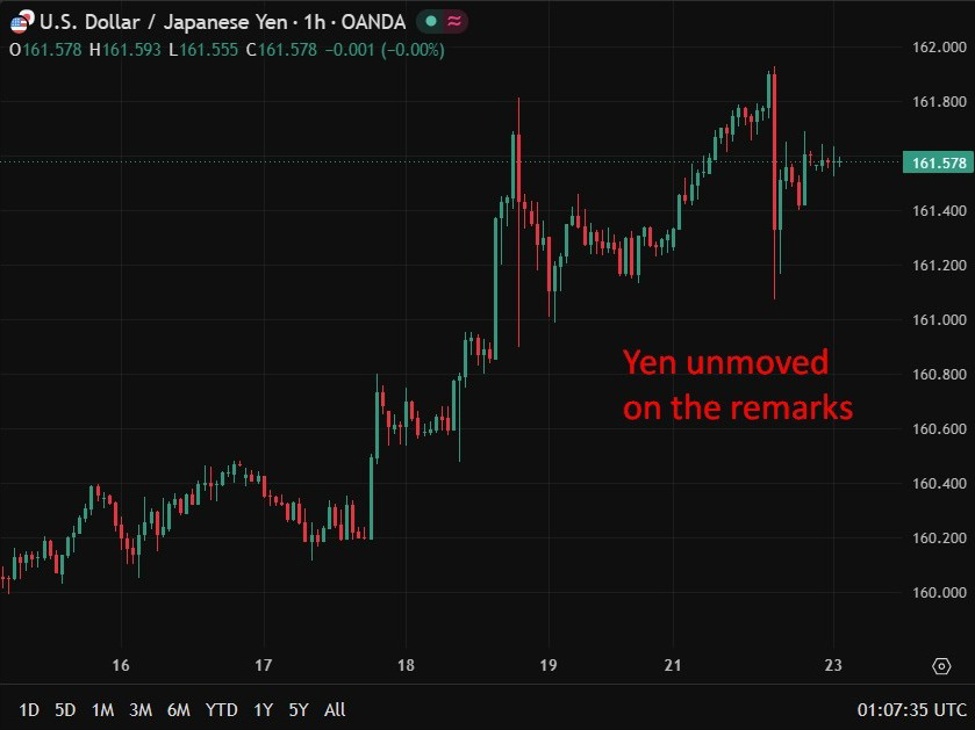

The confirmation by Katayama herself adds official weight to what was earlier reported only through TBS sources, but the market reaction has been telling: USD/JPY has been largely unmoved on the headlines, suggesting traders are reading the statement as maintenance of existing frameworks rather than a signal of imminent intervention. The explicit reference to a pre-existing agreement on taking decisive steps is the language Tokyo uses to keep intervention optionality alive without committing to a timeline, a formulation the market knows well and has learned not to front-run without a more direct trigger. The decision to frame the call as a G7 follow-up rather than an emergency response to yen weakness is a deliberate piece of communication management, softening the urgency of the exchange. Katayama’s refusal to comment on FX levels is standard protocol but notable given where the yen is trading, and the nearly one-hour duration of the call suggests the conversation went well beyond a routine post-summit check-in.
Japan’s Finance Minister Katayama confirmed she held nearly an hour of talks with US Treasury Secretary Bessent on Monday, reaffirming a bilateral pact on decisive market steps and declining to comment on FX levels.
Summary:
- Japanese Finance Minister Katayama confirmed she held an online meeting with US Treasury Secretary Scott Bessent on Monday lasting nearly one hour, characterising it as a follow-up to the G7 summit, according to statements made by the minister on Tuesday
- Katayama said discussions covered global financial markets and the impact of the Iran conflict, and that she had a good discussion on global economic matters with Bessent, per her comments
- The minister reaffirmed that Japan and the US have a pre-existing agreement on taking decisive steps regarding markets, and said there had been no change to that arrangement, according to her statements
- Katayama said she and Bessent reaffirmed bilateral coordination on markets during the call, per her comments
- The minister declined to comment on foreign exchange levels, per her statements
- USD/JPY was largely unmoved on the confirmation of the talks, with the market interpreting the language as a restatement of existing frameworks rather than a signal of imminent intervention
Japanese Finance Minister Aiko Katayama has personally confirmed that she held an online meeting lasting nearly one hour with US Treasury Secretary Scott Bessent on Monday, elevating what had earlier been reported through broadcaster TBS sources into an official acknowledgement and adding fresh detail on the scope and tone of the exchange.
Katayama described the call as a follow-up to the G7 summit, a framing that positions the discussion within the normal machinery of international economic coordination rather than as an emergency response to the yen’s slide toward historically sensitive levels. She said the two officials discussed global financial markets and the impact of the Iran conflict, and characterised the overall exchange as a good discussion covering global economic matters.
The most closely watched element of her remarks was the reaffirmation of what she described as a pre-existing bilateral agreement on taking decisive steps, language that keeps Japan’s intervention optionality firmly intact. She said there had been no change to that arrangement and that she and Bessent had reaffirmed coordination on markets, a formulation Tokyo has used in previous intervention cycles to signal that the two governments remain aligned on the conditions under which action could be taken. Katayama declined to comment on foreign exchange levels, adhering to the standard ministerial protocol that avoids giving the market a specific target to trade against.
The yen had briefly touched around 161.9 on Monday, a whisker short of the two-year low set the previous week. A move above 161.96 would take the currency to its weakest since 1986, a threshold that has been widely discussed as a potential trigger for intervention. Tokyo spent a record 11.7 trillion yen, equivalent to approximately $72.44 billion, defending the currency in the late April to early May period, the largest foreign exchange operation in Japanese history.
Despite the weight of the official confirmation and the proximity of the yen to historically sensitive levels, USD/JPY was largely unmoved on Katayama’s remarks. The market’s muted response reflects a well-established pattern: investors have learned to distinguish between the maintenance of intervention rhetoric, which Tokyo deploys consistently when the yen is under pressure, and the harder signals that have historically preceded actual market operations. For now, the language remains in the former category, and traders are pricing accordingly.


