



Key Takeaways
- Drift’s $3.11 million pool initially pays roughly 1 cent per dollar of verified losses.
- Tether has committed up to 127.5 million USDT, but that money wasn’t in the pool at launch.
- DFX holders can redeem, sell or wait as Velocity revenue and recovered assets enter the pool.
A $1,000 Loss Is Worth About $10 Today
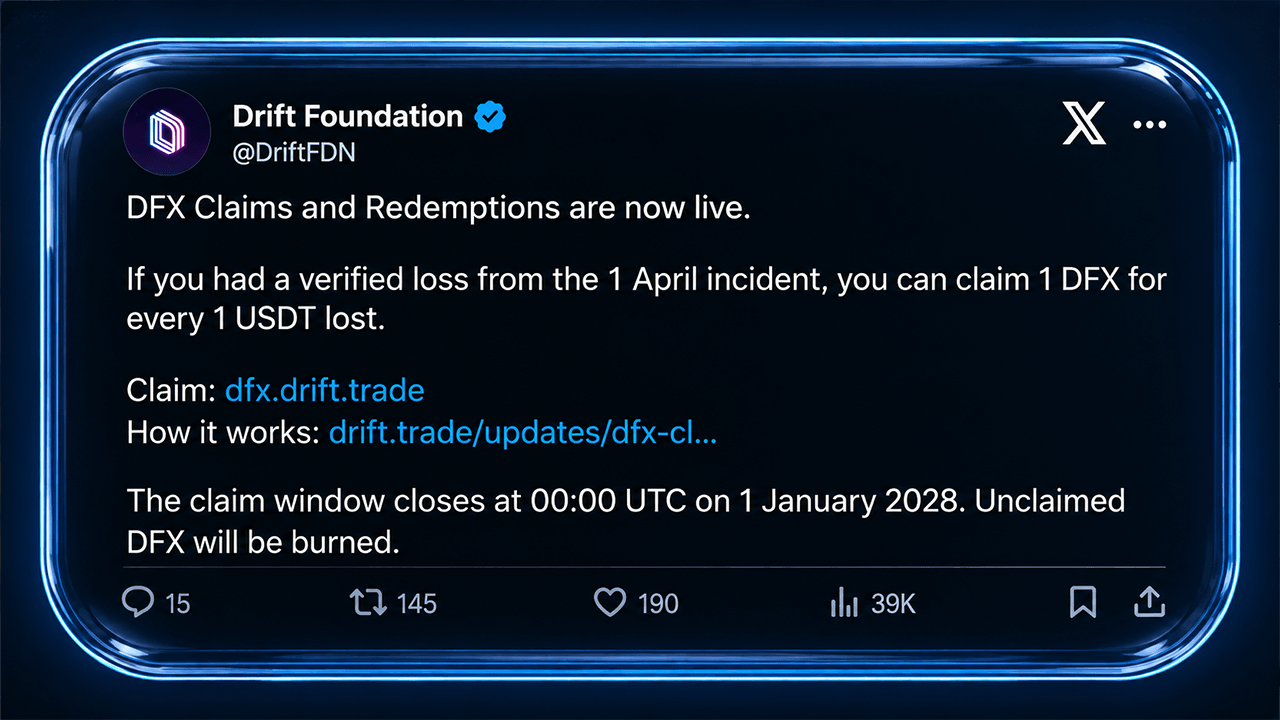
Six months after one of crypto’s biggest heists of 2026, Drift victims finally have a button they can press to get money back. Press it today, however, and a verified $1,000 loss produces roughly $10.40. Drift opened claims Oct. 1 for DFX, a Solana recovery token representing money lost in the April 1 exploit.
Nearly $295.4 million in verified losses are waiting on the other side, while the recovery pool began with about $3.11 million. Victims now face a peculiar wager. Take the penny-on-the-dollar payout, sell the token, or sit tight and hope a much larger pot eventually arrives.
The Drift Foundation’s setup is interesting, to say the least. “DFX is one token for every verified USDT lost in the April incident,” the drift.trade claim page explains. Supply is fixed at 299,500,810.998 DFX, with the foundation saying “no new DFX will ever be minted.” Divide today’s pool by that mountain of tokens, and the arithmetic gets ugly fast. At launch, each DFX could be redeemed for about 0.0104 USDT.
The foundation puts the choice plainly. Holders can “Redeem: burn DFX and receive USDT,” “Sell: transfer DFX or trade it on secondary markets such as Raydium,” or “Hold: keep your claim on the Recovery Pool as deposits arrive and supply falls.” Cash out, though, and that’s your lot. “Redemptions are final,” the website states.
The Pot Is Supposed to Get Bigger
The scheme’s saving grace is that $3.11 million isn’t intended to be the final recovery pool. Velocity, Drift’s rebuilt and rebranded exchange, funnels part of its daily net protocol revenue into it. Tether has committed up to 127.5 million USDT, while strategic partners have pledged another 20 million USDT. Recovered stolen assets are also supposed to land in the pot. But commitments aren’t cash.

By the first Friday after claims opened, about 216,480 DFX had been redeemed for roughly 2,250 USDT, while Velocity’s first daily revenue sweep contributed just 31 USDT. The big partner money had yet to arrive. The foundation says the mechanics favor whoever waits. “Three properties define DFX: the Recovery Pool only grows, the Redemption Amount never falls, and supply only shrinks,” the foundation’s claim portal documentation notes.
If 10% of DFX disappears through redemptions, every surviving token receives roughly 11% more of future deposits. Unclaimed tokens get the ax after the claim window closes Jan. 1, 2028. Still, Drift is careful not to promise a payday. The claim portal documentation adds:
“These figures illustrate the mechanics. They are not a projection or a promise.”
The $285 Million Heist Behind the Token
The whole contraption exists because attackers pulled off an extraordinary caper on April 1. Investigators say a North Korea-linked group spent months masquerading as a quantitative trading firm before tricking Drift Security Council members into pre-signing transactions. At about 16:05 UTC, those signatures handed the attackers administrative control.
They then listed a worthless token called CVT as collateral, deposited 500 million tokens against an artificial price near $1 and withdrew real assets. Chainalysis estimated roughly $285 million was drained, including about $159.3 million in JLP and $71.4 million in USDC. The haul moved fast. Assets were swapped and bridged to Ethereum within minutes.
Victims Are Now Betting on the Recovery
Most of that loot remains beyond reach. Drift said Sept. 30 that roughly 130,259 ETH sat across four Ethereum wallets. About 23,094 ETH had already traveled through the ETH mixer Tornado Cash, while roughly $9.2 million had been frozen elsewhere. Any money recovered through freezes, law enforcement or a public bounty is supposed to flow into DFX. A bounty operated by Bybit offers 10% of assets actually recovered.
That leaves victims with one of the stranger financial instruments born from a crypto hack. Their losses have become freely tradable tokens whose redemption value rises as cash enters the pool and competing claims disappear. The foundation sums up the bargain neatly: “That is for the market to decide.” For someone missing $1,000, the market’s opening answer is about $10.40.