



Key Takeaways
- Four Zcash groups were awarded a combined $400,000, with Grayscale planning a total $1 million in grants.
- Grayscale plans to reinvest 100% of fund management fees for up to a year.
- Campaign placements included a newspaper wrap and full-page ZCSH ad.
Four Zcash Groups Receive Initial Grant Awards
Grayscale launched Zcash Invest on Nov. 10 and committed $1 million to organizations and initiatives supporting the network. Its $1 million funding commitment included an initial $400,000 awarded through four equal grants. The recipients were the Zcash Foundation, Pretty Good Policy for Zcash, Shielded Labs, and Project Tachyon.
The foundation supports open-source development and financial privacy research, while Pretty Good Policy for Zcash is a nonprofit advocacy group educating policymakers. Shielded Labs, a Swiss-based organization, researches and develops Zcash network technology. Project Tachyon is a protocol initiative led by one of Zcash’s co-founders intended to help wallets update faster and process more private transactions.
Steve Vanourny, Grayscale’s head of index, stated:
“We believe Zcash will help define the next era of crypto.”
He linked financial privacy demand to growing blockchain activity and AI’s ability to analyze it. His comments also identified quantum computing as a future technological challenge.
National Campaign Reaches The Wall Street Journal
Zcash Invest targets investors and advisers through a website, social media presence, and educational content. The Zcash investor education platform also highlights the Zcash ETF, a fund holding ZEC whose shares trade under ticker ZCSH. Its launch accompanied the national campaign “Zcash: The Next Era of Crypto.”
Newspaper placements included a front-page wrap promoting Zcash and a full-page interior advertisement highlighting ZCSH in The Wall Street Journal. Zebra-striped artwork drew on imagery associated with the Zcash community. Planned distribution spans print, outdoor advertising, digital media, streaming, and social channels, alongside events and educational material.
Growing analytical capabilities underpin Grayscale’s financial privacy argument: AI could connect public blockchain activity with real-world identities. Zcash supports transparent transactions and shielded transfers, which conceal payment details. These private payments use cryptographic proofs to validate transactions without revealing sender and recipient addresses or amounts.
Fund Fees Back Development as ZEC Falls
Grayscale intends to reinvest 100% of the sponsor fees it receives from ZCSH for up to 12 months following the registration statement’s effectiveness. These management fees would support the fund and Zcash development, marketing, and education. Grayscale pays from its own funds after receiving the fees, and may modify or discontinue the voluntary undertaking.
ZCSH began trading on NYSE Arca on Aug. 25, following its 2017 private-placement launch and 2021 over-the-counter trading debut. Brokerage shares provide indirect ZEC exposure. Despite its ETF name, the product is not registered under the Investment Company Act of 1940, which governs conventional mutual funds and ETFs.
Shareholders gain exposure without buying or safeguarding tokens, avoiding the wallet-management requirements associated with holding cryptocurrency directly.
Security concerns prompted Zcash’s Ironwood network upgrade on July 28 after a vulnerability was discovered in Orchard, a system for holding and transferring ZEC privately. Ironwood introduced a replacement shielded pool and capped withdrawals from Orchard at verifiably deposited amounts, limiting movement of hypothetical counterfeit coins.
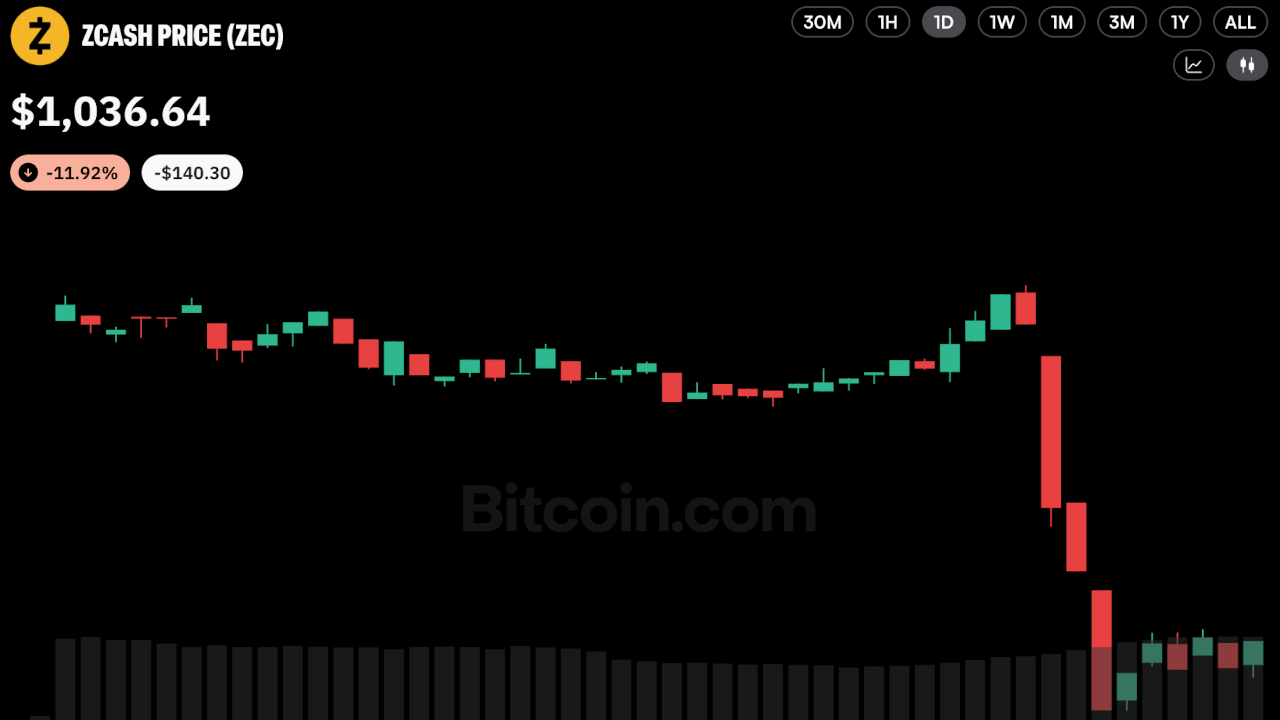
As of this writing, ZEC traded at $1,033 on Nov. 10, down about 12% over the last 24 hours. That’s up slightly from a low of $999.57 earlier Tuesday—the lowest price registered for the privacy coin since early September. Even so, at its current price, ZEC has more than doubled in value since the start of the year.