




Key Takeaways
- Glassnode’s latest assessment exposes a curious contradiction beneath bitcoin’s seemingly exhausted market.
- Options traders are preparing for several possibilities, but a looming expiration could complicate their positioning.
- Millions of dollars in prediction market activity reveal a striking divide between bitcoin’s near-term prospects and its more ambitious price targets.
Analytics Firm Glassnode Warns Capital Keeps Leaving
Glassnode published its latest assessment on the social media platform X on Wednesday, Nov. 11, under the rather ominous title “Running on Empty.” Its central argument is that bitcoin’s price recovery prospects are being constrained by disappearing liquidity, weakening American demand, and mounting pressure on relatively recent investors.
“Bitcoin has slipped below the short-term holder cost basis at $75.6K and trails stocks, while the capital that could lift it keeps leaving,” Glassnode explained. The analytics firm added:
“Stablecoin supply is shrinking at the fastest pace since June 2022, the ETFs are net sellers, and bitcoin trades at a discount on Coinbase.”
Indeed, Glassnode estimates that stablecoin supply contracted by $14.2 billion over 30 days, while U.S. spot bitcoin exchange-traded funds (ETFs) experienced $1.6 billion in net redemptions across 20 trading sessions. Coinbase’s bitcoin premium has also remained negative, reaching its deepest discount since February.
Meanwhile, approximately 35% of short-term holder coins remain profitable, compared with nearly all such holdings at September’s high. Glassnode identified considerable overhead supply extending toward $83,600, potentially complicating recovery attempts as underwater investors seek opportunities to exit.
Nevertheless, the situation is hardly one-sided. “On the other side, the slide has cleared most long leverage near price, bids outweigh asks in the order book, and two large wallet cohorts have started accumulating,” the firm observed. Wallets holding 100 to 1,000 BTC and 1,000 to 10,000 BTC have resumed accumulation, although smaller investors and the largest holders continue distributing.
Glassnode identified substantial resting bids between $68,000 and $72,500, alongside a liquidation concentration between $59,500 and $62,600. Above prevailing prices, comparatively sparse order-book liquidity extends toward $84,000, while short liquidations cluster near $87,500. “The September high was the first higher high since the 2025 all-time high, and that trend change holds as long as price stays above the June low at $58.5K,” Glassnode stated.
Its immediate technical markers include $75,600 for the short-term holder cost basis, $77,500 for the true market mean, and $77,800 for bitcoin’s election-day closing level.
Are Bitcoin Options Traders Preparing for a Recovery or Further Trouble?
Compounding on what Glassnode sees right now, Coinglass derivatives figures reveal a market balancing longer-term optimism against immediate downside protection. Bitcoin options open interest stands at 439,966 BTC, approximately $33 billion, with calls representing 55.72% and puts accounting for 44.28%. The resulting put-to-call ratio of 0.79 suggests upside exposure retains a modest advantage.
The largest options exchange by volume, Coinbase’s Deribit, dominates the largest outstanding contracts. Its Nov. 13 $81,000 call carries 8,305.9 BTC in open interest, followed by the Dec. 25 $80,000 call with 8,113.9 BTC and the $100,000 call with 6,612.7 BTC. December positioning also includes 6,520.6 BTC in $60,000 puts, 5,842.1 BTC in $120,000 calls, 5,518.8 BTC in $40,000 puts, and 5,403.9 BTC in $90,000 calls. Another 5,200.8 BTC sits in Nov. 13 $84,000 calls.
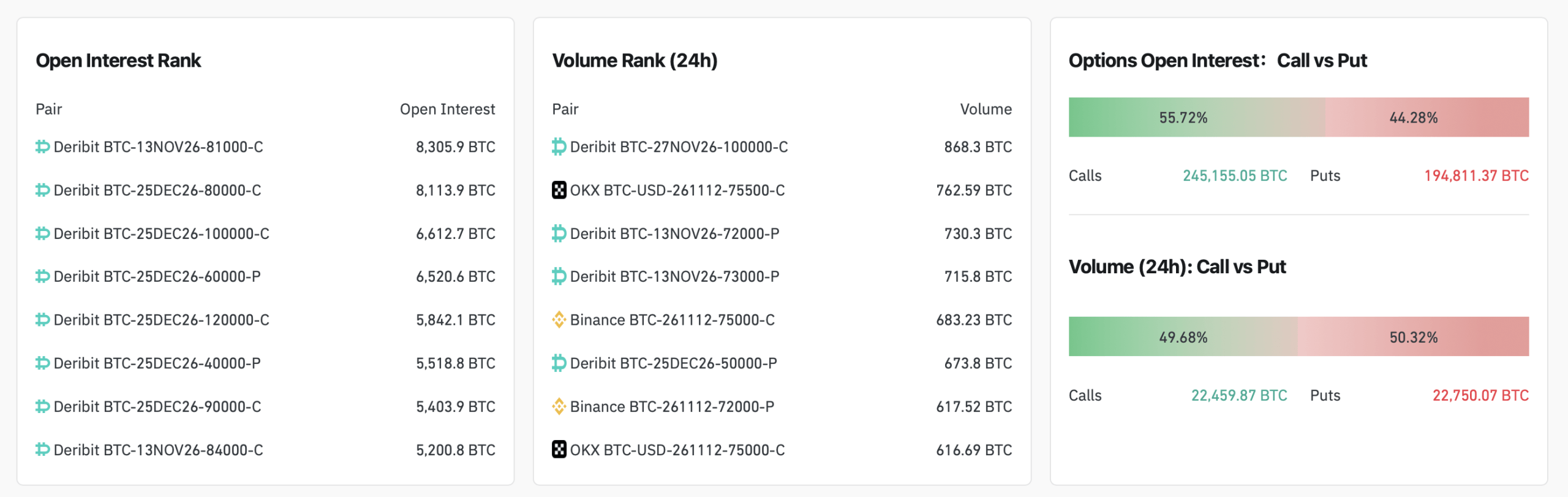
The November $81,000 and $84,000 contracts collectively represent approximately $1 billion in notional exposure, although bitcoin would need a substantial recovery before Friday’s expiration. Recent trading presents a more defensive picture. Across 45,210 BTC in 24-hour options volume, puts accounted for 50.32%, narrowly exceeding calls at 49.68%.
Activity concentrated around Nov. 12-13 contracts struck between $72,000 and $75,500. Particularly active were Deribit’s $72,000 and $73,000 puts, with respective volumes of 730.3 BTC and 715.8 BTC. Other notable contracts included Deribit’s Nov. 27 $100,000 call at 868.3 BTC and Dec. 25 $50,000 put at 673.8 BTC.
Historically, options open interest peaked near $65 billion in October 2025, declined rapidly toward $25 billion after December’s expiration, and briefly recovered to approximately $53 billion in September 2026. Deribit trading volume likewise reached approximately $11.5 billion during September, compared with roughly $5 billion amid this month’s retreat.
What Are Prediction Markets Saying About Bitcoin’s Next Price?
Prediction markets offer another perspective, with four markets across Polymarket and Kalshi reflecting substantial differences between near-term price touches and year-end outcomes. Polymarket’s November bitcoin price market has attracted $5.17 million across 28 targets. Traders assign a 91% probability to touching $75,000, 62% to $77,500, and 39% to $80,000. Conversely, downside probabilities stand at 73% for $72,500, 50% for $70,000, and 18% for $65,000. Reaching $100,000 commands just 1%.
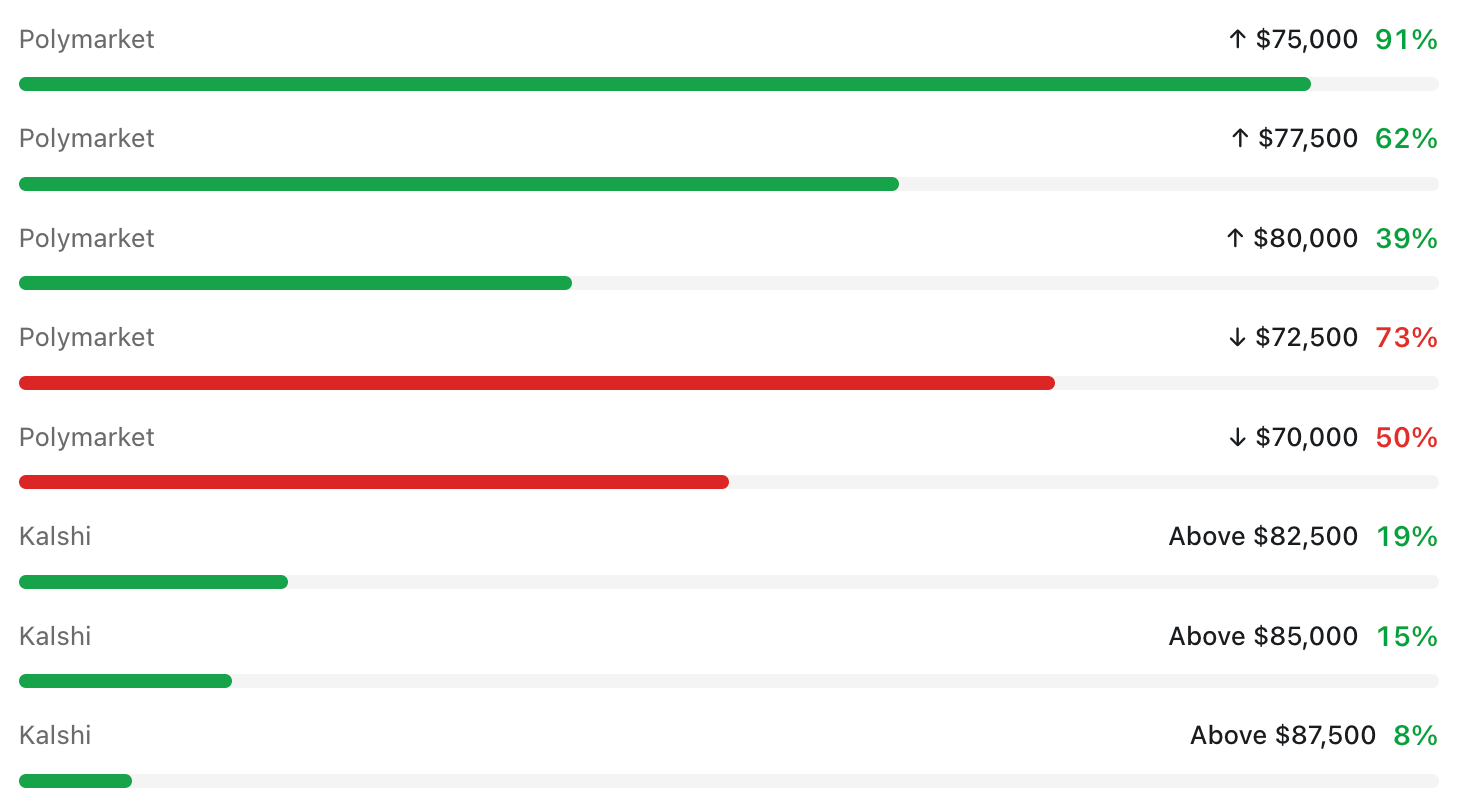
Polymarket’s broader 2026 price-touch market has accumulated $84.26 million. Its probabilities include 61% for $70,000, 34% for $65,000, and 20% for $60,000. Upside targets receive 18% for $90,000, 6% for $100,000, and less than 1% for $250,000. At the same time, Kalshi’s November maximum-price market, with $1.34 million in volume, assigns 19% to exceeding $82,500, 15% to $85,000, and 8% to $87,500.
Kalshi’s separate $46.75 million year-end settlement market favors a narrower outcome. The $70,000-$74,999.99 bracket leads at 18.9%, followed by $75,000-$79,999.99 at 18.5%, and $65,000-$69,999.99 at 13%. Crucially, these contracts measure different outcomes. Polymarket’s price-touch contracts settle when specified thresholds are reached, while Kalshi’s year-end market concerns bitcoin’s actual closing range.
Taken together, Glassnode’s latest liquidity warning, defensive options activity, and seemingly bearish prediction market probabilities portray an uncertain market rather than an inevitable collapse. Large holders are accumulating, yet broader capital flows remain unfavorable. Bitcoin’s immediate challenge is not simply attracting buyers, but demonstrating that renewed demand can outlast the selling pressure already embedded in its market structure.