



Key Takeaways
- Polymarket and Kalshi traders increasingly favor lower bitcoin price targets, although the odds vary considerably by expiration date.
- Options trading shows greater activity in puts than calls, despite substantial outstanding bullish positions for December.
- Bitcoin’s technical indicators remain bearish, while the Crypto Fear and Greed Index registers 11 out of 100.
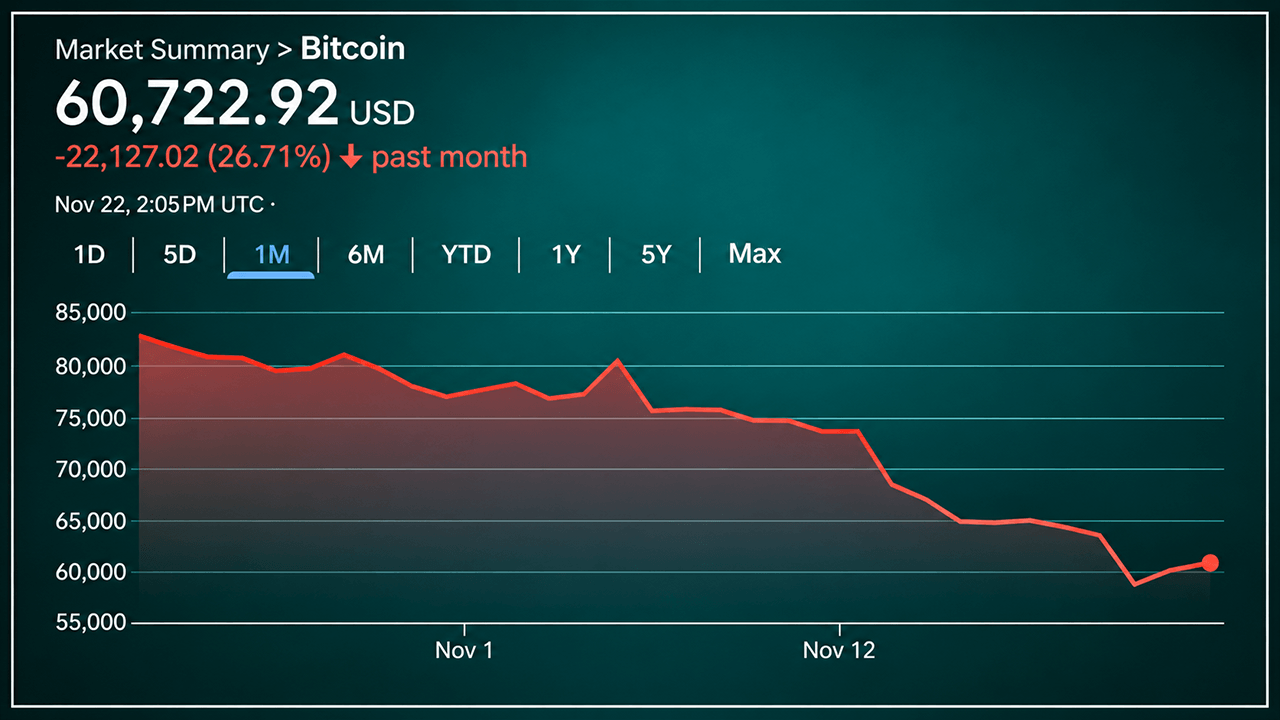
Bitcoin’s price traded at $60,634 during Sunday’s trading session at 9:00 a.m. Eastern time, carrying a $1.22 trillion market capitalization and $36.145 billion in 24-hour trading volume. The leading digital asset by market valuation traded between $55,081 and $61,447 over the preceding day, following a punishing week that left market participants questioning whether additional losses lie ahead.
Alternative.me’s Crypto Fear and Greed Index registered 11, indicating “Extreme Fear,” compared with 12 on Saturday, 10 a week earlier, and approximately 50 last month. Meanwhile, the market’s technical summary showed 14 negative signals, nine neutral readings, and three positive outlooks. Moving averages delivered an even harsher assessment, with 13 bearish signals, one neutral, and one bullish signal.
Polymarket Traders See Limited Upside Before November Ends
Polymarket’s November bitcoin price-target event so far has accumulated $13.74 million in trading volume, with participants assigning a 75% probability to BTC touching $62,500 before the month’s end. That optimism deteriorates rapidly at higher prices, falling to 41% for $65,000, 20% for $67,500 per coin, and 11% for $70,000.
The probability drops to 6% at $72,500, 3% at $75,000, and 2% apiece at $77,500 and $80,000. Targets of $82,500, $85,000, and $87,500 each command 1%, while every remaining target from $90,000 through $100,000 carries less than 1%.
Downside wagers tell a different story. Prediction marketplace traders assign a 53% probability to touching $57,500, followed by 27% for $55,000, 15% for $52,500, and 8% for $50,000. The $47,500 and $45,000 thresholds command 6% and 3%, respectively.
Notably, the $55,000 downside contract accounts for $1,025,066 in trading volume, while the $100,000 upside contract has attracted $462,836. The $85,000 upside bracket carries $515,467, demonstrating that speculative interest persists even where implied probabilities are exceptionally low.
Polymarket’s broader 2026 bitcoin price-target market, with $94.23 million in overall trading volume, offers an equally revealing perspective. Bettors assign a 56% probability to BTC touching $55,000 before year-end, compared with 30% for $50,000, 14% for $45,000, and 12% for $40,000. The probabilities decline to 5% at $35,000, 3% at $30,000, and 2% each at $25,000 and $20,000. Both $15,000 and $10,000 command 1%, as does $5,000.
On the upside, $90,000 carries just 4%, $95,000 commands 3%, and $100,000, $110,000, and $120,000 each register 2%. Targets from $130,000 through $170,000 carry 1% apiece, while $180,000 registers less than 1%, $190,000 stands at 1%, and $200,000, $250,000, $500,000 and $1 million each sit below 1%.
At press time, the largest individual contract volumes include $10.59 million at the $45,000 downside threshold, $9.39 million at $55,000, $6.83 million at $50,000 and $5.68 million at the $250,000 upside target. These figures represent cumulative trading activity, not necessarily capital currently committed or directional conviction.
Kalshi’s Bitcoin Markets Reinforce the Defensive Outlook
Kalshi’s November downside market, carrying $1.9 million in volume, forecasts a $56,000 floor. Traders assign 27% odds to falling below $55,000 and 10% to breaching $50,000. Its November upside market, totaling $2,291,600, forecasts $81,000, although probabilities of exceeding $87,500, $90,000 and $92,500 each stand below 1%.
The platform’s annual downside event has attracted $9.5 million so far, with its forecast floor at $54,000. Probabilities stand at 54% for falling below $55,000, 27% for $50,000 and 15% for $45,000.
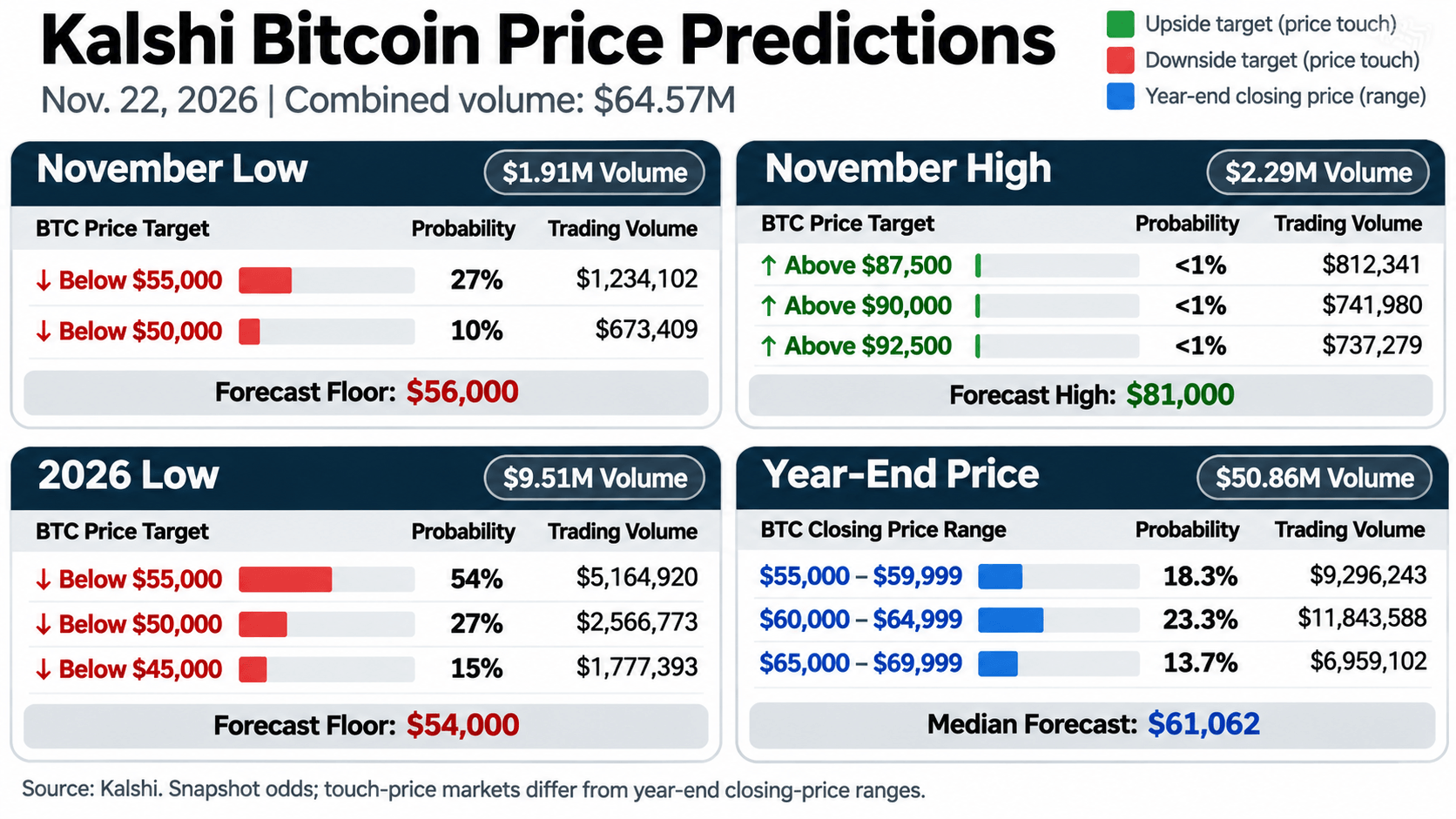
Kalshi’s year-end settlement market, meanwhile, accounts for $50.85 million today. Its median forecast is $61,062, with the 60,000-64,999.99 bracket leading at 23.3%. The 55,000-59,999.99 range commands 18.3%, while $65,000-$69,999 attracts 13.7%.
Collectively, the six prediction markets have recorded $172.53 million in aggregate trading volume, comprising $107.97 million on the prediction marketplace Polymarket and $64.56 million on Kalshi this weekend.
Options Traders Favor Protection as Bitcoin Faces Steep Recovery Hurdles
A look at bitcoin options stats from Coinglass reinforces the defensive interpretation and last week’s bitcoin price action hasn’t helped. Outstanding calls represent 54.19% of open interest, totaling 286,620.55 BTC, against 242,260 BTC in puts. However, puts account for 57.83% of recent trading volume, or 59,347.81 BTC, compared with 43,280.67 BTC in calls.
The 1.37 put-to-call volume ratio indicates heavier activity in downside contracts. All eight leading contracts by volume are puts, headed by Deribit’s Dec. 4 $58,000 put at 6,505.2 BTC and Nov. 27 $56,000 put at 2,809.1 BTC. Nevertheless, December calls retain substantial open interest, including 8,266.6 BTC at the $80,000 strike for Dec. 25, alongside positions at $90,000, $100,000 and $120,000 per unit.
At the current bitcoin price of $60,634 per BTC, reaching $90,000 requires a massive 48.4% advance against the greenback, while tapping six figures demands 64.9%. A rally to $150,000 represents 147.4%, and $250,000 requires 312.3%. The extraordinary $500,000 and $1 million targets demand gains of 724.6% and 1,549.2%, respectively.
Conversely, falling to $55,000 represents a 9.3% decline, while $50,000 requires a 17.5% retreat. A descent to $45,000 translates into a signifcant 25.8% loss, $40,000 represents 34%, and $30,000 means a 50.5% drawdown. At $20,000, the loss reaches 67%, while $10,000 represents an 83.5% collapse.
The current weekend data shows prediction markets, options activity, technical indicators, and sentiment gauges suggest a distinctly bearish near-term disposition, though not unanimous capitulation. Outstanding bullish calls preserve exposure to recovery, while elevated put trading may reflect hedging rather than outright speculation. The prevailing message is caution. Traders are assigning greater credibility to additional downside than to an extraordinary rebound, even as uncertainty leaves both possibilities open.