




Gold (XAU/USD) price posts modest gains of 0.35% on Tuesday, set to end the month with losses of over 11% after retreating from monthly highs around $4,500 towards $4,000, weighed by overall US Dollar strength. The XAU/USD pair trades at $4,026 after hitting an eight-month low of $3,942 earlier in the day.
XAU/USD steadies as Dollar strength keeps monthly losses intact
The US-Iran war was the main reason behind Gold’s collapse in June, propelling Oil prices higher and underpinning the US Dollar. Although they have signed a Memorandum of Understanding (MOU) to end the conflict and Oil prices have eased, the yellow metal failed to gain traction amid expectations that major central banks could raise interest rates.
Bullion prices tend to fare well amid low-interest-rate environments. Speculation that the Federal Reserve (Fed) could hike rates boosted the Greenback and pushed US Treasury yields higher.
The US Dollar Index (DXY), which measures the buck’s performance against six currencies, is up 0.07% at 101.17. The US 10-year Treasury yield surges 3.5 basis points, up to 4.412%.
Money markets have priced in 35 basis points of Federal Reserve tightening by December 2026, though it’s not expected to change policy in July, according to Prime Terminal data.
Over the weekend, hostilities between Washington and Tehran tested the fragility of the MOU. However, both parties halted attacks as US President Donald Trump’s envoys flew to Doha to resume talks.
In the meantime, Cleveland Fed President Beth Hammack was hawkish, insisting that inflation is too high and that, if consumer data holds up, monetary policy is not restrictive enough. She added that the Fed “may need to consider rate hikes.”
Data from the US showed that JOLTS unexpectedly increased in May, indicating rising vacancies but weak hiring, according to the US Bureau of Labor Statistics (BLS). Job openings rose by 7.594 million, beating forecasts of 7.3 million and April’s revised 7.585 million.
The US Conference Board Consumer Confidence improved in June as the truce deal between the US and Iran drove gasoline prices lower.
Ahead, traders are eyeing the ADP National Employment Change data on Wednesday, before the US Nonfarm Payrolls report on Thursday, amid a shortened week due to US holidays.
XAU/USD technical outlook: Gold’s downtrend intact, eyes on $3,500
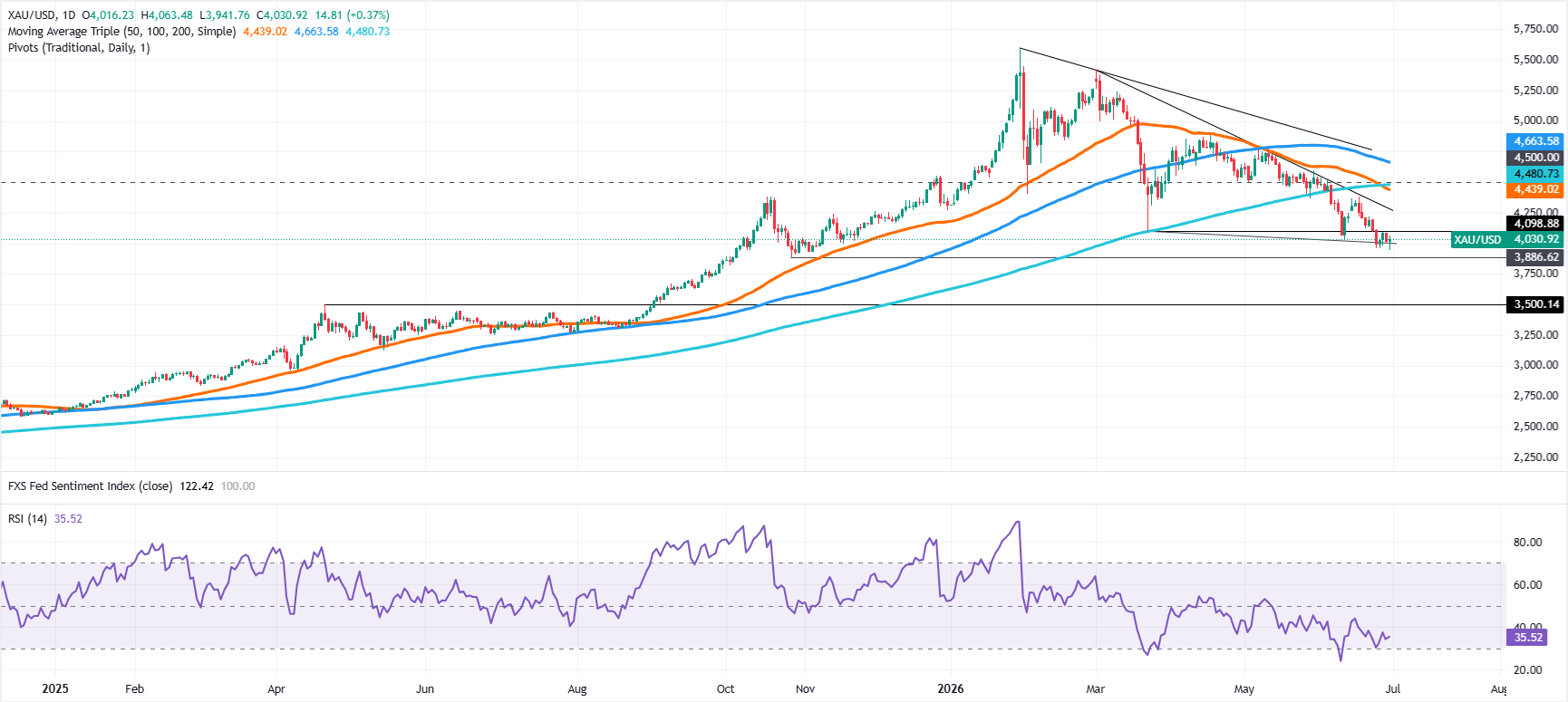
From a technical perspective, Gold is neutral to downward-biased, as it has registered a successive series of lower highs and lower lows. Momentum, as measured by the Relative Strength Index (RSI), is bearish, though it signals that selling pressure has eased in the short term, as the slope points up.
For a bullish reversal, Gold must clear $4,100. A breach of the latter will expose the June 22 daily high at $4,220, followed by a down-slope resistance trendline at around the $4,280-$4,300 area. If those levels are taken, the next stop would be the 50-day Simple Moving Average (SMA) at $4,439.
Downwards, the first support would be the day’s low of $3,941. Once surpassed, $3,900 is up next, followed by the October 28, 2025, swing low of $3,886. On further weakness, the next area of interest would be $3,500, April 22, 2025, daily high turned support.
Gold FAQs
Gold has played a key role in human’s history as it has been widely used as a store of value and medium of exchange. Currently, apart from its shine and usage for jewelry, the precious metal is widely seen as a safe-haven asset, meaning that it is considered a good investment during turbulent times. Gold is also widely seen as a hedge against inflation and against depreciating currencies as it doesn’t rely on any specific issuer or government.
Central banks are the biggest Gold holders. In their aim to support their currencies in turbulent times, central banks tend to diversify their reserves and buy Gold to improve the perceived strength of the economy and the currency. High Gold reserves can be a source of trust for a country’s solvency. Central banks added 1,136 tonnes of Gold worth around $70 billion to their reserves in 2022, according to data from the World Gold Council. This is the highest yearly purchase since records began. Central banks from emerging economies such as China, India and Turkey are quickly increasing their Gold reserves.
Gold has an inverse correlation with the US Dollar and US Treasuries, which are both major reserve and safe-haven assets. When the Dollar depreciates, Gold tends to rise, enabling investors and central banks to diversify their assets in turbulent times. Gold is also inversely correlated with risk assets. A rally in the stock market tends to weaken Gold price, while sell-offs in riskier markets tend to favor the precious metal.
The price can move due to a wide range of factors. Geopolitical instability or fears of a deep recession can quickly make Gold price escalate due to its safe-haven status. As a yield-less asset, Gold tends to rise with lower interest rates, while higher cost of money usually weighs down on the yellow metal. Still, most moves depend on how the US Dollar (USD) behaves as the asset is priced in dollars (XAU/USD). A strong Dollar tends to keep the price of Gold controlled, whereas a weaker Dollar is likely to push Gold prices up.


