


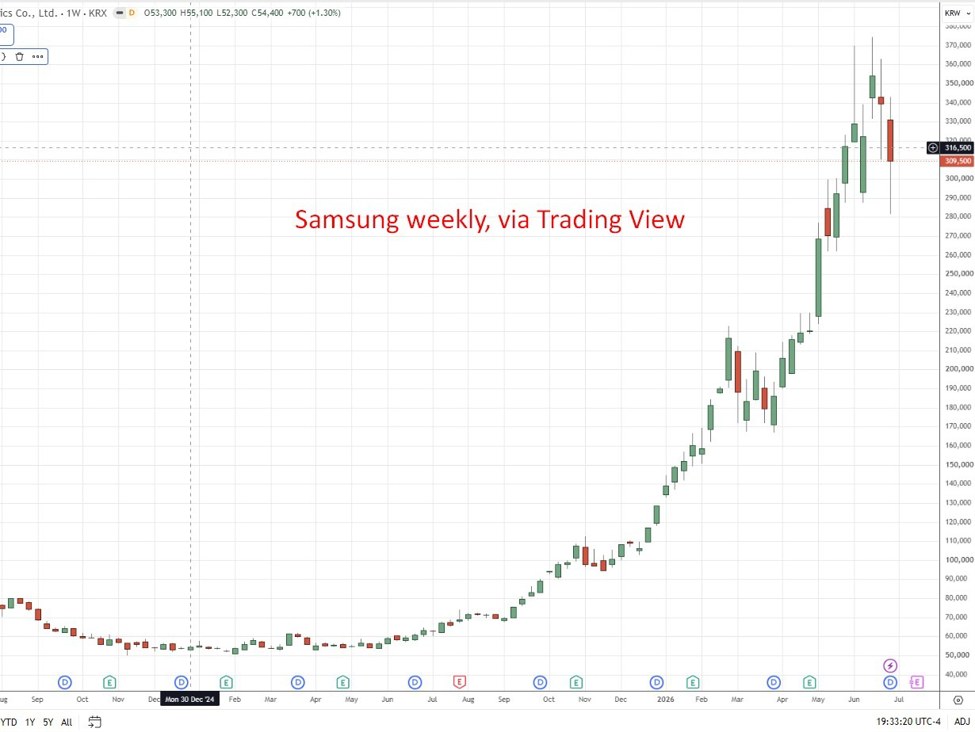

An 18-fold profit jump would confirm the memory sector’s rally is being driven by genuine earnings momentum rather than speculation, reinforcing the trillion-dollar valuations now attached to Samsung, SK Hynix and Micron after triple-digit share gains this year. Rising DRAM and NAND prices point to further margin expansion for memory makers even as they squeeze downstream businesses like Samsung’s own mobile division, a tension likely to show up in further smartphone price increases across the industry. The bigger swing factor for the stock reaction may be the scale of Samsung’s employee bonus provision, which could mask underlying strength if accounting timing pulls reported earnings below the headline consensus figure, while any sign of cooling AI infrastructure spending remains the key downside risk analysts are watching for the sustainability of the current supply squeeze.
Samsung is expected to post an 18-fold jump in Q2 operating profit to a record 86 trillion won, driven by an AI-fuelled memory shortage, with analysts flagging bonus provisions and AI spending as key swing factors.
Summary:
- Samsung is expected to report second-quarter operating profit of 86 trillion won ($56.35 billion), an 18-fold jump from 4.7 trillion won a year earlier and a third consecutive record quarter
- The memory shortage driving the surge is expected to persist at least through next year, fuelled by demand for AI inference infrastructure that is outpacing global supply growth
- Citi Research said DRAM and NAND average selling prices rose 44% and 53% quarter-on-quarter respectively in the second quarter
- Samsung, SK Hynix and Micron shares have surged 158%, 273% and 242% respectively this year, pushing all three companies’ valuations above $1 trillion
- Analysts said a larger-than-expected bonus provision, potentially exceeding 40 trillion won cumulatively, could cause reported earnings to fall short of consensus
- JPMorgan flagged the rapidly rising share of AI memory in cloud providers’ capital expenditure, estimated at 52% this year and over 70% next year, as a risk to the boom’s sustainability
Samsung Electronics is likely to report that its operating profit jumped roughly 18-fold to another record high in the second quarter, as booming demand for AI-related memory chips continues to outstrip global supply, according to Reuters.
The world’s largest memory chipmaker by sales is expected to post an operating profit of 86 trillion won for the April to June quarter, based on an LSEG SmartEstimate drawn from 30 analyst forecasts weighted toward those with the strongest track records. That would mark a jump from 4.7 trillion won a year earlier and a third straight quarter of record profit, driven by a prolonged memory shortage as demand for AI inference infrastructure continues to outpace supply growth from global manufacturers. Analysts expect the memory market to stay undersupplied at least through next year. Growth has been fuelled not only by high-bandwidth memory but also by stronger demand for conventional DRAM and NAND products, as agentic AI systems, which perform more complex, multi-step tasks, require additional memory and storage capacity beyond what earlier AI training-focused applications needed.
Samsung supplies memory chips to major technology companies including Nvidia, Google and Apple, and the price gains have been steep: Citi Research said average selling prices for DRAM and NAND rose 44% and 53% quarter-on-quarter respectively in the second quarter. The shortage has fuelled a sharp rally in memory chipmaker shares, with Samsung, SK Hynix and Micron up 158%, 273% and 242% respectively this year, pushing all three companies’ market valuations above $1 trillion.
Despite the strong operating backdrop, analysts cautioned that reported earnings could fall short of consensus if Samsung books a larger-than-expected provision for employee bonuses. In late May, the company averted a large-scale strike by agreeing to allocate 10.5% of its semiconductor division’s operating profit to special bonuses for chip employees, with some analysts estimating cumulative bonus provisions could exceed 40 trillion won, making the timing of that accounting recognition a key variable for the quarter. Samsung is due to announce detailed earnings later this month.
Looking ahead, analysts see potential delays to AI infrastructure investment as the biggest risk to the current memory boom. JPMorgan noted that while investors broadly agree memory supply and demand fundamentals remain tight, many question whether AI memory’s rapidly rising share of cloud service providers’ capital expenditure, estimated at 52% this year and expected to exceed 70% next year, is sustainable. Any pullback in AI spending could weigh on Samsung and SK Hynix, both of which recently pledged a combined 3,200 trillion won to expand chip capacity in South Korea, with Samsung planning its investment between 2026 and 2040. Nomura expects commodity DRAM prices to rise a further 24% and NAND prices 25% in the third quarter, while Samsung’s mobile business faces its own squeeze, with rising memory costs eating into margins despite recent smartphone price increases and analysts expecting further price hikes may be needed later this year.


