



Summary:
- Trump told Fox News strikes on Iran will continue until he deems it enough, confirmed the US held talks with Tehran and urged a deal, while flagging energy targets are being saved for later in the campaign
- Axios reported Trump convened a Situation Room meeting on Tuesday to weigh a larger new wave of strikes on Iran, with Trump having already floated hitting more sensitive sites including bridges and infrastructure
- Iran struck US bases in Bahrain, Kuwait and Jordan overnight in retaliation
- Centcom said it completed a fresh seven-hour wave of strikes on dozens of Iranian targets near the Strait of Hormuz, coinciding with the resumed naval blockade of Iranian ports from 4pm ET
- Net oil price impact from the latest escalation has been comparatively minor so far, while the US dollar lost further ground
- Japan’s Reuters Tankan held at +13 for manufacturers in July, unchanged from June, while the non-manufacturers’ index eased to +25 from +32; both are seen holding into October, with the data unlikely to shift the BOJ’s hawkish bias, though markets still see little chance of a hike this month, more likely September or October
- Japan’s May core machinery orders fell 12.4% month-on-month, far below the 4.2% decline expected and reversing an 8.7% rise in April, with the year-on-year reading also missing forecasts; the data is dated and volatile, and likely reflects payback from April’s strength given manufacturers’ otherwise upbeat mood
- China’s Q2 GDP grew 4.3% year-on-year, the weakest since Q4 2022 and below forecasts, as June retail sales and industrial output beat expectations but property investment and broader fixed-asset investment continued to slump, alongside a further, if slightly slower, decline in June new home prices
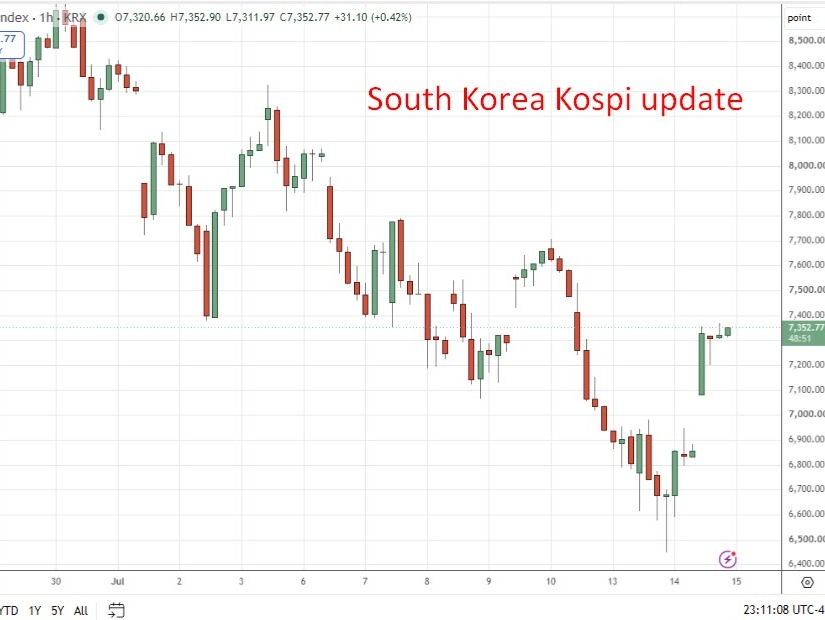
- Asian equities rallied hard on a softer-than-expected US inflation print that cooled July Fed hike bets, with Korea’s Kospi surging 6.9%, triggering sidecar halts on both the Kospi and Kosdaq as SK Hynix jumped nearly 12%, while Japan’s Nikkei and Topix, and Australian shares, also posted gains
It was a session defined by two parallel tracks, an escalating US-Iran conflict running alongside a broad, inflation-driven risk rally across Asian equities, with the two dynamics so far coexisting rather than colliding.
On the geopolitical side, President Trump told Fox News in an interview aired Tuesday night that strikes on Iran would continue until he personally judged the campaign had done enough, adding that Tehran retained some fight but not much, and that energy targets were being deliberately held back for later in the campaign. He also confirmed that the US had held talks with Iran on Tuesday and had urged Tehran to reach a deal, keeping a diplomatic track alive alongside the military one. That picture of restraint sat uneasily against a separate Axios report that Trump convened a Situation Room meeting on Tuesday to weigh a larger new wave of strikes on Iran, with Trump having already talked publicly about potentially hitting more sensitive targets, including bridges and broader infrastructure. Iran responded with strikes on US bases in Bahrain, Kuwait and Jordan overnight, widening the conflict’s reach across the region. Into the Asian session, Centcom confirmed it had completed an additional, seven-hour wave of strikes on dozens of Iranian military targets near the Strait of Hormuz, timed alongside the resumption of the US naval blockade of Iranian ports and coastal areas from 4pm ET. Despite the scale of the latest escalation, the net impact on oil prices has so far been comparatively minor, while the US dollar has lost further ground.
In Japan, the data flow was mixed. The Reuters Tankan showed manufacturers’ sentiment steady at +13 in July, unchanged from June and supported by strong semiconductor and AI server demand, while non-manufacturers’ sentiment eased to +25 from +32 on cost pressures tied to the Middle East conflict and a weak yen. Both indexes are expected to hold into October. Separately, May core machinery orders fell 12.4% month-on-month, well short of the 4.2% decline expected and a sharp reversal from April’s 8.7% gain, with the year-on-year figure of -1.9% also missing forecasts for a 12.9% rise. The series is notoriously volatile and the data itself is dated, and the drop looks largely like payback from April’s strength rather than a genuine turn, particularly given how upbeat manufacturers otherwise remain. None of this is expected to shift the BOJ’s hawkish stance, with markets still assigning little chance of a hike this month but placing better odds on September or October.
China’s data dump added another layer. Second-quarter GDP grew 4.3% year-on-year, missing forecasts and marking the weakest pace since the pandemic-hit final quarter of 2022, as the property slump and oil-shock fallout offset stronger factory output and exports. June activity data was more encouraging on the consumption side, with retail sales up 1.0% and industrial output up 5.3%, both beating expectations, but fixed-asset investment and property investment remained deeply negative, and new home prices fell again in June, albeit at a marginally slower pace than in May.
Equity markets, meanwhile, were in full risk-on mode after a softer-than-expected US inflation report cooled expectations for a July Fed hike and extended an overnight Wall Street rally built on strong bank earnings and chipmaker strength. South Korea’s Kospi was the standout, surging 6.9% and triggering sidecar halts on both the Kospi and Kosdaq as futures spiked, with SK Hynix jumping nearly 12% in tandem with the overnight US tech rally. Japan’s Nikkei and Topix also advanced, alongside Australian shares, though the Nikkei’s gains were tempered somewhat by caution ahead of ASML’s earnings later in the day, a reminder that the AI chip rally’s durability still depends on confirmation from the sector’s key suppliers.


