


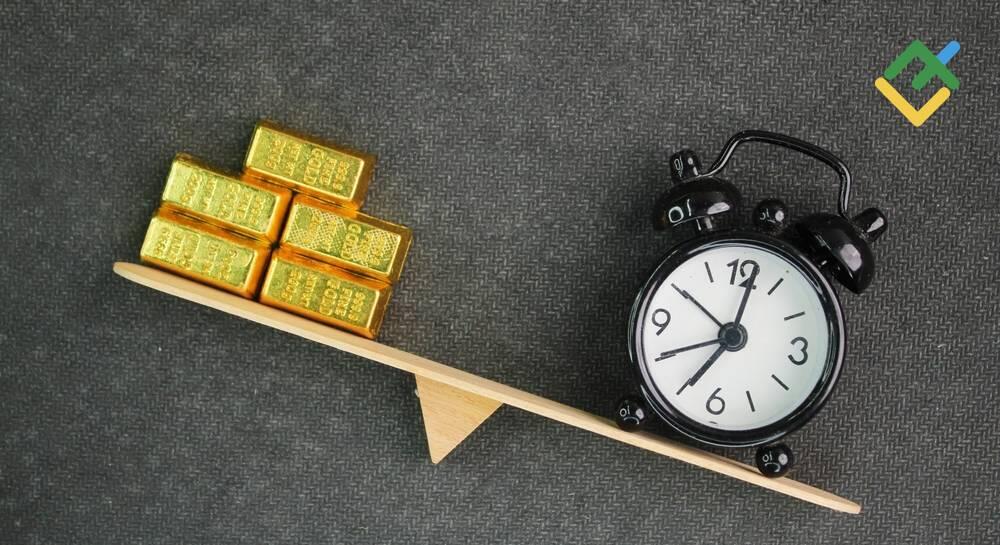


XAU/USD is highly popular among traders due to its high liquidity and volatility. Therefore, every trader should be familiar with gold trading hours. Gold can now be traded 24/7 through perpetual contracts. However, XAU/USD trading results depend not only on the chosen gold trading strategy but also largely on when a trader enters the market. The gold market open time can bring changes in liquidity, trading activity among major market participants, and price movements.
It is important to understand that there is no single best time to trade gold. The optimal period depends on the trading strategy and the trader’s focus. Scalpers need fast price movements and competitive spreads, while swing traders may not pay attention to active intraday trading hours at all. The most active period is usually the London-New York overlap.
The article covers the following subjects:
Major Takeaways
|
How to trade gold? |
Gold trading is one of the most popular forms of investment today. Gold prices can fluctuate significantly, giving traders opportunities to profit even with relatively little capital. |
|
Best gold trading hours |
Forex traders generally consider the London open and the London-New York overlap to be the best times to trade gold. |
|
When is gold trading most active? |
Gold is actively traded by both retail and institutional investors, with trading activity usually peaking when the world’s major markets are open. |
|
What are the best days of the week to trade gold? |
Gold trading is generally most active midweek. The most gold trades occur on Tuesday, Wednesday, and Thursday. |
|
When should you avoid trading gold? |
When trading gold, avoid the Asian trading session and the second half of Friday, when many major market participants start selling gold ahead of the weekend. |
|
Risks of trading gold |
The main risks include potential capital losses due to high volatility, price gaps, and the risks associated with margin trading on Forex. |
Gold Trading Sessions
XAU/USD is an over-the-counter (OTC) instrument, so it is available for trading almost 24 hours a day, five days a week. However, trading activity varies throughout the day. Gold trading can generally be divided into four main periods: the Asian session, the European session, the US session, and the European-US session overlap.
Volatility is particularly important for gold traders, which is why XAU/USD trading hours matter. When the London and New York markets open, more major participants, including banks, funds, and large hedgers, enter the market. This generally leads to higher liquidity and volatility.
The following periods and events are particularly important for gold prices:
-
The European market open.
-
The start of the US session.
-
The first few hours after COMEX opens.
-
The release of key US economic data.
-
The London-New York overlap.
Trading session times may vary when converted to a trader’s local time. The UK, the US, and other countries observe daylight saving time. Therefore, it is more convenient to use UTC as a reference.
The Four Trading Sessions for Gold
The modern gold market can be broadly divided into four periods based on the operating hours of the world’s major financial centers. However, unlike stocks, gold is not tied to a single stock exchange.
The London OTC precious metals market operates almost 24 hours a day, while gold futures trade on CME nearly around the clock, with a one-hour daily maintenance break. Meanwhile, China’s growing precious metals market could become the world’s largest within the next three years.
The gold market is generally divided into the following trading sessions:
-
The Asian trading session, covering Sydney, Tokyo, Shanghai, and Hong Kong.
-
The London trading session.
-
The New York trading session.
-
The London-New York overlap, the most active trading period, lasting four hours.
Thus, a trading session does not necessarily refer to the operating hours of a specific exchange. Rather, it is a convenient way to describe regional trading activity in XAU/USD. Each session has its own sources of liquidity, economic news, and typical price behavior.
Asian Session (Sydney, Tokyo, Shanghai)
The Asian session typically sees the lowest trading activity in XAU/USD. At the start of the session, liquidity in the gold market gradually increases as markets open in Australia, Japan, China, and other parts of Asia. However, over the past two years, this period has become more important for gold trading due to increased activity on the Shanghai Gold Exchange (SGE).
On quiet trading days, the price may move within a narrow range. This can make Asian trading hours suitable for range-trading strategies. Despite relatively low trading volumes, the Asian session should not always be considered quiet, as important news from China or Japan can trigger sharp price movements.
Traders generally use the Asian session for several purposes:
-
Identifying the overnight trading range to place pending orders before the European session begins.
-
Identifying local support and resistance levels.
-
Preparing for the European session.
-
Using range-trading strategies during periods of low volatility.
Before opening a trade, however, traders should keep in mind that the trading range formed during the Asian session may be broken as liquidity increases during the European session.
London Session (European Session)
The London market open is often an important time for gold traders. London has historically been one of the world’s major precious metals trading centers, and the LBMA Gold Price benchmark is set twice a day, at 10:30 a.m. and 3:00 p.m. London time.
As liquidity in the gold market increases, trading activity usually picks up. The price range formed during the Asian XAU/USD trading session can serve as a reference for traders using key-level breakout or trend-reversal strategies.
Traders generally use the London session for the following purposes:
-
Intraday trading.
-
Breakout and bounce trading strategies.
-
Momentum trading.
-
Identifying potential trend continuation or reversal points.
-
Forecasting and analyzing gold prices.
-
Analyzing price reactions to European economic news.
In my experience, the initial price move after the session opens is often a false breakout. At this time, the market may see quick liquidity sweeps followed by price reversals. So, instead of entering immediately on a breakout, it is better to wait for confirmation or place a pending order.
New York Session (American Trading Session)
The New York session is one of the most important periods for XAU/USD trading. Much of the macroeconomic data that can significantly affect market sentiment is released in the US.
Activity in the US futures market is particularly important. Gold futures on CME Globex trade nearly 24 hours a day on weekdays, with a one-hour daily break. For this reason, the first few hours of the New York session often see strong price moves. However, high volatility also increases the risk of slippage, wider spreads, and sharp reversals, especially during economic data releases.
When trading during the US session, traders should pay particular attention to the following factors:
-
US inflation reports.
-
US employment data.
-
Fed decisions and comments.
-
US GDP and retail sales data.
-
Movements in the US Dollar Index.
-
Short-term changes in US Treasury yields.
The London–New York Overlap (the “Golden 4 Hours”)
The London-New York overlap is often considered the best time to trade XAU/USD. During this period, traders in London and New York are active at the same time, which usually results in high market liquidity. This period can also provide many potential trading signals.
The session overlap generally lasts about four hours. During this period, Forex traders use a variety of trading strategies:
-
Intraday trading.
-
Trading range breakouts.
-
Momentum strategies.
-
News trading.
Higher trading volume does not necessarily mean more profitable trades. When important economic data is released, the price can move so quickly that technical levels may become less reliable. Therefore, traders should pay particular attention to risk management.
When Is the Best Time to Trade Gold?
For most intraday traders, the London-New York overlap is the most active trading period. During this period, trading activity and liquidity usually increase, and major economic data from Europe and the US is often released. Higher liquidity usually leads to stronger price movements, creating opportunities for short-term traders.
The best time to trade Forex also depends on the trader and their strategy. For example, range-trading strategies can work well during periods of lower market activity. Momentum strategies and scalping require higher volatility.
-
Asian trading hours are generally more suitable for range-trading strategies.
-
The London open is a good time to look for breakouts or bounces from key levels.
-
The London-New York overlap is suitable for almost any intraday strategy.
-
During the final hours of the New York session, trading activity declines, giving traders time to prepare their plans and strategies for the next day.
Best Days of the Week to Trade Gold
As with any other asset, no specific day of the week is best for trading gold. Trading activity depends on current macroeconomic conditions, fundamental factors, central bank decisions, and geopolitical events.
However, when a new trading week begins, the gold market may react to events that occurred over the weekend, potentially resulting in price gaps. Economic data releases are also common midweek. On Friday, trading activity may remain high during the first half of the US session, especially when important US economic data is released. At times like these, traders often ask the key question: why are gold prices rising? However, activity may decline toward the end of the trading day.
When trading on different days of the week, consider the following:
1. Monday: price gaps may occur as traders open new positions after the weekend.
2. Tuesday, Wednesday, and Thursday are often the most suitable days for traditional intraday trading.
3. Friday can bring unpredictable price movements due to US economic data releases, with sharp moves possible during the afternoon session and in the final hours before the market closes.
Best Time to Trade Gold by Trading Style
The best time to trade gold depends directly on the trader’s specific goals. The same market conditions may be attractive to a scalper but completely unsuitable for a swing trader.
When choosing the best time to trade, consider three main factors: volatility, liquidity, and fundamental factors that may affect prices.
-
Scalping: periods of the highest liquidity and volatility.
-
Intraday trading: the London open and especially the London-New York overlap.
-
Basic swing trading: any time, as trades are held from several trading days to several weeks.
-
News trading: specific periods before and after important news releases.
-
Gold futures trading: the most active COMEX trading hours.
Day Traders and Scalpers
Timing is particularly important for intraday traders and scalpers. They need sufficient volatility for potential profits to cover trading costs, as well as tight spreads. Therefore, the most attractive periods are usually the London open, the New York open, and the London-New York overlap. Scalpers generally trade for only a few hours a day, during periods of the highest market activity.
How to trade gold intraday:
-
Choose one or two trading periods.
-
Mark the key support and resistance levels from the previous day or the Asian trading session in advance.
-
Check the economic calendar.
-
Reduce position sizes or close positions altogether before important news releases.
-
Stop trading once you reach your predetermined profit or loss limits.
Intraday trading requires strict adherence to a trading plan, as overall performance depends on the results of multiple trading days rather than individual trades. Therefore, even a minor deviation from the plan can affect overall trading performance.
Swing Traders
For swing traders, timing matters less than it does for scalpers. Positions are usually held for several days to several weeks, and sometimes longer. In my experience, my longest gold trade lasted 17 months.
When swing trading gold, traders should pay attention to the following factors:
-
Daily and weekly support and resistance levels.
-
The main trend on higher time frames.
-
Central bank monetary policy decisions.
-
US Consumer Price Index and labor market data.
-
The outlook for the US Dollar Index.
-
Changes in US Treasury yields, especially the 10-year yield.
-
Geopolitical risks.
However, trade entry timing still matters. If a technical signal appears just before an important data release, traders should assess all potential risks. Swing traders do not need to monitor the Forex market constantly. Their strategy mainly involves identifying entry points and placing pending orders.
News-Aware and Futures Traders
Many gold traders focus less on a particular trading session and more on specific news releases. US releases are particularly important for gold because XAU/USD is denominated in US dollars, and these releases can affect expectations for Fed interest rates and real bond yields.
Futures traders should also consider the COMEX market structure and contract specifications. Standard Gold Futures contracts on CME trade nearly 24 hours a day, but traders should check the exact trading schedule and any holiday-related changes before trading.
When trading on news, traders should follow several rules:
-
Identify key levels.
-
Assess the volatility expected from the news release.
-
Determine the potential risk in advance.
-
Check the chart against the economic calendar.
-
Follow a predetermined trading plan and established risk limits.
Remember that the market generally reacts not to the release itself, but to the difference between the actual result and analysts’ expectations or forecasts. Therefore, even positive news for gold can cause the price to fall if the market has already priced it in.
Hours to Avoid When Trading XAU/USD
Sometimes, the best decision a trader can make is not to open a trade. Gold prices can move by tens or even hundreds of dollars within a short period, making periods of extreme volatility particularly risky.
Traders should be especially cautious immediately before major economic data releases. Volatility may increase, and a pending order may be executed at a significantly worse price than expected due to slippage. A similar situation can occur during unexpected geopolitical events, when technical signals may temporarily become less reliable due to a sudden surge in market orders.
In general, traders should avoid trading gold or reduce their position size in the following situations:
-
There are no clear trading signals.
-
The spread is significantly wider than usual.
-
Important economic data is due in a few minutes.
-
The market is moving erratically and lacks a clear structure.
-
The goals set in the trading plan have already been reached.
-
The trader is trying to recover losses on gold after a series of unsuccessful trades in other assets.
-
Liquidity has declined significantly ahead of weekends or holidays.
Conclusion
Gold is a popular asset among traders with medium to large amounts of capital. Knowing the best time to trade gold on Forex or the futures market is important. Remember that gold, despite being considered a safe-haven asset, is a complex instrument. Before trading it, traders should at least understand the factors that affect its price.
Knowing the best XAU/USD trading hours can help you develop a potentially more profitable trading strategy. Gold investments can be both short-term and long-term and can also be used to hedge other financial assets. Consider the gold market opening time when trading, as timing can directly affect results.
Price chart of XAGUSD in real time mode
The content of this article reflects the author’s opinion and does not necessarily reflect the official position of LiteFinance broker. The material published on this page is provided for informational purposes only and should not be considered as the provision of investment advice for the purposes of Directive 2014/65/EU.
According to copyright law, this article is considered intellectual property, which includes a prohibition on copying and distributing it without consent.


