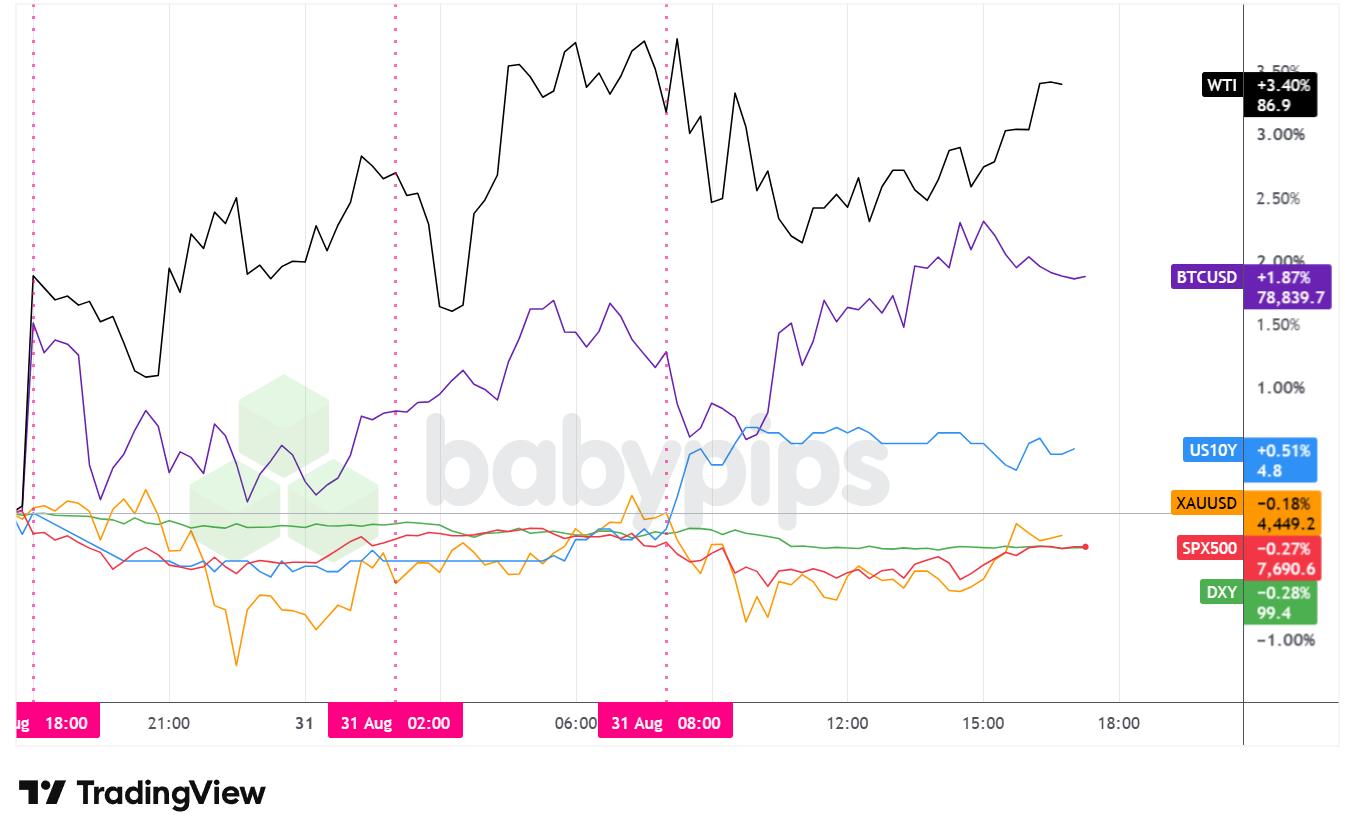




A weekend flare-up in the Middle East set the tone for the new week, as the first U.S. strikes on Iran in over a month pushed oil sharply higher and kept last Friday’s hawkish Fed repricing alive. Crude led the broad market with a gain near 1.5%, the 10-year Treasury yield firmed, and the dollar drifted to a mixed, arguably net softer finish against the majors on a quiet month-end session.
Check out the forex news and economic updates you may have missed in the latest trading session!
News Headlines & Data:
- Japan Retail Sales for July 2026: 4.0% y/y (1.0% y/y forecast; 0.5% y/y previous)
- Japan Industrial Production Prel for July 2026: 4.1% y/y (3.0% y/y forecast; 4.9% y/y previous)
- New Zealand ANZ Business Confidence for August 2026: 53.7 (55.7 forecast; 56.1 previous)
- Australia Housing Credit for July 2026: 0.5% m/m (0.5% m/m forecast; 0.6% m/m previous)
- Australia Business Inventories for Q2 2026: -0.2% q/q (0.7% q/q forecast; 0.5% q/q previous)
- Australia Private Sector Credit for July 2026: 8.4% y/y (8.5% y/y forecast; 8.5% y/y previous)
- China NBS General PMI for August 2026: 49.5 (50.2 forecast; 49.3 previous)
- China NBS Non Manufacturing PMI for August 2026: 49.0 (50.4 forecast; 49.0 previous)
- China NBS Manufacturing PMI for August 2026: 49.8 (49.9 forecast; 49.2 previous)
- Australia TD-MI Inflation Gauge for August 2026: 0.5% m/m (0.4% m/m forecast; 1.0% m/m previous)
- Japan Housing Starts for July 2026: 8.2% y/y (13.0% y/y forecast; 18.6% y/y previous)
- Japan Construction Orders for July 2026: -13.4% y/y (5.0% y/y forecast; -6.7% y/y previous)
- Germany Inflation Rate Prel for August 2026: 2.9% y/y (3.0% y/y forecast; 2.8% y/y previous)
- Germany Harmonized Inflation Rate Prel for August 2026: 2.9% y/y (3.0% y/y forecast; 2.8% y/y previous)
- Australia Cotality Dwelling Prices for August 2026: -0.9% m/m (-1.2% m/m forecast; -0.7% m/m previous)
- Dallas Fed Manufacturing Index for August 2026: 11.6 (0.7 forecast; 1.3 previous)
Broad Market Price Action:
Dollar Index, Gold, Oil, S&P 500, U.S. 10-yr Yield, Bitcoin Overlay – Chart Faster With TradingView
Oil gapped higher at the Sunday reopen on the weekend strikes and stayed elevated through the session, topping the broad market overlay with a gain near 1.5%. The 10-year Treasury yield firmed alongside it, bitcoin recovered from an overnight dip to finish modestly higher, and the S&P 500 and gold both edged lower. The dollar index softened through the U.S. hours to close near the bottom of the pack.
The S&P 500 spent the session drifting lower and closed near 7,690, off around 0.11% from the Sunday reopen. The index probed a session low near 7,666 late in the London morning before grinding back through the afternoon. Higher oil and firmer rate expectations set an unhelpful backdrop, and it’s worth noting that the calendar flip into September, historically the weakest month for U.S. equities, may have added to the cautious tone heading into Friday’s payrolls report.
Gold traded heavy for a second session, closing near 4,447 and down roughly 0.26%. Bullion opened the week near 4,459, held firm through the early Asian hours, then slid to a session low near 4,403 late in the Asian session as the dollar and yields stayed elevated in the wake of Friday’s hawkish Warsh selloff. Prices clawed back part of the drop through London and the U.S. afternoon but could not reclaim the opening level. The metal dipped below 4,400 in intraday trade for the first time since mid-August.
WTI crude oil was the day’s standout, closing near 86.87 and up roughly 1.5% from the reopen. Oil gapped up to start the week after U.S. forces struck two Iranian rocket launchers on Larak Island near the Strait of Hormuz on Sunday, prompting an Iranian retaliation on American bases in the region. Crude pushed to a session high near 87.17 during the early U.S. morning before easing into the afternoon, holding most of its gains as the renewed hostilities dashed hopes for a near-term normalization of traffic through the strait.
The U.S. 10-year Treasury yield edged higher, closing near 4.75% and up around 0.47% on the day. Yields drifted through Asia before pushing to a session high near 4.76% during the U.S. morning, a move consistent with higher energy costs and firmer rate-hike expectations keeping upward pressure on the long end. The finish left the yield near its highest since early this year.
Bitcoin closed near 78,900, up roughly 0.44% on the day. Prices slid to a session low near 77,457 during the Asian hours as the risk-off open weighed, then recovered steadily from the London morning to a session high above 79,100 in the U.S. afternoon. No single crypto-specific catalyst stood out, so the intraday swing likely tracked the broader shift in risk tone as equities steadied off their lows.
FX Market Behavior: U.S. Dollar vs. Majors
Overlay of USD vs. Major Currencies – Chart Faster With TradingView
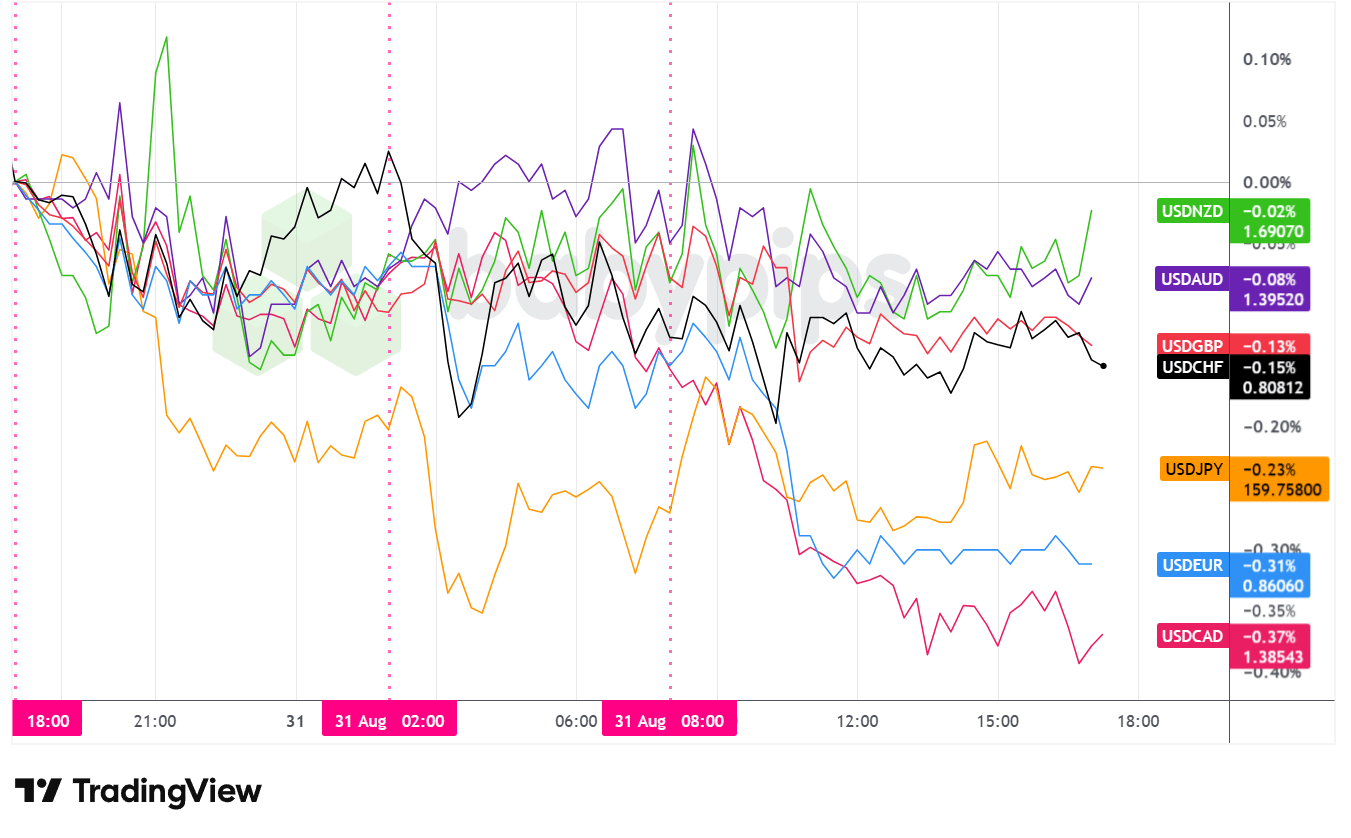
The U.S. dollar traded mixed against the major currencies on Monday, finishing arguably net softer overall on a quiet month-end session with little in the way of fresh U.S. catalysts.
The week opened with a modest risk-off gap on the weekend Iran escalation, and the dollar started firm before drifting lower as the sessions progressed. During the Asian session, the yen firmed even as broader risk sentiment soured, with USD/JPY slipping from near 160.13 at the reopen toward 159.60 by the London handoff. Japanese government bond yields extended their climb, with the 10-year JGB reaching its highest since 1996, and it’s possible the move in yields underpinned the yen despite the softer equity tone. China’s official manufacturing PMI improved to 49.8 but stayed in contraction, and Australia’s monthly inflation gauge showed the annual pace accelerating to 4.8%, an uncomfortable signal for the RBA that left the Aussie broadly steady.
After the London session opened, news flow stayed light with month-end positioning likely encouraging caution. German state inflation readings came in hotter than July, and the national preliminary print landed at 2.9% year over year, a touch below forecast but firm enough to reaffirm the ECB’s path into September. European bond yields pushed higher, with 10-year German yields near multi-year highs, though the dollar held a narrow range against most majors through the morning.
Once the U.S. session opened, the dollar leaned net weaker into the afternoon, with the euro and Canadian dollar the standout gainers against the greenback. The Dallas Fed manufacturing index jumped to 11.6, well above the 0.7 forecast, but the upbeat reading did little to lift the dollar on an otherwise data-light afternoon. USD/CAD drifted to a session low near 1.3852, helped by the firmer oil backdrop, while the dollar stabilized against the yen and closed the session mixed.
Upcoming Potential Catalysts on the Economic Calendar
- Australia S&P Global Manufacturing PMI Final for August 2026 at 11:00 pm GMT
- U.K. BRC Shop Price Inflation for August 2026 at 11:01 pm GMT
- Japan Capital Spending for June 30, 2026 at 11:50 pm GMT
- Japan S&P Global Manufacturing PMI Final for August 2026 at 12:30 am GMT
- Australia Building Permits Prel for July 2026 at 1:30 am GMT
- China RatingDog Manufacturing PMI for August 2026 at 1:45 am GMT
- Japan Consumer Confidence for August 2026 at 5:00 am GMT
- Germany Retail Sales for July 2026 at 6:00 am GMT
- U.K. Nationwide Housing Prices for August 2026 at 6:00 am GMT
- Swiss Retail Sales for July 2026 at 6:30 am GMT
- Swiss procure.ch Manufacturing PMI for August 2026 at 7:30 am GMT
- Euro area S&P Global Manufacturing PMI Final for August 2026 at 8:00 am GMT
- U.K. Monetary Developments for July 2026 at 8:30 am GMT
- U.K. S&P Global Manufacturing PMI Final for August 2026 at 8:30 am GMT
- Euro area Inflation Rate Flash for August 2026 at 9:00 am GMT
- Euro area Unemployment Rate for July 2026 at 9:00 am GMT
- New Zealand Global Dairy Trade Price Index for September 1, 2026
- U.S. Fed Barr Speech at 1:05 pm GMT
- Canada S&P Global Manufacturing PMI for August 2026 at 1:30 pm GMT
- U.S. S&P Global Manufacturing PMI Final for August 2026 at 1:45 pm GMT
- ISM Manufacturing PMI for August 2026 at 2:00 pm GMT
- U.S. JOLTs Job Openings & Quits for July 2026 at 2:00 pm GMT
- Dallas Fed Services Index for August 2026 at 2:30 pm GMT
Tuesday’s session hinges on the run of final August manufacturing PMIs across Asia, Europe, and the U.S., along with the euro area inflation flash and the U.S. ISM manufacturing and JOLTS prints, any of which could sharpen the rate debate that has driven markets since Friday.
The unresolved Strait of Hormuz situation, with oil holding above 86, remains a live risk under all of it, and an argument could be made that the reaction to Friday’s U.S. payrolls report will matter more than any single data point before it. Fed Governor Barr’s speech may also draw attention for any read on how the committee is weighing the inflation-versus-labor tradeoff.
When oil spikes on geopolitical risk, why does the dollar weaken instead of strengthen? And why do some currency pairs rally while others sell off? These moves only make sense once you understand how the major asset classes actually move together. Premium members can read our lesson:
📖 What Is Intermarket Analysis?
Reading this helps you understand how stocks, bonds, commodities, and currencies flow together, why crude oil moves can predict currency shifts, and how to read multiple asset classes as a unified system instead of isolated price charts.
And if you’re not a Premium subscriber yet, consider joining.
With Babypips Premium, you get full access to School of Pipsology lessons that help you understand not just which direction price moves, but the cross-asset dynamics driving every major forex shift.