


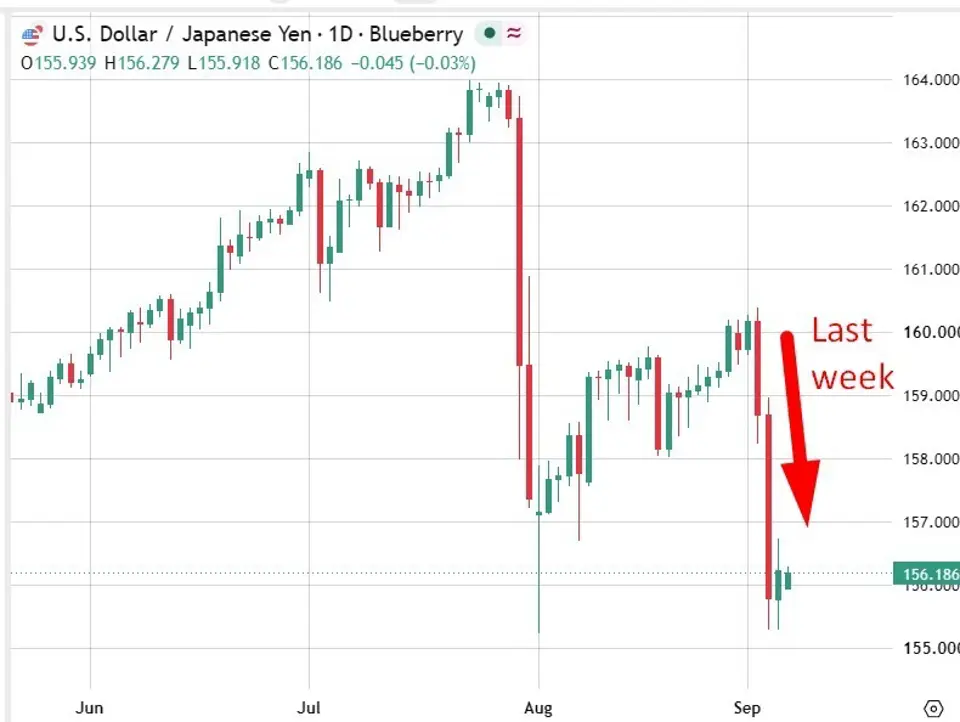

The move in USD/JPY, from near 160 to under156 over the space of a week, reflects a rapid repricing of BOJ intentions rather than a broader dollar story, with markets now treating a September hike as close to fully priced. The more consequential swing factor is the roughly one-in-four probability now attached to a second, back-to-back hike as soon as October, since that scenario would mark a genuine departure from the BOJ’s historic six-month cadence between moves. A faster BOJ tightening path also carries flow-on effects for yen crosses more broadly, including AUD/JPY, where a narrowing rate differential and unwind of yen-funded carry positions could add downside pressure on the cross if the hawkish repricing continues.
—
The yen just had its best week in a month, and it’s the market’s growing belief in back-to-back BOJ hikes, not just one hike, driving the move.
Summary:
- USD/JPY fell from near 160 to around 156 last week, one of the yen’s sharpest weekly gains in months
- A Bloomberg report cited by Japanese brokerage analysts said the BOJ is likely to raise its policy rate by 25bp to 1.25% at the September meeting, playing down chances of a larger 50bp move
- BOJ Policy Board member Hajime Takata had earlier said 2026 marks “a change in phase,” suggesting the BOJ’s traditional six-month gap between hikes may no longer apply and that “back-to-back rate hikes could result”
- Following Takata’s comments, the OIS market priced the probability of a September hike at around 97%, with roughly a 25% probability of a further hike as soon as October
- Analysts note Takata is among the most hawkish Policy Board members and his remarks should not be read as the BOJ leadership’s collective stance
- One brokerage’s own forecast sees hikes to 1.25% in September and 1.50% in December, with a growing chance the pace of tightening beyond that could be faster than previously assumed
The yen strengthened sharply last week, with USD/JPY falling from near 160 to around 156, as traders repriced the odds of not just one but potentially two BOJ rate hikes in quick succession. According to a research note from a Japanese brokerage, a Bloomberg report had indicated the BOJ is likely to raise its policy rate by 25bp to 1.25% at its September meeting, while playing down the case for a larger 50bp increase.
The rally built on speculation first triggered by BOJ Policy Board member Hajime Takata, who said in a speech that 2026 marks “a change in phase and the beginning of a new regime,” arguing that the central bank’s traditional cadence of hiking roughly once every six months may no longer fit the current environment. Takata said “back-to-back rate hikes could result” depending on circumstances, and that the BOJ should consider a broader range of options on hike size rather than defaulting to 25bp increments.
Following those comments, the interest rate swap market priced the probability of a September hike at around 97%, while assigning roughly a 25% probability to a further hike as soon as October, a genuine break from the BOJ’s historical pattern. The yen’s advance and a flattening of the JGB yield curve, as superlong yields declined, reflected markets pricing in a BOJ moving to address a perceived behind-the-curve position.
Analysts caution against reading too much into Takata’s remarks alone, since he is regarded as one of the more hawkish members of the Policy Board and his comments do not necessarily reflect the BOJ leadership’s collective view. The latest reporting is seen as consistent with a steady, rather than back-to-back, hiking path in the near term, with one brokerage maintaining its forecast for hikes to 1.25% in September and 1.50% in December while now attaching greater weight to the possibility that the pace of tightening beyond that point could prove faster than previously assumed.
Takata triggered yen rise.


