


Hot U.S. producer prices and a fresh leg higher in oil pushed Treasury yields toward multi-year highs on Thursday, pressuring stocks for a fourth straight session and lifting the dollar across the board. Traders boosted their bets on a Federal Reserve rate hike next week, while the European Central Bank raised rates for the second time since the Iran war erupted and pointed to more tightening ahead.
Check out the forex news and economic updates you may have missed in the latest trading session!
News Headlines & Data:
- API Crude Oil Stock Change for September 4, 2026: -0.3M (-2.6M previous)
- U.K. RICS House Price Balance for August 2026: -28.0% (-28.0% forecast; -30.0% previous)
- Australia Consumer Inflation Expectations for September 2026: 4.9% (5.1% forecast; 4.9% previous)
- European Central Bank Interest Rate Decision for September 10, 2026: 2.65% (2.65% forecast; 2.4% previous)
- Euro area Deposit Facility Rate for September 10, 2026: 2.5% (2.5% forecast; 2.25% previous)
- Euro area Marginal Lending Rate for September 10, 2026: 2.9% (2.9% forecast; 2.65% previous)
- U.S. Initial Jobless Claims for September 5, 2026: 206.0k (209.0k forecast; 206.0k previous)
-
U.S. PPI for August 2026: 5.4% y/y (5.1% y/y forecast; 4.7% y/y previous)
- U.S. Core PPI for August 2026: 4.6% y/y (4.5% y/y forecast; 4.2% y/y previous)
- U.S. Wholesale Inventories for July 2026: 1.3% m/m (1.3% m/m forecast; 0.2% m/m previous)
- U.S. Existing Home Sales for August 2026: -2.0% m/m (-0.2% m/m forecast; -1.7% m/m previous)
- EIA Crude Oil Stocks Change for September 4, 2026: -0.39M (-4.45M previous)
Broad Market Price Action:
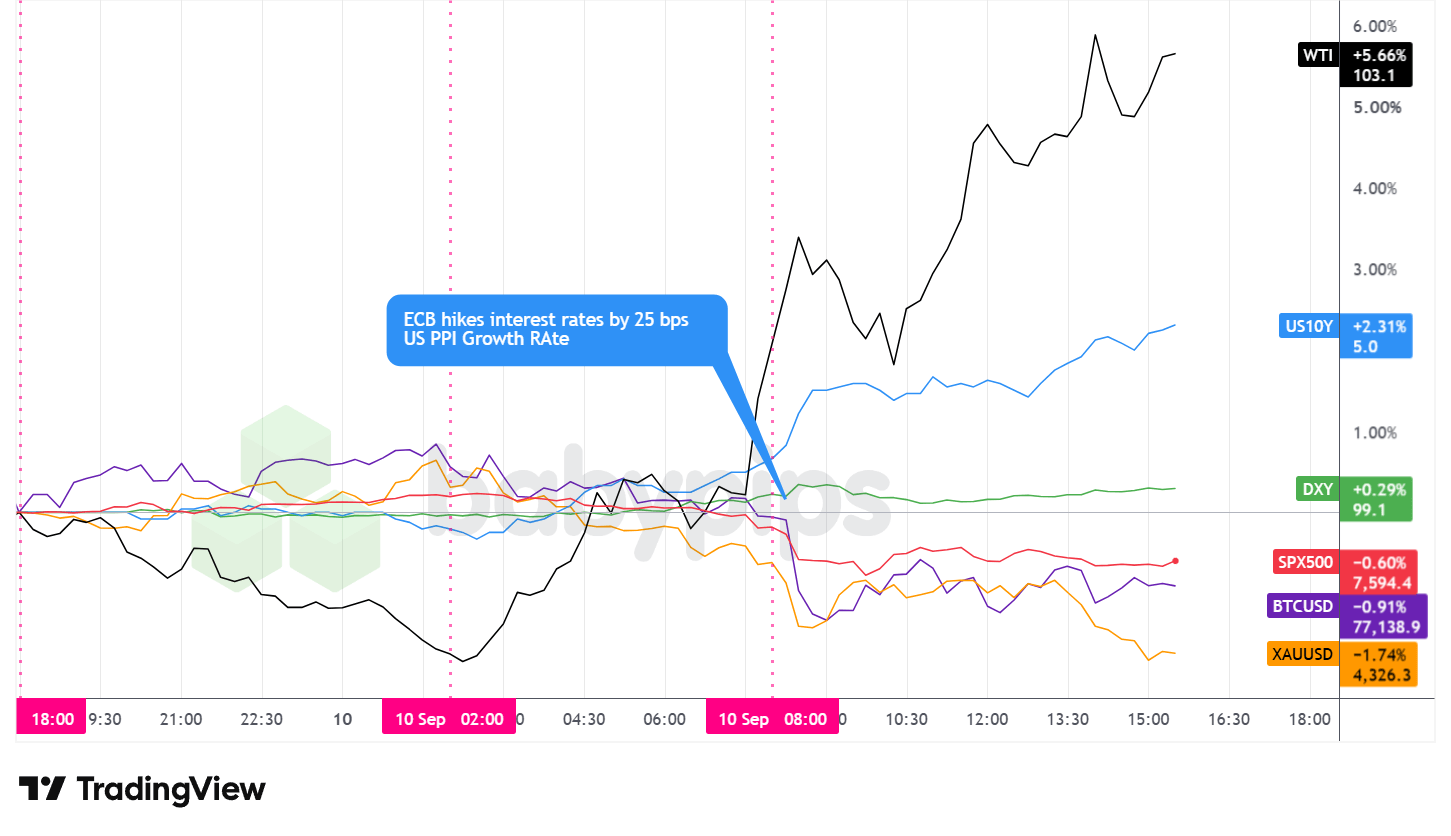
Dollar Index, Gold, Oil, S&P 500, U.S. 10-yr Yield, Bitcoin Overlay – Chart Faster With TradingView
A hot producer price report and a third straight day of oil gains pushed Treasury yields higher, and the overlay shows how cleanly that fed through the rest of the board. Stocks, gold, and bitcoin all leaned lower while crude and yields climbed, leaving the session with a tidy split between the inflation winners and everything exposed to higher rates. The move built through the London morning and firmed once U.S. traders arrived.
Oil led the board again. WTI crude climbed roughly 5.7% to trade near $103 a barrel, adding to this week’s advance as sporadic reports of fighting in the Middle East kept a supply-risk premium in the price. Crude drifted lower through the Asian session, found a floor in early London trade, then accelerated once U.S. dealers arrived, running to a session high near $103.30 in the afternoon. Brent traded above $107 at its firmest, according to Bloomberg.
The 10-year Treasury yield rose about 2.3% to finish near 4.96%, sitting at multi-year highs. Yields ground higher through London and then jumped after the August producer price report showed wholesale inflation running at 5.4% year over year, well above the 4.7% pace in July. Energy did most of the lifting, and the print firmed the case for the Fed to hold policy tight into next week’s meeting. Money markets moved to price around a 70% chance of a rate increase on September 15 to 16, with a move fully priced by October.
The S&P 500 slipped around 0.6% to settle near 7,594, a fourth straight lower close and its longest losing streak since June. Higher energy costs and firmer yields kept buyers on the sidelines, and the index leaked lower from the London open into the U.S. afternoon. A soft core reading within the same PPI report offered little comfort, since the headline number and the oil move dominated the sentiment picture ahead of Friday’s consumer price data.
Gold fell roughly 1.7% to trade near $4,326, one of its weaker sessions of late. The metal held near $4,400 through the Asian hours, then drifted lower across London and the U.S. session as rising real yields and a firmer dollar outweighed any safe-haven pull from the Middle East headlines. Gold does not always catch a bid when geopolitical risk sits in the background.
Bitcoin eased around 0.9% to trade near $77,140, sliding to a low near $76,800 during the U.S. morning before steadying. Germany’s finance ministry drafted a bill to end the country’s crypto tax exemption, though the measure remains unlegislated and applies only to future purchases, so its near-term weight likely sits on sentiment rather than price. With no forceful crypto-specific driver on the tape, the move mostly tracked the same risk-off tone that gripped speculative assets as oil-driven inflation fears and rising yields set the mood.
FX Market Behavior: U.S. Dollar vs. Majors
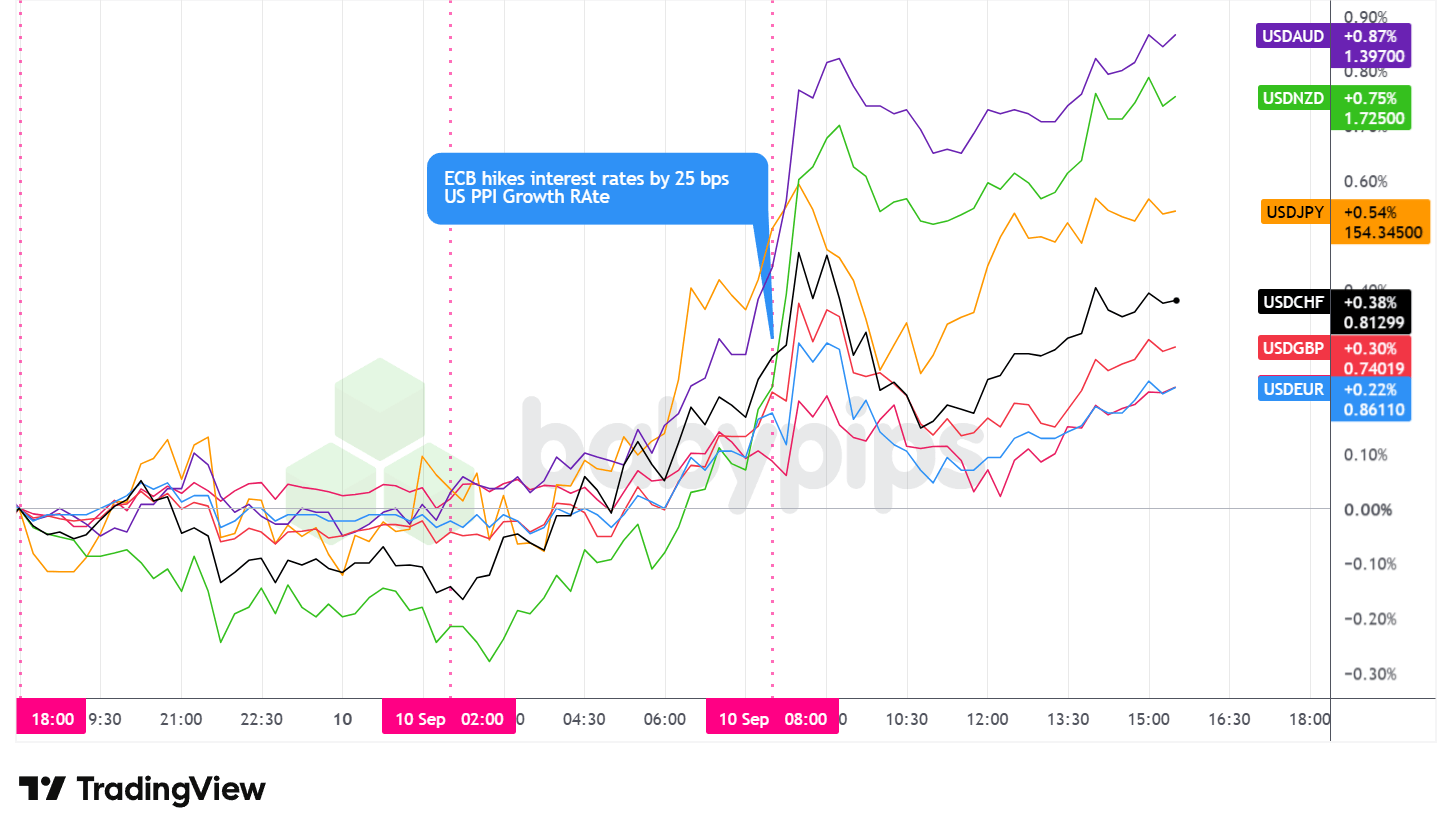
Overlay of USD vs. Major Currencies – Chart Faster With TradingView
The U.S. dollar firmed across the board on Thursday, with the Dollar Index adding about 0.3% to close near 99.1. The greenback spent the overnight hours going nowhere and then found a strong bid through the London and U.S. sessions as the producer price data and climbing yields did the heavy lifting.
During the Asian session, the dollar leaned slightly soft and traded in narrow ranges. The index drifted to its low near 98.72 around the New York midnight hour as traders waited on the U.S. inflation report. The yen held a firm tone early after Bank of Japan board member Kazuyuki Masu said the central bank looks set to keep raising rates, citing oil, food, producer price and yen-driven inflation risks ahead of the September 17 to 18 policy meeting, and USD/JPY dipped toward 153.30. Australia’s consumer inflation expectations eased to 4.9%, and the Aussie and Kiwi traded quietly with little to push them either way.
The London session turned the dollar higher. Oil and bond yields rose in tandem through the European morning, a backdrop that favored the greenback against most majors. The euro drew its own support from the ECB, which lifted rates for the second time since the Iran war began and struck a hawkish tone, with reporting suggesting policymakers see room for another move as soon as October.
Christine Lagarde warned that higher energy costs would feed gradually into core and food prices, and the euro clawed back an earlier decline. That relative resilience left the euro near the front of the pack even as the dollar advanced, and the Canadian dollar held up better than its peers as the oil rally lent the loonie some cover.
The U.S. session delivered the decisive move. When the hot PPI print crossed the wires, the dollar surged to its session high, with the index tagging 99.12 in the first half hour of New York trade before holding those gains into the close. The antipodeans took the hardest hit, as the Aussie and Kiwi lagged the field on the risk-off tone and the firmer rate-hike odds, while the pound and franc gave ground more gradually. USD/JPY recovered back above 154.00 despite the yen’s early firmness, tracking the wider move in U.S. yields.
By the close, the dollar had gained against every major, with the growth-sensitive Aussie and Kiwi at the back of the field and the euro and Canadian dollar proving the most resilient. An argument could be made that the day belonged less to any single currency than to the inflation-and-yields story running underneath all of them, and traders may stay reactive to that theme heading into Friday’s U.S. CPI.
Upcoming Potential Catalysts on the Economic Calendar
- New Zealand Business NZ PMI for August 2026 at 10:30 pm GMT
- Japan PPI for August 2026 at 11:50 pm GMT
- U.K. GDP for July 2026 at 6:00 am GMT
- Swiss Consumer Confidence for August 2026 at 7:00 am GMT
- U.K. NIESR Monthly GDP Tracker for August 2026 at 11:00 am GMT
- Germany Current Account for July 2026 at 12:30 pm GMT
- U.S. CPI Growth Rate for August 2026 at 12:30 pm GMT
- ECB President Lagarde Speech at 2:00 pm GMT
- U.S. Michigan Inflation Expectations Prel for September 2026 at 2:00 pm GMT
- University of Michigan Consumer Sentiment Index for September 2026 at 2:00 pm GMT
- ECB Lane Speech at 5:00 pm GMT
Friday hands the market the release it has been circling all week. The U.S. consumer price report is the session’s pivotal event and the last major inflation read before the Fed meets, so a hot print would harden the case for a hike and could extend the push in the dollar and long-end yields, while a softer number would give the doves something to work with.
Ahead of that, the U.K. growth and production figures and Japan’s overnight PPI offer earlier tests, and the crude risk premium stays live in the background, so traders may keep positioning cautious and reactive to headlines rather than committing to a clear bias.
When producer prices surge and oil rallies, Treasury yields spike in response, setting off a cascade through equities, commodities, and currencies all at once. Premium members can read our lesson:
📖 What Is Intermarket Analysis?
Reading this helps you understand how asset classes influence each other, why oil and yields moving together drives currency flows, and how to read multiple markets as one interconnected system instead of treating them separately.
And if you’re not a Premium subscriber yet, now’s a good time to join and get the full toolkit for understanding market moves like this one.
With Babypips Premium, you get full access to School of Pipsology lessons that help you understand not just what each market is doing, but how they’re connected and what those connections mean for your trades.