



Key Takeaways
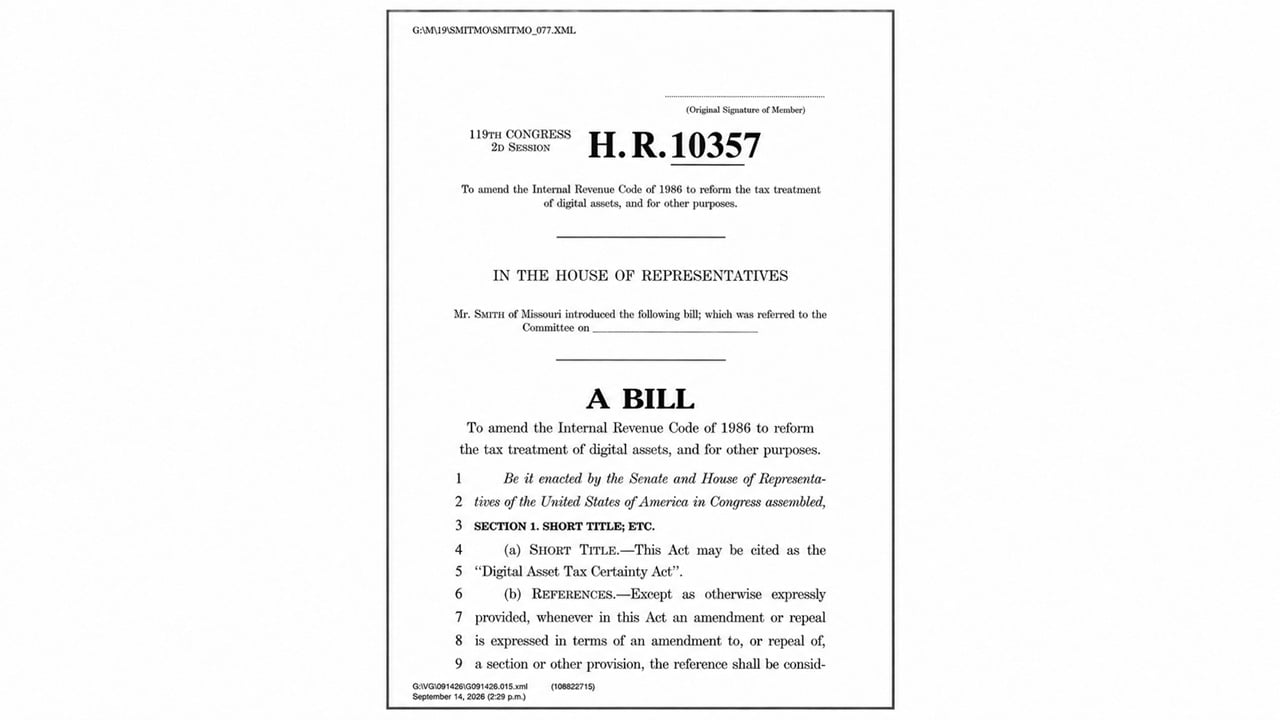
- The Digital Asset Tax Certainty Act, H.R. 10357, faces a Ways and Means markup at 10 a.m. ET on Sept. 16.
- Users with more than 5,000 transfers in the prior year would not qualify for the $10 fee exclusion.
- Reports indicate that the bill is unlikely to become law in 2026, with little House floor time before November.
What the Bill Actually Changes
Bloomberg Government reported that Smith, a Missouri Republican, released the text on Monday night and that it pulls in provisions from bipartisan legislation by Rep. Steven Horsford (D-Nev.) and Rep. Max Miller (R-Ohio). The measure covers de minimis transactions, gain and loss accounting, transfers, wash sale rules, mining, staking and broker requirements.
The provision most users will feel is small in dollars and constant in practice. The bill would eliminate taxes on de minimis network or transaction fees, meaning any fee under $10. Every swap, bridge and transfer on a blockchain carries a fee, so a carve-out at that level reaches almost everyone who uses crypto rather than just holding it.
The catch is written for the busiest wallets, as anyone “that engaged in more than 5,000 transfers” over the prior year is excluded, which pushes high-frequency traders and automated strategies back into full reporting. The idea of a de minimis tax exemption has come up before on Bitcoin.com News as a possible support for bitcoin’s price, since everyday spending only works if small payments don’t each create a tax event.
The Wash Sale Door Closes
The package also reaches for revenue because right now, a crypto trader can sell at a loss, buy the same asset back right away and still claim the deduction, a gap that stock investors do not get. H.R. 9172, introduced June 8 by Reps.
Mike Carey and Jodey Arrington, would apply wash-sale and constructive-sale rules to digital assets while excluding qualified U.S. dollar stablecoins. Analysts have reported its estimated revenue impact at $2.074 billion over fiscal 2026 through 2036.
Smith has postured the effort as an attempt to “give taxpayers clearer rules for digital assets,” arguing existing frameworks had not kept pace with new financial technology.
The Provision That Might Not Survive
Mining and staking are where the markup could get messy. Companion bill H.R. 9175 would let miners and stakers defer income on newly created tokens until they sell them, with an estimated cost of $2.956 billion over the same decade.
Punchbowl News reported on Sept. 13 that committee Republicans were strongly considering dropping the mining and staking provisions and described the issue as the biggest tension point with Horsford, the most vocal crypto backer among Ways and Means Democrats and a crucial swing vote.
There is also speculation that the options on the table included keeping the deferral, removing it or capping it with a five-year limit.
Why Now, and Why It Probably Stalls
The markup follows a June 9 hearing at which the committee took testimony from Coinbase, Fidelity, Coin Center and NYU Law’s Tax Law Center. It also lands the same day the House Financial Services Committee votes on the Strategic Bitcoin Reserve bill, and one day after the Senate’s CLARITY Act cloture vote.
What to Watch Wednesday:
- Whether the mining and staking deferral stays, disappears or gets a five-year cap.
- Whether Horsford and other Democrats vote to advance the text.
- Whether the $10 threshold or the 5,000-transfer cutoff moves in amendments.


