



Key Takeaways
- Bitcoin held near $84,000 on Friday after intraday volatility triggered $67 million in liquidations.
- Block Scholes noted rising U.S. bond yields and $100 oil created strong macroeconomic pressure.
- Spot ETF inflows and Strategy buying set up potential market resilience heading into Q4 2026.
Intraday Reversals Drive $71M in Liquidations
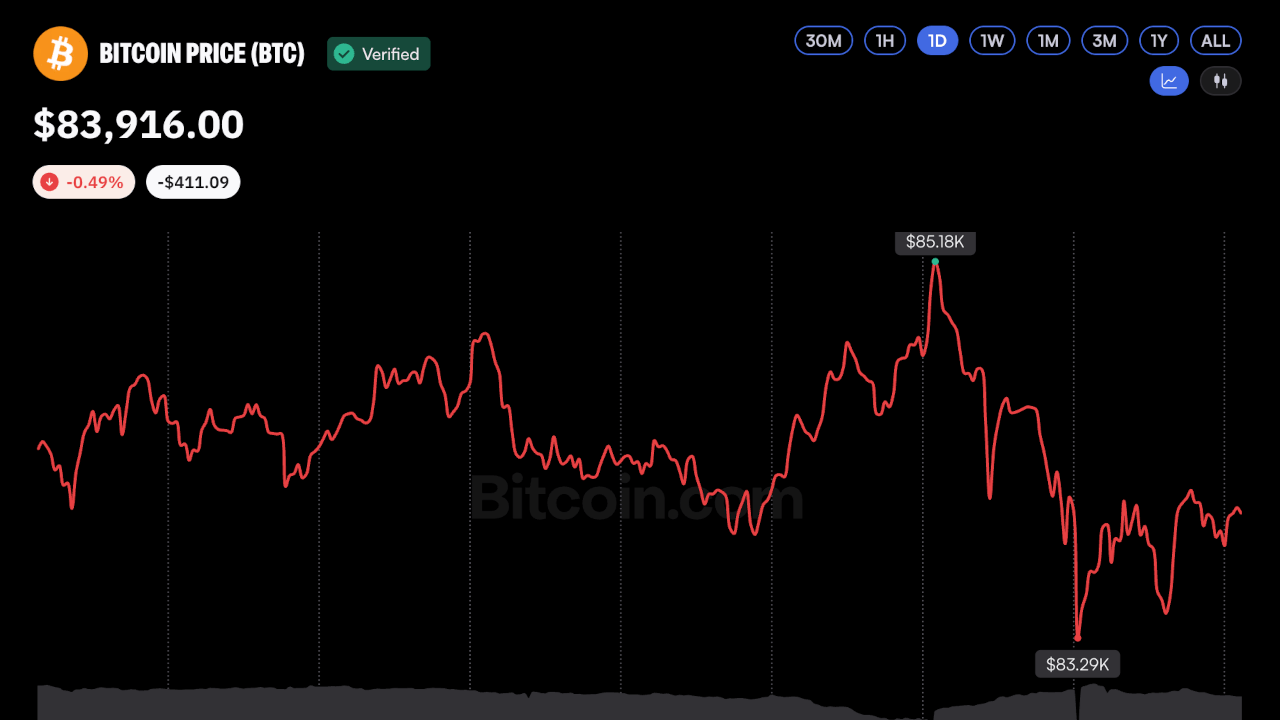
Bitcoin traded mostly in the $84,000-to-$85,000 range on Friday before a sudden volatility spike pushed its price near $83,000. After losing momentum following its second breach of $87,000 earlier in the week, bitcoin gradually gave back most of its Monday gains, when it had surged by more than $5,000.
Before the volatility spike, however, the daily price chart showed that bitcoin’s price was largely confined to an $84,000-to-$84,750 range, with occasional dips below or moves above those levels. Shortly after 3 a.m. EST, the trend shifted as the price dipped to just above $83,800. A relief rally then pushed it to an intraday high of $85,238 just over four hours later.
Sentiment flipped immediately as bitcoin fell to $83,229 at approximately 10:05 a.m. EST. A subsequent relief rally carried the cryptocurrency to just under $84,000 before it gave up ground, slipping under $83,500. As of this writing, bitcoin was again pressing toward $84,000, little changed from 24 hours earlier.
Bitcoin’s muted price action helped cap leveraged position liquidations at $67 million, split between approximately $47 million in longs and $20 million in shorts. Across the broader crypto market, however, the ratio of wiped out longs to shorts narrowed as several altcoins trended higher, with a few posting double-digit gains. According to Coinglass data, total long liquidations exceeded $145 million, compared with $134 million in short positions.
Macro Forces and Geopolitical Friction Weigh on Sentiment
While some analysts characterize bitcoin’s move over the past two days as a temporary consolidation preceding another rally, others argue that broader macroeconomic forces and Middle East geopolitical friction are actively shaping its price action.
Andrew Melville, head of research at Block Scholes, said crypto and equity markets had been contending with three primary factors over the past week: rising U.S. government bond yields, higher oil prices, and comments from Federal Reserve officials indicating that a September rate hike could mark the beginning of a new tightening cycle.
“Treasury yields across the curve have been rising, despite Treasury operations to buy back longer-dated government bonds,” Melville said. “Yesterday, the 30-year yield rose to its highest level since 2004, while over the past two days alone, benchmark 10-year yields are up around 20 basis points. Since the beginning of the U.S.-Iran conflict alone, the two-year yield has climbed more than 150 basis points.”
“Additionally, Brent crude has settled back above $100 per barrel despite reports of a potential phased reopening of the Strait of Hormuz, and a slew of Fed speakers this week have adopted a hawkish stance, resulting in Fed funds futures pricing in at least three rate hikes over the next year,” he said.
Despite those pressures, Melville noted that risk assets have remained resilient, citing bitcoin’s rally past $87,000 earlier in the week and U.S. equities trading near record highs.
“Institutional sentiment backs that resilience,” Melville said, noting that spot bitcoin exchange-traded funds (ETFs) recorded their largest single-day inflow earlier in the week since bitcoin’s record inflow levels in October. He also pointed to Strategy making its first bitcoin purchase in nearly a month, which he said has given crypto bulls a spring in their step.
“With risk assets continuing to show resilience in the face of so much uncertainty, this makes for a good setup as we move toward the fourth quarter of 2026,” he concluded.


