



Key Takeaways
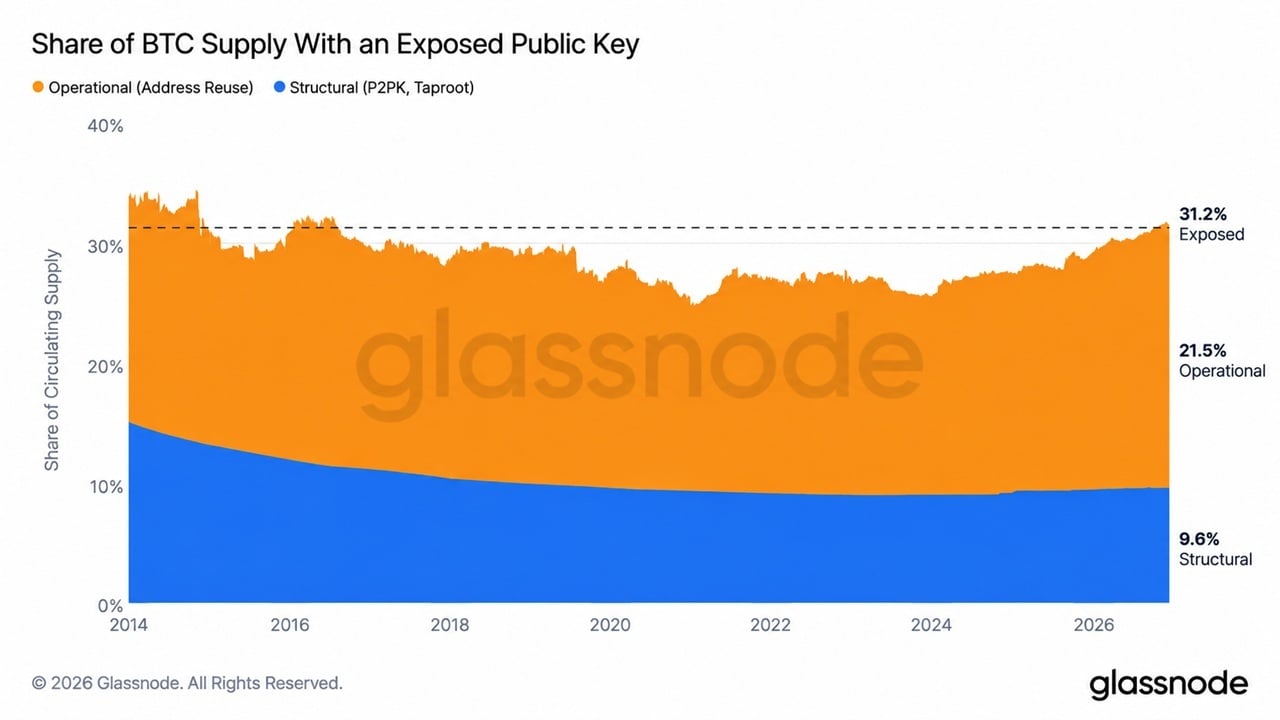
- Glassnode counts 6.26M BTC with exposed public keys, up from 24.8% of supply in early 2021 to 31.2% now.
- About 1.79M BTC held by exchanges is exposed, roughly 57% of identified exchange holdings.
- Vitalik Buterin told holders on Oct. 8 not to scramble into new wallets despite rising AI warnings.
How Much Bitcoin Is Exposed?
The number seems to be rising at a rapid pace, so much so that in a thread posted by Glassnode co-founder Rafael Schultze-Kraft, he pointed out that the figure currently stands at 6.26 million BTC, or 31.2% of bitcoin’s total supply. That is up from 24.8% in early 2021 and back at 2016 levels.
Glassnode’s own May 2026 report had counted 6.04 million BTC, or 30.2%, so roughly 220,000 more coins have joined the exposed pile in under five months.
A Bitcoin address normally hides its public key behind a hash until the owner spends from it. Once that key is visible, a machine powerful enough to reverse the math, whether a quantum computer or something faster than expected, could in theory work backward to the private key.
Coins behind a hidden key are not in that position.
Where Does the Exposure Come From?
The simple answer is ‘address reuse,’ which is when someone keeps receiving funds at an address that has already spent. That aspect alone accounts for 4.33 million BTC at the moment. Glassnode said that balance rose from 3.79 million over the past year and now covers 21.5% of circulating supply.
The other 1.94 million BTC is exposed by script type, including 1.71 million BTC in pay-to-public-key (P2PK) outputs, an early format that shows the key by design, of which 1.10 million is attributed to Satoshi Nakamoto. Another 222,000 BTC sits in Taproot outputs, which also reveal a key by default.
Exchanges are also a big piece of the entire picture given that about 1.79 million BTC held by exchanges have exposed keys (or roughly 57% of identified exchange holdings). Lastly, Glassnode’s May report found the split varies sharply by venue, i.e. Coinbase had only 5% exposed balances, against 85% for Binance and 100% for Bitfinex.
Why Is Everyone Suddenly Talking About It?
Because the threat model just got shorter, Ethereum Foundation researcher Justin Drake urged a “bunker mode” this week, arguing that AI-accelerated mathematics could break the Elliptic Curve Digital Signature Algorithm (ECDSA) “within months rather than years” in a worst case. All of this is before any quantum computer even arrives on the scene.
In fact, Bitcoin.com News recently covered how experts split over that warning, and Europol had raised its own quantum-risk alarm a day earlier.
Should Holders Move Coins Now?
Vitalik Buterin believes there is no rush and that he doesn’t recommend anyone go scrambling “to move their funds to new wallets today,” while also adding that the risks from AI-accelerated math should be taken seriously. Moreover, he also noted:
” It is very easy to lose funds from a misconfigured rushed upgrade. I personally have lost more money in botched migrations than I have lost in all hacks.”
Arthur Hayes also shares a similar line of thinking, with the Bitmex co-founder listing “AI encryption FUD” next to the 2017 block size wars, COVID in 2020, and the 2023 FTX collapse as the latest fear a “mega bull run” has to climb.