




Ethereum price has fallen more than 2% to around $2,318 on October 29, as continued withdrawals from U.S. spot Ethereum exchange-traded funds (ETFs) have coincided with weakness across the crypto market.
Summary
- Ethereum price fell 2.12% to $2,317.78 as selling continued across the cryptocurrency market.
- U.S. spot Ethereum ETFs recorded $21.41 million in reported net outflows on October 28.
- BlackRock’s ETHA recorded $44.83 million in withdrawals, outweighing inflows into competing funds.
- Ethereum’s MACD remained negative, while the 2,290–2,300 range offered immediate price support.
- Analysts identified $2,400 as a recovery level, with further losses possible if ETH breaks below $2,290.
U.S. spot Ethereum ETFs recorded $21.41 million in reported net outflows on October 28, their third consecutive session of withdrawals, according to SoSoValue. BlackRock’s iShares Ethereum Trust (ETHA) accounted for $44.83 million in outflows, while inflows into other funds offset some of the losses.
Meanwhile, the selling followed a difficult week for ETH, which briefly touched $2,293.44 before recovering above $2,300. Bitcoin declined 1.66% during the same 24-hour period, while the total cryptocurrency market capitalization fell approximately 1.7%.
Why is Ethereum price falling today?
Ethereum’s latest decline coincided with another round of institutional fund withdrawals. SoSoValue data showed that investors withdrew $88.58 million from spot ETH ETFs on October 26, followed by $60.22 million on October 27 and another $21.41 million on October 28.
Across the three sessions, the funds recorded approximately $170.21 million in combined net outflows. The October 28 figures placed cumulative net inflows since launch at $12.55 billion, with total ETF net assets valued at $14.27 billion and daily trading volume reaching $480.72 million.
BlackRock’s ETHA contributed heavily to the latest withdrawals. However, the positive flows recorded by competing funds showed that investor activity was not entirely one-sided.
As crypto.news previously reported, Ethereum ETFs lost approximately $320.1 million during October 12–16, compared with $228.4 million withdrawn from Bitcoin ETFs. BlackRock’s ETHA accounted for nearly $299 million of those Ethereum fund withdrawals.
Market conditions have remained unfavorable since then. ETH traded below its seven-day moving average of $2,354 and its 30-day moving average of $2,498, while Bitcoin’s decline coincided with weakness across other major cryptocurrencies.
Ethereum price tests $2,300 as technical indicators remain bearish
Ethereum traded near $2,320 on October 29, according to the TradingView daily chart, after briefly falling to $2,300. The cryptocurrency has struggled to recover from its late-September high near $2,800, recording a series of lower highs during the following weeks.
Technical indicators continued to favor sellers. The Moving Average Convergence Divergence (MACD) line stood at -57.69, below the signal line at -51.75, while the histogram remained negative at -5.94.
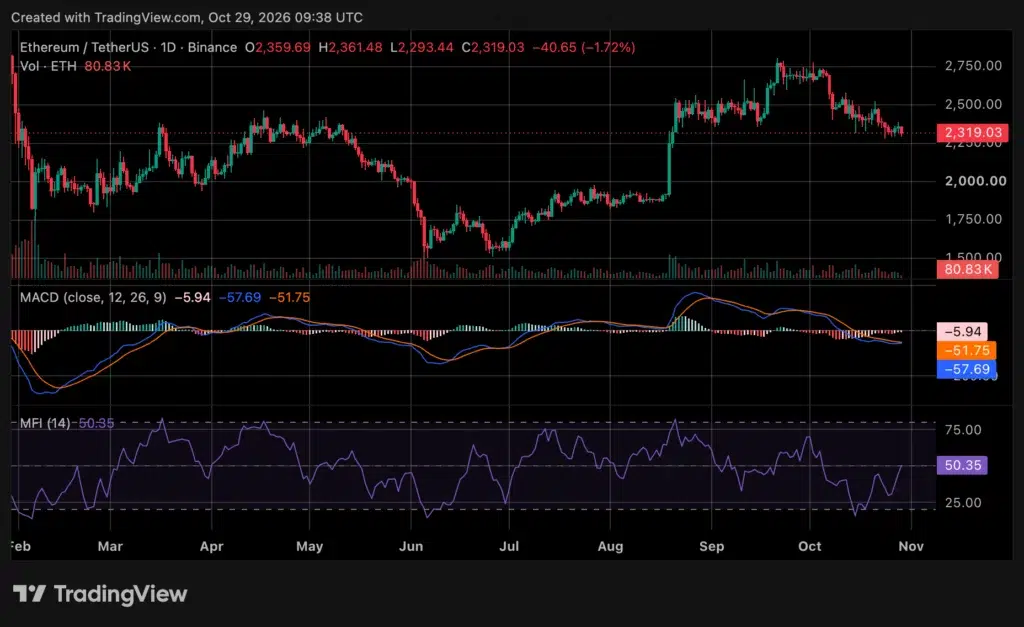
Meanwhile, the Money Flow Index (MFI) recovered to 50.35 after briefly entering oversold territory. The reading placed the indicator close to neutral, although the recovery did not establish a confirmed change in ETH’s price trend.
Immediate support lies between $2,290 and $2,300. A sustained move below this area could expose Ethereum to $2,200, followed by another support level around $2,100. On the upside, buyers would need to reclaim $2,400 before attempting another move toward $2,500.
An October 27 Ethereum price analysis similarly identified $2,300 as a closely watched level after ETH traded near the lower Bollinger Band.
Ethereum whales sell $348 million as exchange balances rise
Ethereum’s recent price weakness has coincided with selling activity among large holders, with on-chain data showing that whales reduced their holdings by approximately 160,000 ETH, worth more than $348 million, over the past few days.
According to crypto analyst Ali Martinez, citing Santiment data, Ethereum’s on-chain transaction volume surpassed $100 billion as the cryptocurrency approached $2,400 on October 28. However, ETH failed to hold that price level and subsequently dropped below $2,300.
During the same period, whale wallets reportedly reduced their holdings by around 160,000 ETH. Meanwhile, the amount of Ethereum held on cryptocurrency exchanges grew by approximately 100,000 ETH, valued at $240 million. The increase placed more tokens on trading platforms, although the figures do not establish whether those holdings have been sold.
Martinez identified $2,385 as an important price level, warning that continued trading below it, alongside elevated exchange balances, could leave Ethereum vulnerable to further losses.
“If Ethereum remains below $2,385 while exchange balances stay elevated, $2,000 is the downside target I’m watching,” the analyst wrote.
Crypto analysts identify levels that could support an ETH recovery
Despite the latest decline, cryptocurrency analyst Michaël van de Poppe expressed optimism about Ethereum’s recovery prospects in an October 28 post.
“The first level was hit and we’re breaking upwards for $ETH,” he wrote, while acknowledging that the market had not confirmed a bullish breakout.
Van de Poppe had previously identified prices below $2,300 as a potential buying area, arguing that Ethereum could recover quickly if buyers defended that region.
Another analyst, Daan Crypto Trades, identified $2,350 as an important level for Ethereum to recover. According to his October 28 commentary, ETH was attempting to reclaim that former support after spending several days below it.
Daan pointed to the daily 200-period exponential moving average as support and identified $2,550 as a higher resistance level. In his assessment, a sustained recovery above $2,550 could eventually open a path toward $3,000 or more.
Ethereum ETF outflows continue as Glamsterdam faces delays
Apart from fund withdrawals, Ethereum developers are reviewing technical problems affecting the upcoming Glamsterdam network upgrade.
On October 23, the Ethereum Foundation postponed the Hoodi testnet activation, previously scheduled for October 26, while developers examined compatibility concerns involving EIP-8037 and existing smart contracts.
The upgrade had already activated on the Sepolia testnet on October 6. Developers have not announced a replacement Hoodi activation date or confirmed a mainnet rollout schedule.
A subsequent Glamsterdam security update on October 27 reported that developers had merged a fix addressing a separate validator deposit-handling flaw in the upgrade’s specifications.
Disclosure: This article does not represent investment advice. The content and materials featured on this page are for educational purposes only.


