



Key Takeaways
- Bitcoin’s white paper turns 18 on Oct. 31, after growing from peer-to-peer cash into a global asset.
- Blackrock funds and government reserves show how deeply bitcoin has entered mainstream finance.
- Long-term security now hinges on whether transaction fees can replace shrinking miner subsidies.
Bitcoin’s White Paper Turns 18 as Institutional Adoption Deepens
Bitcoin was designed to let people send money without a bank. Now, 18 years later, Wall Street sells access to it, and Washington has ordered a national reserve.
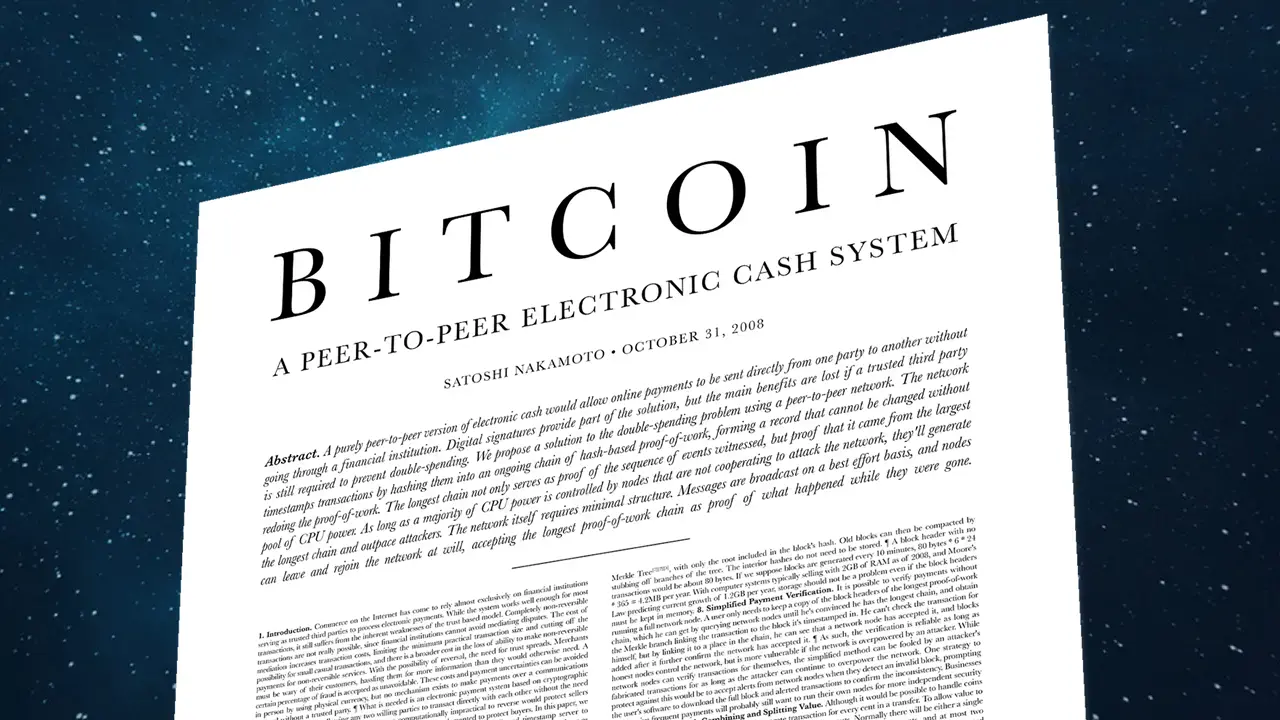
That contrast frames the anniversary of “Bitcoin: A Peer-to-Peer Electronic Cash System.” Published on Oct. 31, 2008, the nine-page paper addressed a deceptively simple problem: how to stop someone from spending the same digital money twice without a trusted institution keeping score.
Oct. 31, 2026, marks 18 years since its release. The story is no longer simply whether that idea could work: It is what happens when a system built to reduce reliance on institutions becomes an asset those institutions want to own.
Born in a Crisis, Built on Older Ideas
The announcement arrived on a cryptography mailing list, not at a bank or government briefing. Writing as Satoshi Nakamoto, its author described a system that was “fully peer-to-peer, with no trusted third party.”
The timing mattered. Lehman Brothers had filed for bankruptcy on September 15, 2008. Governments and central banks were rescuing financial institutions as confidence fractured. But Bitcoin’s intellectual roots were older than the crisis. They reached into the cypherpunk movement, whose members used cryptography to defend privacy.
The paper cited Wei Dai’s b-money proposal, Adam Back’s Hashcash, and earlier work on digital timestamps by Stuart Haber and W. Scott Stornetta. Nakamoto brought those tools and incentives into one system for agreeing on who owned what.
What Bitcoin’s White Paper Actually Solved
Digital files are easy to copy. Digital money cannot work that way: sending a coin must mean giving up the ability to spend it again. Banks enforce that rule through their records, but Bitcoin proposed a shared transaction history maintained across a network instead.
Miners compete through proof-of-work, spending computing power to add blocks of transactions. Other participants check that each block obeys the rules. To rewrite confirmed history, an attacker must redo that work and overtake the honest network.
Trust did not vanish. It moved toward public rules, software, and incentives. The model had a vital condition: honest miners must control more computing power than any cooperating group trying to cheat.
The idea spread to other networks, too. Ethereum’s founding paper drew on Bitcoin to propose a system for software-run agreements, known as smart contracts. Bitcoin had demonstrated how strangers could maintain a shared record without one firm in charge.
“Nearly two decades on, bitcoin’s impact extends beyond its role as a form of digital money,” said Saumya Saxena, global builders lead at Coinbase’s Base. “It has helped establish new possibilities for how value can be transferred, held and accessed, while inspiring further innovation across decentralised networks and digital asset markets.”
From a Proposal to Two Pizzas
On January 3, 2009, Nakamoto created Bitcoin’s first block.
Embedded inside was a newspaper headline: “The Times 03/Jan/2009 Chancellor on brink of second bailout for banks.” The words linked Bitcoin’s birth to the 2008 financial crisis. They did not, on their own, explain its author’s motives.
Nakamoto announced the first software release on January 8. Early participant Hal Finney later recalled receiving 10 bitcoins from Nakamoto as a test and reporting bugs as the software took shape.
Then came a transaction people could picture. On May 22, 2010, programmer Laszlo Hanyecz reported exchanging 10,000 bitcoins for pizza, after offering that sum for two large pies.
The lasting point is not what those coins would be worth today. It is that someone had accepted an internet experiment in exchange for dinner.
Growth Brought Failures and a Fight Over Purpose
As trading grew, users often put their trust back in firms that held their coins.
Prominent bitcoin exchange Mt Gox shut down in 2014 after thefts from its wallets came to light. FTX’s collapse in 2022 exposed another danger, after its founder, Sam Bankman-Fried, had diverted billions of dollars in customer funds.
These episodes exposed failures of custody and management, rather than the double-spending problem Nakamoto had addressed. A network could function while a firm holding users’ money failed.
Meanwhile, a 2017 fight over how to handle more payments produced Bitcoin Cash, a separate coin. Bitcoin also adopted the Segregated Witness upgrade. Behind the technical argument was a practical choice: how to accommodate more transactions without making the network harder for ordinary participants to verify.
Scarcity Becomes a Measurable Milestone
The white paper did not spell out every rule associated with Bitcoin. It discussed a limit on new coins but didn’t state the famous 21 million ceiling. That came from the software.
The code halves the new coins paid to miners every 210,000 blocks, roughly every four years. The fourth halving, in April 2024, reduced that subsidy to 3.125 BTC per block.
On March 9, 2026, mined supply reached the 20 million milestone. More than 95% of the eventual supply had been issued, with the remainder scheduled to emerge over more than a century.
This distinction matters, as supply rules can be checked, but future demand cannot. A fixed supply is not a promise of rising prices.
Wall Street Finds a Way In
Companies started buying before the funds arrived. In August 2020, software firm Strategy (then Microstrategy) announced a $250 million bitcoin purchase. It made bitcoin the principal asset in its treasury reserves. Now it holds tens of billions of dollars’ worth of the asset, more than any other company.
The U.S. Securities and Exchange Commission approved spot Bitcoin exchange-traded products on January 10, 2024. These products hold bitcoin directly. Investors could buy fund shares through familiar brokerage accounts rather than manage their own digital wallets.
By October 26, 2026, Blackrock’s iShares Bitcoin Trust reported about $64.7 billion in net assets. That is the value of one fund’s assets, not the cumulative cash investors had put in. Still, its scale illustrates how far Bitcoin has come from a mailing-list experiment.
There is an irony here. A fund makes Bitcoin easier to buy precisely by restoring intermediaries: an asset manager, a broker, and a custodian. It offers exposure to bitcoin’s price, not the same control as holding the keys yourself.
Governments Take Different Paths
Official adoption has not followed a single direction.
El Salvador made Bitcoin legal tender in September 2021. However, reforms tied to its 2025 International Monetary Fund program let businesses choose whether to accept it. Taxes had to be paid in US dollars.
Washington chose a different route. A March 6, 2025, executive order directed the creation of a Strategic Bitcoin Reserve, initially using eligible bitcoin forfeited to the government. The order also called for budget-neutral ways to acquire more, but it did not announce an unrestricted taxpayer-funded buying program.
The contrast is telling: Bitcoin can be promoted as a payment method, treated as a reserve asset, or sold as an investment. Those are different roles, with different tests of success.
Who Carries the Risks?
For users, holding their own coins brings freedom and responsibility. Lost keys can mean lost funds. Payments generally cannot be reversed by calling a bank, and a public transaction record does not guarantee privacy.
Buying through a broker does not remove price risk. Governments must account for their stewardship of public assets, while miners must cover operating costs as new-coin rewards decline.
“As adoption grows, education, trust, and responsible participation become just as important as the technology itself. Bitcoin’s next chapter will be shaped not just by technological progress, but by how confidently and responsibly more people can participate in its ecosystem,” Harish G Vatnani, country head for India at Zebpay told Bitcoin.com News.
There is also the looming risk of quantum computers breaking the elliptic curve cryptography that protects bitcoin by deriving private keys from public keys using Shor’s algorithm.
These are not side issues. They determine who can use the system safely, who profits from it, and who absorbs losses when something goes wrong.
The Unfinished Question in the Original Design
The white paper foresaw a point when transaction fees would replace new coins as miners’ compensation.
An October 2026 report from Cambridge’s Centre for Alternative Finance brings that assumption back into focus. Fees accounted for just 0.67% of miner revenue in the 90 days ending October 4, the researchers found.
That does not establish an imminent security crisis. Prices, costs, and demand can change. Yet it leaves a question that Wall Street’s interest does not answer: Who will pay enough to secure the network as new issuance dwindles?
Eighteen years after its release, bitcoin’s central bargain remains: users can avoid a financial middleman, but they cannot avoid risk.
Nakamoto’s seminal paper did not make trust disappear. It changed where people could place it.