


Monday’s session opened on hope, as President Trump’s weekend decision to pause strikes on Iran knocked oil lower and lifted risk appetite through the Asian hours.
The optimism didn’t last. Chipmakers sold off hard by the early afternoon on renewed doubts about artificial intelligence spending and dragged Wall Street down with them, even as most individual stocks held their ground. The dollar spent the day caught between the two stories, sliding early before rebuilding into a net gain against the majors heading into the close, with Wednesday’s Fed decision and a wave of Big Tech earnings waiting on the other side of the week.
Check out the forex news and economic updates you may have missed in the latest trading session!
News Headlines & Data:
- Over the weekend, the U.S. held off striking Iran for two straight nights, and Iran said it had stopped retaliating; oil opened down nearly 5%. Brent dropped from roughly $98.75 to around $93.50 within minutes of the session starting.
- On Monday, Japanese Prime Minister Takaichi said Japan needs to “exit excessively tight fiscal policy,” boost domestic investment, and move the economy onto a growth path, while stressing that the shift should not become reckless spending.
- China Industrial Profits (YTD) for June 2026: 18.7% y/y (19.2% y/y forecast; 18.8% y/y previous)
- Japan Leading Indicators Index for May 2026: 116.5 (116.8 forecast; 116.1 previous)
- Germany Ifo Business Climate for July 2026: 86.6 (85.9 forecast; 85.6 previous)
- Euro area M3 Money Supply for June 2026: 3.3% (3.2% forecast; 3.2% previous)
- Euro area Loans to Companies for June 2026: 4.0% y/y (4.1% y/y forecast; 4.0% y/y previous)
- Euro area Loans to Households for June 2026: 3.0% y/y (3.2% y/y forecast; 3.1% y/y previous)
- U.K. CBI Distributive Trades for July 2026: -26.0 (-45.0 forecast; -54.0 previous)
-
U.S. Durable Goods Orders for June 2026: 0.3% m/m (2.2% m/m forecast; -4.5% m/m previous)
- U.S. Core Durable Goods Orders for June 2026: 0.6% m/m (1.0% m/m forecast; 1.3% m/m previous)
- Bank of Canada Market Participants Survey: the median respondent still sees the policy rate at 2.25% through 2026, with the first move up only in 2027, while the long-run nominal neutral rate is put at 2.75%. The survey also shows a cautious macro backdrop: median forecasts are for Canadian GDP growth to recover to 1.6% by end-2026 and 1.9% by end-2027, while CPI inflation is expected to run at 2.6% and 2.1% respectively
- U.S. Dallas Fed Manufacturing Index for July 2026: 1.3 (-1.0 forecast; 0.0 previous)
Broad Market Price Action:
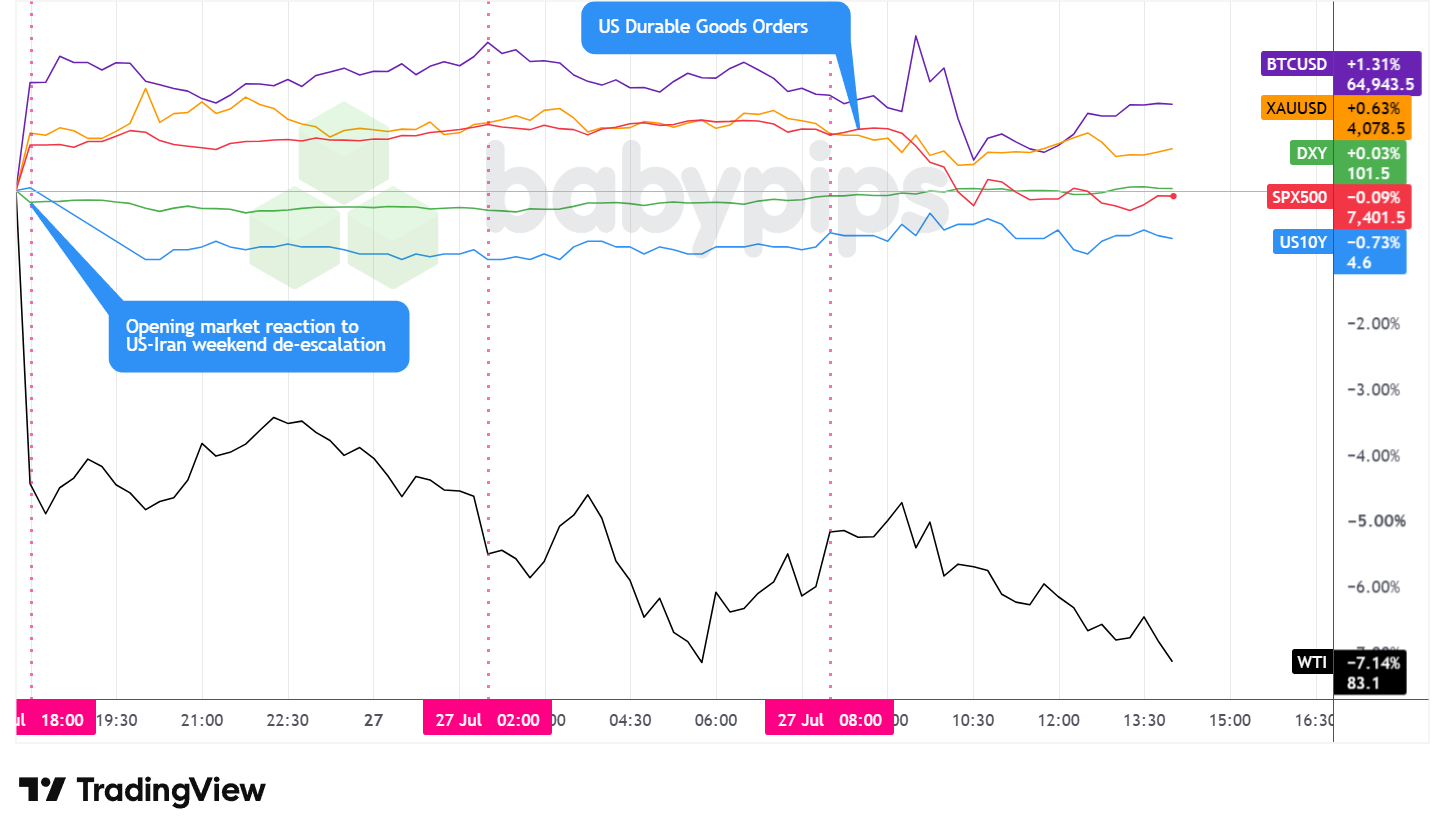
Dollar Index, Gold, Oil, S&P 500, U.S. 10-yr Yield, Bitcoin Overlay – Chart Faster With TradingView
Monday’s open carried a clear gap across risk assets, tied to the weekend pause in U.S.-Iran hostilities. Oil absorbed the brunt of it. WTI crude sank by roughly 7% on the session, falling from the high $86s into the low $83s, with the steepest drop landing right at Sunday’s open and the decline grinding lower from there with only brief pauses along the way.
Gold moved the opposite direction early. It pushed above $4,100 during the Asian hours, then gave that back through the London morning and into the U.S. session, settling higher on net near $4,080. The retreat from the highs possibly reflects the same de-escalation working against gold’s safe-haven bid even as the metal held onto a net gain.
Bitcoin traded in a tight range through the Asian and London hours, spiked higher after the US session open, then reversed hard and dropped to a session low near $64,300. It clawed back through the rest of the afternoon to trade net higher, though the round trip suggests the move had more to do with positioning around the data than any lasting conviction.
Equities carried the clearest version of the gap-and-fade pattern. The S&P 500 opened well above Friday’s close, climbed to a session high near 7,490 in the late morning, then reversed as a broad measure of semiconductor stocks fell more than 3% on fresh skepticism about the payoff on artificial intelligence spending. The index fell to lows near 7,380 before stabilizing, trading only modestly lower by the early afternoon even after that steep intraday reversal, an outcome that suggests most of Monday’s weekend gap held even as the session’s own high-to-low swing looked far larger. Most individual S&P 500 stocks actually traded higher on the day; the index’s weakness concentrated in a handful of mega-cap chip names.
Treasury yields eased across the session. The 10-year gapped lower at Sunday’s open, traded in a tight band through the Asian and London hours, climbed back toward its session highs around the Durable Goods release, then eased back into the early afternoon to trade net lower on the day, consistent with the same risk swings playing out across the rest of the board.
Promoted: Is Your Small Account Holding Your Strategy Back?
Trading $100 isn’t the same as trading $100k. Emotional discipline & trading flexibility is easier when you have the right backing. FTMO is a global prop firm with a 4.8★ rating on 40K+ reviews, serving traders since 2015! No time limits. Free trials. Up to $200K in Demo Capital.
Start a free trial with FTMO!
Disclosure: To help support our content, we may earn a commission from our partners if you sign up through our links, at no extra cost to you.
FX Market Behavior: U.S. Dollar vs. Majors
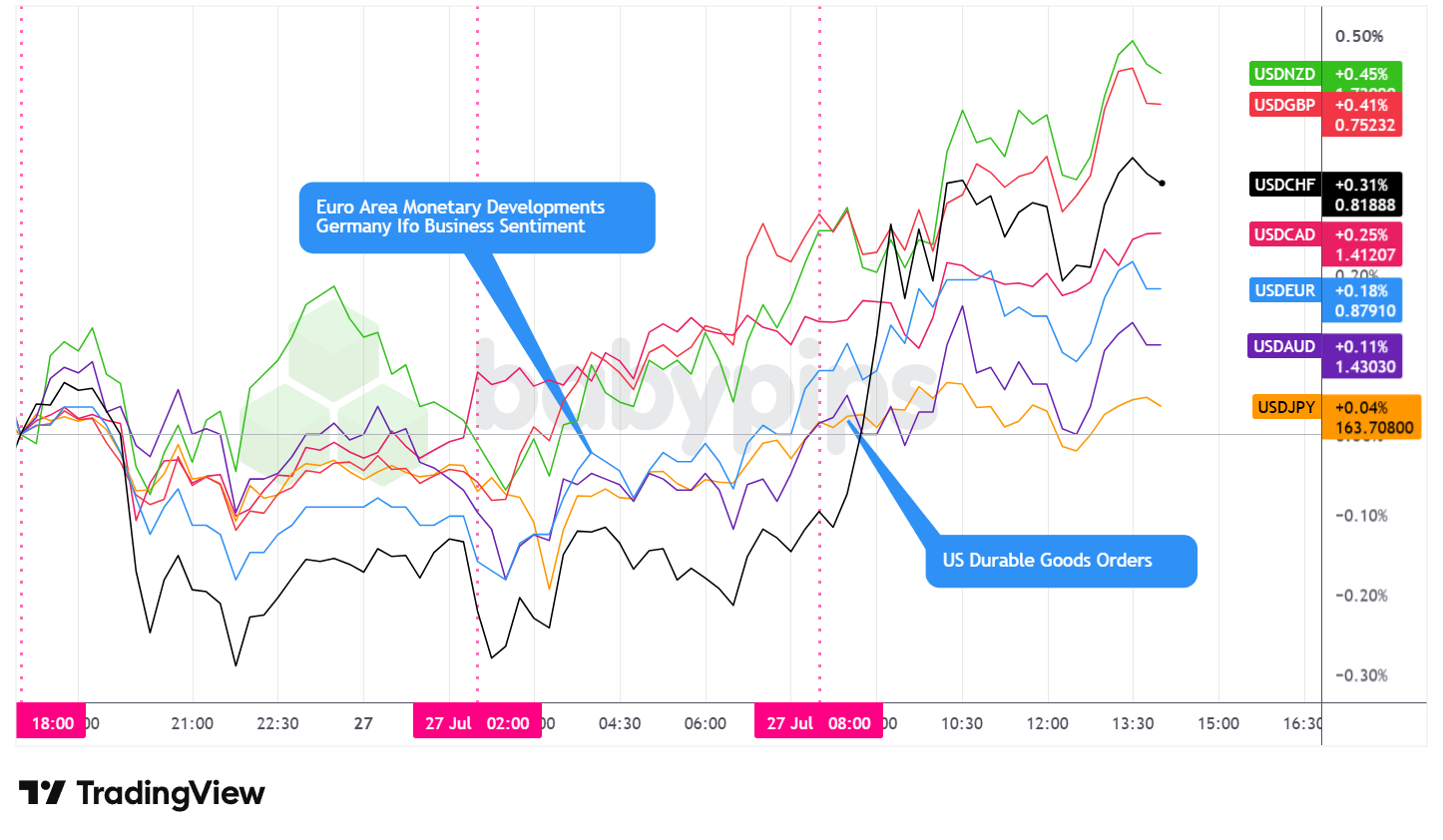
Overlay of USD vs. Majors – Chart Faster With TradingView
The Dollar Index opened Monday with its own gap against the majors, tracking the same weekend Iran de-escalation that hit oil and lifted broader risk appetite. With safe-haven demand for the greenback fading as war-risk premium came out of the market, the dollar traded net lower through the Asian session.
That slide leveled off after the London open. From there, the dollar built a net rebound against the majors that carried through the U.S. session open and continued gaining ground until the London close. Firmer than expected data out of Europe, including Germany’s Ifo Business Climate and the U.K.’s CBI Distributive Trades survey, didn’t stop the dollar’s climb. An argument could be made that the Durable Goods release into the New York open, alongside positioning ahead of a loaded week for the Fed and Big Tech earnings, mattered more for the dollar than the European prints did.
After the London session closed, the dollar pulled back then bounced again through the remainder of the U.S. session, possibly as the chipmaker-driven equity selloff extended and safe-haven flows turned more selective. Even so, in the run-up to Monday’s close the dollar traded net higher against the majors on the day, with the clearest gains against the New Zealand dollar and the British pound, and only marginal gains against the Japanese yen.
Promoted: The Strategy is Half the Battle; Your Mindset is the Rest.
Most trading mistakes aren’t technical—they’re psychological. In the classic “Trading in the Zone” by Mark Douglas (⭐ 4.7★ | 10,000+ reviews on Amazon), you’ll learn how to master the probabilistic thinking and emotional discipline mentioned in today’s article. If you struggle with hesitation or breaking your rules, this is your manual for consistent execution.
Click on the link to learn more about “Trading in the Zone” by Mark Douglas!
Disclosure: To help support our content, we may earn a commission from our partners if you sign up through our links, at no extra cost to you.
Upcoming Potential Catalysts on the Economic Calendar
- U.K. BRC Shop Price Inflation for July 2026 at 11:01 pm GMT
- China Politburo Meeting
- Australia RBA Gov Bullock Speech at 3:05 am GMT
- U.S. ADP Employment Change Weekly for July 11, 2026 at 12:15 pm GMT
- U.S. Goods Trade Balance Adv for June 2026 at 12:30 pm GMT
- U.S. S&P/Case-Shiller Home Price for May 2026 at 1:00 pm GMT
- U.S. House Price Index for May 2026 at 1:00 pm GMT
- Richmond Fed Manufacturing Index for July 2026 at 2:00 pm GMT
- CB U.S. Consumer Confidence for July 2026 at 2:00 pm GMT
- U.S. Dallas Fed Services Index for July 2026 at 2:30 pm GMT
Tuesday marks the first day of the Fed’s two-day policy meeting, though the rate decision itself doesn’t land until 6:00 pm GMT Wednesday, so the next session’s tone likely hinges more on whether Monday’s chipmaker-driven equity weakness extends and whether the Iran de-escalation holds.
Reserve Bank of Australia Governor Michele Bullock speaks early in the Tuesday session, and any hint on the RBA’s policy path could move the Aussie regardless of the broader risk tone. On the data side, a soft U.S. Conference Board Consumer Confidence print or a JOLTs report showing continued cooling in labor demand could feed into the dollar narrative ahead of Wednesday, though this year’s run of shutdown-distorted data means any single release may carry less weight than usual.
Markets will also watch for fresh word out of the Iran-Oman shipping talks and Tuesday’s scheduled meeting between President Trump and Israeli Prime Minister Netanyahu in Washington, given how closely oil and safe-haven flows have tracked the conflict headlines so far.
Later in the week, Wednesday brings earnings from Microsoft and Meta, with Apple and Amazon following Thursday, all of it landing against a backdrop of growing investor scrutiny over AI infrastructure spending.
Stay frosty out there, forex friends!
Monday’s session was a textbook example of how market sentiment shifts drive currencies. The dollar gyrated between risk-on and risk-off moods as geopolitical headlines changed and equities sold off. But most traders don’t know how to read those shifts or predict which currencies benefit when market mood swings. Premium members can read our lesson:
📖 Risk-On / Risk-Off: How Market Mood Moves Currencies
Reading this helps you understand how the market’s appetite for risk drives currency flows, which currencies strengthen when traders feel bold, which ones win when fear takes over, and how to check the risk weather before placing any trade.
And if you’re not a Premium subscriber yet, now’s a good time to sign up.
With Babypips Premium, you get full access to School of Pipsology lessons that help you understand how to read risk sentiment shifts before they hit your portfolio, so you’re not caught by surprise when the market mood suddenly changes.